North Georgia Rivers
Toccoa River Striper Fly Fishing: Is There a Run?
 Daniel Bowman
Updated October 2, 2026
10 min read
Daniel Bowman
Updated October 2, 2026
10 min read

The short version
Stripers don't run up the Toccoa tailwater. A striper spawning run moves upriver out of a reservoir, and the tailwater sits below Blue Ridge Dam, downstream of Lake Blue Ridge, so lake fish can't migrate into it. Bowman's river striper floats run on other North Georgia rivers, mostly around Dahlonega, from the last week of March into summer, with April to June the prime window. Double-digit fish are common and fish pushing 20 pounds are caught every year. A striper float costs $425 per boat for a half day or $575 for a full day, the same as a Toccoa trout float.
Do stripers run up the Toccoa tailwater?
No. This one trips people up, so it's worth walking through.
River stripers make a spring spawning run. The fish spend most of the year in the deep, cool water of a big reservoir, then push upriver into the moving water that feeds that reservoir. Daniel puts the run simply in his striper float trips description: the fish migrate up from reservoirs each spring, hold in the rivers through summer, and drop back down in early fall.
Now look at the Toccoa. The tailwater, the stretch most anglers mean when they say "the Toccoa," starts below Blue Ridge Dam and runs downstream toward Tennessee. It sits below Lake Blue Ridge, not above it. A fish in the lake that "runs upriver" heads away from the dam, into the river that flows into the lake. To reach the tailwater it would have to travel downstream through the dam itself. That isn't a migration.
So any article that tells you "stripers migrate from Lake Blue Ridge up into the tailwater below the dam" has the river backwards.
What the Toccoa tailwater is great for is trout. TVA's cold bottom release from Blue Ridge Dam keeps it trout water all year, and it's one of the best drift boat floats in the state. If you fish it on your own, the one thing to learn first is the dam, and our Toccoa generation schedule guide explains how TVA's single generating unit changes the river in under an hour.
How a river striper run works
Understanding the run makes it easier to plan a trip, whichever river you fish.
- Spring trigger. As rivers warm in late March and April, stripers leave the reservoir and push upstream to spawn.
- Summer holding. After the spawn, many fish stay in the river through summer, holding in deep holes, big bends, and current seams.
- Fall drop-back. In early fall the fish drop back down to the reservoir.
For anglers, that means a long season. On the rivers Bowman fishes, the run starts in the last week of March and some years lasts as late as early September. April through June is prime time, when the most fish are in the river and they're feeding hard.
Where Bowman fishes for river stripers
Bowman's striper floats run on several North Georgia rivers, and most trips take place in the areas around Dahlonega. Bowman lists the Chattahoochee for striper floats. Where you float on a given day depends on water levels; after heavy rain, the guides may move the trip to a different river that's fishing better, or reschedule if the rivers are blown out.
That flexibility is a big part of booking a guide for stripers. The fish move with the water, and a guide who's on the rivers every week knows which one is fishing.
A striper float covers:
- Half day: 4 hours on the water, $425 per boat
- Full day: about 8 hours, $575 per boat, lunch included
- Groups: up to 8 anglers across multiple boats
- Tackle: fly or conventional, your choice, all gear provided
When is the best time to fish for river stripers?
Here's the season in one table, using the window Bowman fishes:
| Window | What's happening | What it means for you |
|---|---|---|
| Last week of March | First fish push into the rivers | Early, uncrowded, fish are fresh in |
| April to June | Prime run, most fish in the river | The best odds of the season |
| July and August | Fish hold in deep holes through the heat | Fewer fish, still big ones |
| Early September (some years) | Late fish before the drop-back | A bonus window when it happens |
| Fall | Fish drop back to the reservoir | Switch to trout |
If you only have one shot, book April to June. If you want the river to yourself, the last week of March is worth the gamble on weather.
What to expect on a striper float
A striper float is a different trip from a trout day, and it helps to set expectations.
It's a quality trip, not a numbers trip. Don't expect ten fish. Expect a lot of casting and a real chance at the biggest freshwater fish you've ever hooked. Bowman's guides put it plainly: as long as you stick with it and work the water, they have consistent success chasing these fish all season long.
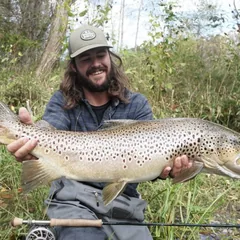
The fish are big. Double-digit fish are common during the run, and fish pushing 20 pounds are caught every year. Stripers are often over 10 pounds and at times over 20.
Bass show up too. Bass bycatch is part of most striper days, which keeps the rod bending between striper shots.
You fish from a drift boat. You sit or stand in the boat while the guide rows you through the best holes, bends, and seams. It's comfortable, and it's the only practical way to cover the water stripers hold in.
What gear do you use for stripers on the fly?
Striper fly fishing uses heavier tackle than trout fishing. Bowman provides everything, but here's what's in the boat so you know what you're casting.
Fly tackle:
- 8- and 9-weight rods
- Sink-tip and intermediate lines to get the fly down
- 4 to 6 inch articulated streamers
Conventional tackle:
- Medium-heavy or heavy-action spinning gear
If you bring your own:
- An 8 or 9 weight with an intermediate or sinking line for stripers
- A 6 or 7 weight with a floating line is good to have for the bass
The casting is the workout. Throwing a big streamer on a sinking line all day is a lot of casting, so expect sore shoulders and a few long breaks to stretch.
Fly rod or conventional gear?
This is one of the few Bowman trips where conventional tackle is just as welcome as a fly rod. Here's how to choose.
Pick the fly rod if you already fly fish, you want the challenge, and a striper on a fly would be a career fish for you.
Pick conventional gear if you're new to fishing, you're bringing a mixed group, or you'd rather spend the day fighting fish than learning a double haul.
Split the boat if you're two anglers with different goals. One can throw streamers on the fly while the other casts conventional, and the guide sets each of you up for the day's conditions.
Either way, you don't need to know how to fly fish to book. It helps, but the guide will rig you and coach you.
What should you bring on a striper float?
The list is short, because Bowman provides the rods, reels, tackle, and terminal gear.
- Polarized sunglasses. They cut glare and protect your eyes from big flies.
- Sunscreen. You'll be on open water for hours.
- Layers. Late March mornings can be cold. Summer floats are warm, so light, breathable clothing works best.
- A Georgia fishing license. Every angler 16 and older needs one. Buy it online through Georgia's licensing site before the trip. If the float runs through designated trout water, Georgia also requires the trout license (the trout stamp), so ask your guide which applies when you book.
- Water and snacks on a half day. Full days include lunch.
Check the current Georgia fishing regulations if you plan to keep a fish. Most anglers release river stripers.
What happens if the river is high or off-color?
Rain changes river striper fishing more than almost anything else, so here's how Bowman handles it.
- The guides watch water levels closely and put you on the best water available.
- If one river is blown out, they may move the trip to a different river that's fishing.
- If every river is too high, they'll reschedule to a different day.
- They fish rain or shine, and cancel only for dangerous conditions like flooding or lightning.
Why do you need a drift boat for stripers?
River stripers hold where wading anglers can't reach them: deep holes, outside bends, and the seams below big current. Those spots are often too deep to stand in and too far from the bank to cast to well.
A drift boat solves three problems at once:
- Coverage. The guide rows you past one holding spot after another, so you get more good casts in four hours than you'd get in a full day on foot.
- Angle. From the boat you can swing a streamer across a deep hole or strip it along a bend at the depth the fish are holding.
- Fighting room. When a big fish runs, the guide can follow it instead of watching it take all your backing.
That's why every Bowman striper trip is a float. It's also why the trips are priced per boat: two anglers share one guide and one boat for the same $425 half day.
How do you fight a big striper on a fly rod?
Hooking a striper is the hard part. Landing one takes a few habits that trout fishing doesn't teach.
- Strip-set, don't trout-set. When the fish eats, pull the line hard with your stripping hand instead of lifting the rod. A big streamer hook needs a firm set.
- Clear the slack. Let loose line come off the boat floor through your fingers so it doesn't tangle around your feet or the reel.
- Get it on the reel. Once the slack is gone, fight the fish from the reel and let the drag do the work.
- Use the rod's butt. Keep the rod low and to the side. Bending the tip straight up gives a big fish the advantage.
- Let it run. A striper's first run is strong. Let it go, then gain line back when it stops.
- Listen to the guide. The guide will position the boat and tell you when to pull and when to ease off.
Most lost stripers come off in the first ten seconds, from a soft set or slack line. Get those two right and your odds go way up.
Who is a striper float for?
A striper float fits a few kinds of people especially well.
- The trout angler who wants something bigger. If you've fished the Toccoa or private water and want a fish that pulls harder than anything you've hooked, this is the trip.
- The gift for an angler who has everything. A shot at a 15-pound fish on a fly rod is a memory, not another piece of gear.
- Groups of friends. Up to 8 anglers across multiple boats, with conventional gear welcome, so mixed groups work.
- Summer visitors. When the freestone trout creeks run warm in July, stripers are still holding in the rivers.
It's a weaker fit for a first-ever fishing trip with young kids, because the casting is heavy and the action comes in bursts. For that, a trout float on the Toccoa keeps everyone busier.
Striper float or Toccoa trout float?
People searching "Toccoa striper" are often deciding between a striper day and a Toccoa trout day. Both are drift boat floats at the same price. Here's the comparison:
| Compared on | River striper float | Toccoa trout float |
|---|---|---|
| Where | Rivers around Dahlonega | Toccoa tailwater below Blue Ridge Dam |
| Season | Late March into summer, prime April to June | Year-round (cold tailwater) |
| Target | Stripers, often 10+ pounds, plus bass | Rainbow and brown trout |
| Rods | 8 and 9 weight, sinking lines | Trout rods, typically 5 or 6 weight |
| Price | $425 half day, $575 full day, per boat | $425 half day, $575 full day, per boat |
| Best for | One giant fish, a bucket-list fight | Steady action, learning to fish |
If the goal is one fish you'll talk about for years, book the striper float. If you want steady action or it's your first time on a fly rod, a Toccoa River float trip is the easier day. In midsummer the Toccoa's cold water is also the best trout option in the state, which our guide to summer fly fishing in North Georgia covers.
Common mistakes on a first striper trip
Booking the Toccoa tailwater for stripers. The run doesn't happen there. Book a striper float and let the guide pick the river.
Expecting trout-trip numbers. Striper days are about quality. Count the shots at a big fish, not the fish in the net.
Bringing a trout rod. A 5-weight won't turn over a big streamer or land a 15-pound fish. Use the 8 or 9 weight in the boat.
Showing up without a license. Every angler 16 and older needs one, even on a guided float.
Giving up after lunch. Stripers often hold in the same deep holes all day. The guide will keep you on them, and the bite can turn on in a single cast.
Waiting until fall. By early fall the fish drop back to the reservoir. Book inside the late-March-to-summer window.
Frequently Asked Questions
Do stripers run up the Toccoa River below Blue Ridge Dam?
No. A striper spawning run moves upriver out of a reservoir, and the Toccoa tailwater sits below Blue Ridge Dam, downstream of Lake Blue Ridge. Lake fish can't migrate up into it. The tailwater is a cold trout river instead.
Where can I fly fish for river stripers in North Georgia?
Bowman runs striper floats on several North Georgia rivers, mostly around Dahlonega, and Bowman lists the Chattahoochee. The guide picks the river based on water levels that week.
When is the striper run?
On the rivers Bowman fishes, the run starts in the last week of March and some years lasts into early September. April to June is prime time.
How big are river stripers?
Double-digit fish are common during the run, and fish pushing 20 pounds are caught every year. It's a quality-over-quantity trip.
How much does a striper float cost?
$425 per boat for a half day and $575 per boat for a full day with lunch, all gear included. See the striper float trips page to book.
Do I need to know how to fly fish?
No. It helps, but conventional tackle is just as welcome on a striper float, and the guide sets you up for the day's conditions.
Book a striper float
River striper floats run late March through summer. Half day $425 per boat.
Chattahoochee striper float, from $425 per boat · 4.9 stars on Google
See the trip or Toccoa River →