Trip Planning
What to Expect on Your First Guided Fly Fishing Trip
 Daniel Bowman
Updated October 2, 2026
10 min read
Daniel Bowman
Updated October 2, 2026
10 min read

The short version
On a first guided trip with Bowman Fly Fishing, you meet your guide at the river, usually around 8 a.m., using directions the guide sends the day before. Everything you need to fish is provided: rods, reels, flies, waders and boots. Bowman's promise to beginners is short: "Never held a fly rod? We'll teach you in 20 minutes." A half day is 4 hours on the water from $400 for one angler, and a full day is 8 hours with a riverside lunch. You bring sunglasses, layers for the weather and a Georgia fishing license.
What happens on a first guided fly fishing trip?
Every guided day follows the same simple shape, whichever river you fish, from an Etowah wade trip to a Toccoa float. Knowing it ahead of time takes most of the nerves out of a first trip.
- The day before: a message arrives from your guide with the meeting time and turn-by-turn directions. Most trips meet at the water you'll fish, not at a shop or an office.
- The meeting: usually around 8 a.m. You meet the guide, and anyone who needs gear gets fitted for waders and boots.
- The lesson: the guide shows you how to hold the rod, make a basic cast and watch the line. Bowman says it can teach a complete beginner in about 20 minutes.
- The fishing: the guide walks you to water that holds fish, tells you where to put the fly, and coaches each drift. When something goes wrong, the guide untangles it and you go again.
- Lunch, on a full day: full-day trips stop for a riverside lunch.
- The end: back to the cars, with photos of the day. Bowman lists photos as included on its trips.
A half day is 4 hours on the water. A full day is 8. Nothing about the day asks you to know anything in advance.
Where do you meet, and how early should you arrive?
Bowman's trips meet at the river, and the guide sends directions and a time the day before. Many of the meeting spots are on private water down country roads, so the directions matter more than a map pin. Plan to arrive a few minutes before the meeting time so you can park, use a restroom if there is one nearby, and get into waders without rushing.
If you are coming from Atlanta, most of Bowman's water is about 75 to 90 minutes away. Leave early enough to beat the traffic leaving the city. A guide who is waiting at 8 a.m. is losing your fishing time, not theirs. If you get turned around on a back road, call your guide rather than guessing at the next turn.
What does Bowman provide, and what do you bring?
A first-timer doesn't need to buy a single piece of fishing gear. Bowman's trip pages promise rods, reels, waders and boots, plus every fly and all the line the day needs.
What you bring:
- Polarized sunglasses. They protect your eyes from a swinging fly and let you see into the water.
- Sunscreen and a hat. Sun off the water burns faster than you expect.
- Layers for the weather. Mornings by a mountain river are often cooler than the forecast for town.
- Your Georgia license and trout license, purchased online ahead of time. More on that below.
- Water and a snack for a half day. Full days include lunch.
Own a rod you like, or waders that fit? Bowman encourages you to use your own, and the guide will set it up for the day. There's more detail in what to wear on a guided fly fishing trip.
A checklist for the night before
A few minutes the evening before makes the morning easy:
- Read the guide's message twice. Note the meeting time, and save the directions where you can open them without a signal; reception along mountain rivers is patchy.
- Buy the licenses if you haven't, and keep them on your phone.
- Check the forecast and pack a rain shell if it is mixed, since the trip goes ahead in light rain.
- Lay out your layers, sunglasses, hat and sunscreen.
- Fill a water bottle and pack a snack for a half day.
- Get cash for the tip if you plan to tip in cash.
- Set the alarm with time for traffic out of the city and a few spare minutes at the river.
What should you wear under waders?
Waders keep the river off you, but what you wear underneath decides whether you are comfortable. Skip cotton, which stays cold once it gets damp. Wear synthetic or wool layers you can add or remove: a thin base layer, then a fleece or light jacket on cool days. Thin synthetic or wool socks work under the wader boots. In summer, light quick-dry pants and a long-sleeve sun shirt are the usual choice. Leave jewelry and anything you'd hate to drop in a river at home.
Do you need a fishing license?
Yes, if you are 16 or older. Georgia requires a fishing license plus a trout license on trout water, and that includes private water with a guide. Anglers under 16 don't need either.
| Who | What to buy | Cost |
|---|---|---|
| Georgia resident | Annual fishing license + annual trout license | $15 + $10 = $25 |
| Visitor from another state, one day | One-day fishing license + one-day trout license | $10 + $10 = $20 |
| Anyone under 16 | Nothing | $0 |
Buy them at Go Outdoors Georgia before you leave home, because there is no counter at the river. The state's trout fishing regulations list seasons and limits, though on a guided trip the guide keeps track of those for you. The license can live on your phone. For trips to the Tuckasegee in North Carolina, you need a North Carolina license instead. The Georgia fishing license guide covers every option.
How does the guide teach a first-timer?
A guide's job on a first trip is to get you casting well enough to catch fish, not to make you an expert. Most of the teaching happens in the first few minutes and then continues in small corrections all day.
The basics come first. You learn to hold the rod with your thumb on top, to move the rod back, pause and move it forward, and to let the line do the work. Then the guide shows you the part that matters most on a trout stream: the drift. The fly has to float down the current naturally, with no pull from the line. When the indicator or the dry fly dips, you lift the rod.
Bowman puts it plainly: "Never held a fly rod? We'll teach you in 20 minutes." Its guides are patient teachers who'll have you casting in minutes. If you want a head start, how to fly cast walks through the motion, but you don't need to practice before the trip.
Will you actually catch a fish?
Nobody can promise a fish, and a guide who does is guessing. What a guide controls is putting you on good water, with the right fly, and teaching you to drift it well. That stacks the odds heavily in your favor.
Reviews from Bowman's clients give a sense of what a first day can look like. One reads simply: "Never fly fished before. Loved every minute." Another visitor described a group that "brought zero gear" and finished "just short of 50 fish." Those are good days, not guarantees, and the weather and the season shape every trip. For more on that question, see will I catch a fish on my first trip?
What happens when a fish takes the fly?
It happens faster than you expect, which is why the guide talks you through it before it does. When the indicator dips or a fish rises to your dry fly, lift the rod tip smoothly. Don't yank, because fine tippet breaks. Keep the rod up and the line tight, and let the fish pull against the bend of the rod. Your guide will tell you when to reel and when to let it run, then net it for you.
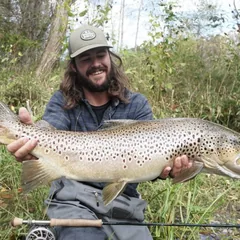
On Bowman's private water, every fish is released. The guide will keep it in the water as much as possible, take a quick photo, and help you let it go. That is part of why the fish on that water grow so large.
What if you make mistakes or get frustrated?
You will tangle the line, catch a tree and miss a few fish. Everyone does, and the guide has seen all of it. Untangling and re-rigging is part of a guide's day, and it costs you nothing but a minute. The fastest way to improve is to tell the guide what feels wrong, and to try the small correction they give you on the next cast.
Which river suits a first trip?
Bowman fishes several rivers, and each gives a beginner a different day. These notes come from Bowman's own trip pages.
The Etowah. The closest guided trout water to Atlanta, about 75 minutes from Buckhead. Bowman fishes private water near Dahlonega, including a beat on a vineyard. It is a small-to-medium river you wade, which keeps the casting short and the water easy to read. For a first trip from the city, it is the most common choice.
The Soque. Private water in Habersham County, about 90 minutes from Atlanta, known for very big rainbows and browns. Bowman calls it great for all skill levels, and it is a wade trip like the Etowah. The fish average 18 inches or better, so a beginner's first trout can be a big one. Bowman doesn't fish it from June 10 to September 20, when the water runs warm.
The Toccoa float. A drift boat trip below Blue Ridge Dam, where the guide rows and you fish from the boat. It suits anyone who would rather not wade, and the cold water from the dam keeps it fishing in summer, when the Soque is resting. It is priced per boat for one or two anglers.
Noontootla Creek. Wild-trout water that Bowman describes as technical and not for beginners. Save it for a later trip.
If you're unsure, tell Bowman what matters most, such as the shortest drive, the biggest fish or not wading, and the guide will match the river to it.
Should your first trip be a half day or a full day?
For most first-timers, a half day is the right start. Four hours is enough to learn, catch fish and decide whether you love it, without wearing out. A full day suits a beginner who already knows they want a long day outside, or a group where some people will take breaks.
| Trip | 1 angler | 2 anglers | 3 anglers |
|---|---|---|---|
| Etowah or Soque wade, half day (4 hours) | $400 | $550 | $675 |
| Etowah or Soque wade, full day (8 hours, lunch) | $550 | $725 | $900 |
| Toccoa drift boat float, half day | $425 per boat | $425 per boat | $850 (two boats) |
| Toccoa drift boat float, full day | $575 per boat | $575 per boat | $1,150 (two boats) |
The Etowah is the closest guided trout water to Atlanta and a common first trip. A float on the Toccoa keeps you seated in a drift boat, which suits anyone who would rather not wade. The rates page lists every trip, and half day vs. full day goes deeper on choosing.
What if the weather is bad?
Bowman fishes rain or shine. Trout don't mind light rain, and it often makes the fishing better. Bowman only cancels or reschedules for dangerous conditions such as lightning, flooding or extreme cold. Bring a rain shell if the forecast is mixed and you'll be glad you went.
How much should you tip the guide?
Tipping is separate from the trip price and is paid to the guide when the trip ends. The tipping guide puts the usual range at 15 to 20% of the trip cost. On a $400 half day, that is $60 to $80. Cash is simplest.
How do you book a first trip?
Send a request with your dates, how many people are coming and which trip you're interested in. If you're not sure which trip fits, the trip finder asks a few questions and suggests one. Bowman replies by text or phone within 24 hours, confirms the date and time, and collects payment, which is what locks in the trip. Weekends book up fast, so a weekday or an early request gives you more choice.
Frequently Asked Questions
What time should I arrive for a guided fly fishing trip?
Most Bowman trips meet at the river around 8 a.m. Your guide sends exact directions and the meeting time the day before. Arrive a few minutes early so you can park and get into waders without rushing.
Do I need to know how to fly cast before my first guided trip?
No. Bowman guides complete beginners every week, and promises: "Never held a fly rod? We'll teach you in 20 minutes." The guide teaches the cast, the drift and how to set the hook as you go.
How long is a typical guided fly fishing trip?
A half day is 4 hours on the water, and a full day is 8 hours with a riverside lunch. A half day suits most first-timers.
What do I need to bring?
Polarized sunglasses, sunscreen, layers for the weather and a Georgia fishing license with the trout license. Bowman provides rods, reels, waders, boots, flies, leaders and tippet. Full days include lunch.
Is fly fishing physically demanding?
A wade trip means walking on uneven riverbanks and standing in moving water, usually knee to thigh deep, with the guide choosing safe spots. Anyone who would rather not wade can book a drift boat float on the Toccoa and fish seated in the boat.
What if the weather is bad?
Bowman fishes rain or shine and only cancels or reschedules for dangerous conditions such as lightning, flooding or extreme cold. Light rain often improves the fishing.
What happens at the end of the trip?
You walk back to the cars, get out of the waders, and look through the photos of the day, which Bowman includes. Every fish on Bowman's private water is released. If the day went well, a tip of 15 to 20% of the trip cost is the usual range.
Can I bring my own rod?
Yes. Bowman encourages you to bring your own rod, reel or waders if you have them, and provides everything for anyone who doesn't.
Ready for your first trip?
Use our trip finder to match a guide, river, and date in under two minutes — or call (706) 963-0435 if you'd rather talk it through with a human.
Etowah River private water trip, from $400 · 4.9 stars on Google
See the trip or See Trophy Water Trips →