Seasons & Conditions
January Fly Fishing in North Georgia: What Works
 Daniel Bowman
Updated October 1, 2026
13 min read
Daniel Bowman
Updated October 1, 2026
13 min read

The short version
January fly fishing in North Georgia is a midge-and-streamer game on cold water. The best water is the Toccoa tailwater (cold dam release, holdover and stocked rainbows, big post-spawn browns) and the delayed-harvest stretches stocked through winter under catch-and-release regulations. Fish small midges (size 18-22), sowbugs, and eggs under an indicator on bright cold days; throw streamers on warm overcast days when the browns move. The mid-day window of 11 AM to 3 PM is the productive part of a January day — sleep in, the bite turns on with the warmest water. Check the TVA's observed Blue Ridge outflow for generation before you wade, dress for genuine cold, and expect to have the river nearly to yourself. A guided winter trip is the fastest way to skip the trial-and-error.
January is the most underrated month to fly fish North Georgia. The crowds are gone, the big browns are still aggressive coming off the November spawn, and the tailwaters run the same cold 50-degree water they always do — meaning the fish are right where you left them in October. The catch is that January punishes anyone who shows up with summer tactics. You fish smaller, slower, and deeper, you read the day's weather before you read the water, and you pick your river based on what the dams and the air temperature are doing that morning. Get those three things right and a January trip will out-fish a crowded April Saturday.
Is North Georgia worth fly fishing in January?
Yes — January is one of the best months of the year to fish North Georgia if you fish it on its own terms. The tailwaters don't freeze and don't warm; the Toccoa below Blue Ridge Dam is fed from deep in the lake, so its water stays steady through the winter and is often warmer than the air on a January morning. That stable water keeps trout feeding when wild freestone creeks have gone cold and sluggish.
Three things make January genuinely good rather than merely tolerable:
- No crowds. Access points that hold a dozen cars in April are empty in January. You can have an entire run to yourself, which matters more in winter when fish stack into a handful of deep, slow holding lies.
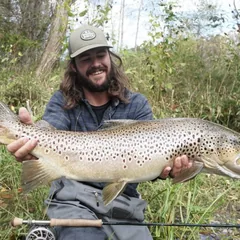
- Post-spawn brown trout. Brown trout spawn in November and December. By January they're done, hungry, and rebuilding condition — which is why January and February produce some of the largest browns of the year on the streamer.
- Holdover and freshly stocked fish. Georgia's delayed-harvest waters get stocked through the winter and sit under catch-and-release rules, so the trout density stays high even as harvest-season fish thin out elsewhere.
The trade-off is honest: fewer fish per hour than a May caddis day, a shorter productive window, and real cold to manage. But a January fish is usually a better fish, earned with better fishing.
Where should you fly fish in North Georgia in January?
The best January water is anything fed by cold, stable flow — tailwaters first, delayed-harvest stretches second, and small wild creeks a distant third. Here's how the main North Georgia options stack up for a winter trip:
| Water | January status | Why it works (or doesn't) | Best tactic |
|---|---|---|---|
| Toccoa tailwater (below Blue Ridge Dam) | Prime | Steady cold dam release, holdover rainbows, big post-spawn browns | Midges/sowbugs under indicator; streamers on warm days |
| Delayed-harvest streams | Prime | Stocked through winter, catch-and-release, high fish density | Eggs, midges, small nymphs |
| Soque River (private water) | Very good | Private water; Bowman says winter can bring some of the largest fish of the year | Sowbugs (14-18), midges (18-22) |
| Tuckasegee River (NC, delayed harvest) | Very good | Heavy winter stocking, drift-boat floats, year-round trout | Indicator nymphing, streamers |
| Wild Cohutta/Blue Ridge creeks | Tough | Cold, low, sluggish freestone water; fish barely feed | Slow deep nymphing on warm afternoons only |
For most January anglers the answer is the Toccoa tailwater or a delayed-harvest stream. The tailwater gives you the most consistent water temperature and the shot at a trophy brown; the delayed-harvest water gives you the highest odds of catching numbers when you just want to bend a rod on a cold day. If you've read our broader guide to winter fly fishing in North Georgia, this is the January-specific version of that decision.
Why the Toccoa tailwater is the January default
The Toccoa below Blue Ridge Dam is the single most reliable piece of January trout water in the region. The dam releases cold water from deep in Lake Blue Ridge regardless of the surface weather, so while a freestone creek might be 38°F and dead, the Toccoa tailwater is sitting in the high 40s and the fish are still metabolizing food. That difference is the whole ballgame in January.
What the tailwater gives a winter angler:
- Stable temperature. The 13-plus miles below the dam stay cold-water-trout-viable through the worst of winter.
- Holdover rainbows and wild browns. Georgia DNR stocks the river through the year, and the fish that survive into winter are stronger and smarter — a better class of fish than summer's fresh stockers.
- A real shot at a 20-inch-plus brown. The post-spawn streamer window peaks in late winter. The Toccoa produces several genuine trophy browns every winter for anglers willing to throw big flies in low light.
- Holdover fish in the deep runs, which stay put through the winter. (The tailwater follows general trout rules; confirm current rules with the Georgia Wildlife Resources Division before you fish.)
The one piece of homework the Toccoa demands in January is the same as every other month: the generation schedule. TVA releases water through the dam's single generating unit, and the river can rise about 3 feet within an hour. In winter, power demand spikes on cold mornings and evenings, which means generation can come on hard exactly when you'd want to be on the water. Check TVA's observed Blue Ridge outflow the morning of your trip — below roughly 200 cfs means no generation and safe wading; over 1,000 cfs means generation is on and you should be in a boat, not the river. Our Toccoa generation schedule guide breaks down exactly how to read it.
Delayed harvest: where to catch numbers in January
Delayed-harvest water is North Georgia's answer to "I want to actually catch fish in the dead of winter." These are stretches the state stocks heavily through fall and winter and manages as catch-and-release, single-hook artificial-only from November 1 through mid-May. Because nobody can keep a fish during that window, the trout density stays high all winter — and the same fish get caught again and again, which keeps the action steady on cold days when fish per cast are otherwise scarce.
What makes delayed harvest the right call for a January numbers day:
- High density. Regular winter stockings plus zero harvest mean a single good run can hold dozens of catchable trout.
- Forgiving fish. Recently stocked rainbows aren't as selective as a holdover brown. Eggs, San Juan worms, and small flashy nymphs get eaten.
- Predictable rules. The November-to-May catch-and-release window is consistent year to year. Always verify the current dated regulations and exact stream boundaries with the Georgia Wildlife Resources Division — the list of designated streams and their open/closed dates is published and updated each season.
Across the state line, the Tuckasegee River in Western North Carolina runs the same delayed-harvest framework on a bigger scale — North Carolina stocks the Tuck's DH stretches monthly through winter, and a single mile of that water can hold two thousand-plus trout. It's a drift-boat river, which means January generation flows become a feature instead of a hazard: you fish through the high water from the boat instead of being chased off the bank. A Georgia license doesn't cover it, though — North Carolina requires its own.
January tactics: how to actually fish cold water
January fly fishing comes down to one principle — slow everything down and fish small. Cold water drops a trout's metabolism, so the fish won't move far or fast to eat. Your job is to put a small, easy meal right in front of its nose and drift it dead-slow through the deep, slow water where winter fish hold.
The system that works on a typical cold, clear January day:
- Find the slow deep water. In winter, fish abandon fast riffles for the deepest, slowest pools and the soft seams behind boulders. If the water looks like a place a tired fish would rest, fish it.
- Run an indicator nymph rig. Two flies, a strike indicator, and enough weight to tick bottom. The fly should drift at the speed of the current near the riverbed, not the faster surface.
- Go small. Size 18-22 midges (zebra midge, WD-40, rojo midge), sowbugs in 14-18, and a size 18-20 pheasant tail cover most January days. On delayed-harvest water, add an egg pattern and a San Juan worm.
- Lengthen your drift and set on anything. Winter takes are subtle — a slight hesitation of the indicator, not a slam. Set the hook on any pause.
- Save streamers for warm, overcast days. When a January warm front pushes air temps into the 50s under cloud cover, the big browns move. That's the day to throw a sculpin or an articulated streamer on a sink-tip and strip it slow through the deep slots.
The best flies for the Toccoa tailwater guide goes deeper on specific winter patterns and sizes, but the short version is: small and subsurface most days, big and stripped on the rare warm one. If you want to see how the same principles play out across the country, Fly Fisherman magazine's winter coverage of cold-water midge and streamer tactics tracks closely with what works on the Toccoa.
Time the day: the 11-to-3 window
The most important January adjustment isn't a fly — it's the clock. The productive part of a winter fishing day is the warmest part, when the sun has had a few hours to nudge the water temperature up a degree or two and the insects (mostly midges) get active. That window is roughly 11 AM to 3 PM.
Why this matters more than gear in winter:
- Trout feed on the warming trend. A one- or two-degree bump in water temperature in early afternoon is enough to flip the feed switch. Dawn, the coldest point, is usually the slowest.
- Midge hatches happen mid-day. The bugs that do hatch in January come off in the warmest hours, and a mid-day midge hatch can produce surprising dry-fly action on flat winter pools.
- You stay warmer. Showing up at 10 AM instead of dawn means you're fishing in the warmest air of the day, which keeps your hands working and your guides ice-free.
The practical version: sleep in, eat a real breakfast, get on the water around 10-10:30, and fish hard through 3 PM. This is the opposite of summer, when you'd be off the water by mid-morning. In January, the middle of the day is the whole day.
A worked example: a cold, clear Toccoa Saturday
Say it's a January Saturday, the forecast is bluebird and 34°F at dawn climbing to 48°F by afternoon, and TVA's gauge shows the Toccoa at 180 cfs with no morning generation scheduled. Here's how that day plays out:
- 9:30 AM — You confirm TVA's observed outflow is still low and flat. No generation yet. You rig two rods: an indicator nymph rig and a streamer rod you probably won't touch on a bright day.
- 10:30 AM — On the water. You skip the fast water entirely and walk to a deep, slow pool below a riffle. First rig: a size 18 zebra midge trailed off a size 16 sowbug, split shot, indicator set deep.
- 11:30 AM–2:30 PM — The bite turns on as the water warms. Takes are soft — the indicator just stalls — and you set on every hesitation. Most fish are stocked and holdover rainbows in the 10-14 inch range, plus one heavier fish that hugs the bottom seam.
- 2:30 PM — Generation pulse. The gauge jumps and the water starts pushing at your shins. You're done wading — exactly the moment you'd be in trouble if you weren't watching the river. You walk out.
- 3:00 PM — Off the water, hands cold but intact, with a solid mid-day session behind you and the whole river to yourself.
That's a good, normal January day: a tight productive window, subtle takes, no crowds, and a non-negotiable respect for the generation schedule. A guide compresses the trial-and-error — they'll have already picked the day and the stretch around the dam release.
What to wear and bring in January
Dress for the cold first and the fishing second — a January trip is won or lost on whether you can keep your hands functional. The water coming off the dam is cold, the air is colder, and standing still in a run drops your core temperature fast.
The winter checklist:
- Layered base and mid-layers under your waders — merino or synthetic, never cotton. A puffy mid-layer makes the difference at 2 PM.
- Quality waders and wading boots, plus thick wool socks. Felt or rubber both work; just stay dry.
- Fingerless gloves or fishing-specific gloves, plus chemical hand warmers in your pockets. Cold hands are the number-one reason people quit early in January.
- A warm hat and a buff or neck gaiter. You lose real heat off your head and neck.
- Polarized sunglasses. Winter light is low and glaring off the water — you need them to read the slow water and spot fish.
- Hot drink and high-calorie snacks. You burn energy staying warm.
If you book a guided trip, the guide supplies rods, flies, and the technical tackle — you bring the warm clothing and the willingness to fish slow. For a fuller breakdown, our general gear guidance applies year-round, but in January the warm layers are the part you cannot skip.
How much does a January guided trip cost?
A guided North Georgia trip costs the same in January as it does in June — winter is not a discounted season, because the cold-water tailwaters fish well year-round and the guides work just as hard. Bowman's wade-trip pricing starts at $400 for a half-day for one angler, $550 for two, and $675 for three; full-day wade trips start at $550 for one, $725 for two, and $900 for three. Drift-boat floats, the right tool for the Toccoa or Tuckasegee on a generation day, run $425 for a half-day (Toccoa) and $575 for a full day (Toccoa or Tuckasegee) for one to two anglers. Corporate and group rates are $190 per person for a half-day and $260 per person for a full day. Confirm current pricing and availability at booking.
Why a guide earns its keep specifically in January:
- They've already picked the day. A guide knows which stretch is fishing, what the dam is doing, and whether the warm-front streamer window is open — decisions that take a self-guided angler several frustrating trips to learn.
- They handle the generation math. On a tailwater, the guide reads the schedule and keeps you safe and fishing, whether that means wading early or floating through the release.
- They cut the cold-weather trial-and-error. Winter is the least forgiving season to learn on your own. A day with a guide is worth several solo days in January.
The quiet season is exactly when local knowledge pays off most, because the margin between a good day and a blank day is thinner. Book a guided winter trip or use the trip finder to match the right water to the forecast.
Frequently Asked Questions
Is January too cold to fly fish in North Georgia?
No. The tailwaters and delayed-harvest streams fish well all winter because the water stays steady enough for trout. The Toccoa below Blue Ridge Dam is fed from deep in the lake, so it barely reacts to a cold snap in the air. The challenge isn't the fish, it's keeping yourself warm. Dress in layers, bring hand warmers, and fish the warmest part of the day (11 AM to 3 PM) and January is genuinely productive.
What's the best river to fly fish in North Georgia in January?
The Toccoa tailwater below Blue Ridge Dam is the most reliable January water — cold stable flow, holdover rainbows, and big post-spawn browns. Delayed-harvest streams are the best bet for catching numbers because they're stocked through winter and managed catch-and-release. The Soque (private water) and the Tuckasegee in North Carolina are both strong winter options too.
What flies should I use in January?
Go small and subsurface. Midges in size 18-22 (zebra midge, WD-40, rojo midge), sowbugs in 14-18, and small pheasant tails cover most cold days under an indicator. On delayed-harvest water, add egg patterns and San Juan worms. Save streamers — sculpins and articulated patterns on a sink-tip — for warm, overcast days when the browns move.
What time of day is best for January trout fishing?
Mid-day, roughly 11 AM to 3 PM. The water warms a degree or two in the early afternoon sun, which turns on both the trout's feeding and the midge hatch. Dawn is the coldest, slowest point in winter — the opposite of summer. Sleep in, get on the water mid-morning, and fish hard through mid-afternoon.
Do I need to check the generation schedule in January?
Yes — every time you fish a tailwater like the Toccoa. TVA generates water for power, and demand spikes on cold winter mornings and evenings, so the river can rise about 3 feet within an hour. Check TVA's observed outflow: below ~200 cfs is safe wading, over ~1,000 cfs means generation is on and you should be in a boat.
Can I catch big brown trout in January?
Yes — January and February are among the best months for trophy browns. Brown trout spawn in November and December, and by January they're post-spawn, hungry, and rebuilding. The highest-percentage approach is a streamer fished slow through deep slots on a warm, overcast day. The Toccoa produces several 20-inch-plus browns every winter.
Is delayed-harvest water open in January?
Yes. Georgia's delayed-harvest streams are managed as catch-and-release, single-hook artificial-only from November 1 through mid-May, so January is squarely in the open, high-density window. Always confirm the current dated regulations and the exact list of designated streams with the Georgia Wildlife Resources Division before you go.
How many fish should I expect to catch on a January day?
Fewer than peak spring, but quality over quantity. On a productive delayed-harvest day you can land double-digit numbers of stocked and holdover trout. On the Toccoa tailwater, expect a steadier but slower pick of rainbows in the 10-14 inch range with a shot at a heavier holdover or a trophy brown. The mid-day window does most of the work — most fish come between 11 AM and 3 PM.
Fish North Georgia in the quiet season
January means cold water, big browns, and an empty river. Book a guided winter trip or use the trip finder to match the day to the water.
Toccoa River float trip, from $425 per boat · 4.9 stars on Google
See the trip or Reserve Your Trip →