Seasons & Conditions
March Fly Fishing in North Georgia: Pre-Spawn Guide
 Daniel Bowman
Updated October 1, 2026
15 min read
Daniel Bowman
Updated October 1, 2026
15 min read

The short version
March is the start of the pre-spawn window in North Georgia, and it's one of the most underrated months of the year. Water temperatures are climbing out of the winter doldrums into the mid-40s and low 50s, which flips trout from survival mode into active feeding. Wild and stocked rainbow trout move toward their spring spawn, holdover browns recover from their fall spawn and feed hard, and the year's first real hatches — blue-winged olives (size 18–22), early black caddis (size 14–16), and midges — start showing on gray afternoons. The play is to fish the warmest part of the day, lead with nymphs and streamers, and time the dries to the BWO window. The cold Toccoa tailwater fishes most consistently in March; freestones like the Etowah come alive on the warm days after a rise in water temp. A guided March trip is a high-percentage way to catch the pre-spawn aggression before the spring crowds arrive.
What does "pre-spawn" mean in March?
Pre-spawn means trout are feeding heavily in the weeks leading up to spawning, and in North Georgia March is the heart of that window for rainbow trout. Rainbows are spring spawners — they build redds and lay eggs as water temperatures climb through the mid-40s into the low 50s, which in North Georgia typically lands across March and into April depending on elevation and water type. In the weeks before they spawn, they eat aggressively to put on condition, which is exactly the behavior an angler wants to exploit.
The picture is layered, because not every trout in the river is on the same clock:
- Wild and stocked rainbows are pre-spawn through March, staging near gravel and feeding hard before they pair up.
- Brown trout spawn in the fall (October–November), so by March they're well into recovery and feeding to rebuild after the winter — aggressive, but not spawning.
- Brook trout, Georgia's only native trout, also spawn in fall, so the wild brookies in the high headwaters are post-spawn and feeding when the water allows.
The practical takeaway is that March stacks two motivations on top of each other: rainbows fattening up for the spawn, and browns and brookies eating to recover from theirs. That's why a cold, gray March afternoon can produce a better grab than a bluebird May day — the fish have a reason to eat. The job is matching your hours and your flies to when and how they're feeding.
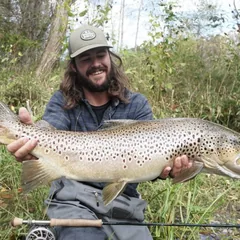
Pre-spawn rainbows feed to put on condition before the spawn, and recovering browns feed to rebuild after theirs — March stacks both, which is why a warm afternoon can fish better than its reputation suggests.
Why does water temperature decide everything in March?
Water temperature is the single variable that runs March, because it controls whether trout are in survival mode or feeding mode. Trout are cold-blooded, so the thermometer sets their metabolism — and March is the month the thermometer crosses the line that turns the bite on. The same temperature logic that governs the best time of day to fish governs the whole month in early spring.
Here's how the bands play out in a North Georgia March:
| Water temp | Trout behavior | March tactic |
|---|---|---|
| Below 40°F | Sluggish, bottom-pinned, feeding sparingly | Slow deep nymphs, fish the warm midday hours only |
| 42–48°F | Waking up, starting to move and feed | Nymphs and slow streamers; first dry chances on warm afternoons |
| 50–58°F | The pre-spawn sweet spot — active, willing | Full menu: nymphs, streamers, and BWO/caddis dries |
| Above 60°F | Rare in March but possible on warm spells | Fish the hatch; expect strong surface activity |
A March day often starts in the high 30s or low 40s and climbs a few degrees through the afternoon as the sun works the water. That climb is the whole game. The bite frequently doesn't turn on until the water nudges past the mid-40s, which is why late morning to mid-afternoon is the prime window in March — the inverse of the dawn-and-dusk rule that governs summer. Carry a stream thermometer and you'll predict the day far better than any calendar: a freestone reading 44°F at noon is on the cusp, and the same creek at 50°F by 2 p.m. is fishing. Many of the rainbows you'll catch in March trace back to the cold-water national fish hatchery system that stocks these rivers, and the same thermal sensitivity those hatcheries manage for is what drives the March bite — these fish live and die by a few degrees.
What's hatching in North Georgia in March?
March brings the year's first real hatches, but they're sparse and weather-dependent, so most of your fishing is still subsurface. The marquee surface event is the blue-winged olive, and the supporting cast is early black caddis and the midges that have been hatching all winter. None of it is dense the way a May caddis blitz is, but a good BWO afternoon is the first dry-fly fishing of the year and worth planning around.
The March bug menu:
- Blue-winged olives (BWO), size 18–22. The defining March hatch. BWOs love exactly the kind of cool, gray, drizzly afternoon that feels miserable to fish in — and a bluebird high-pressure day shuts them down. When you see small gray-olive mayflies riding the surface from roughly noon to 4 p.m., switch to a parachute BWO or a small olive emerger.
- Early black caddis, size 14–16. The little black caddis (sometimes called the early brown stonefly's caddis cousin) starts popping on warmer March afternoons, especially on freestone water. A small dark Elk Hair Caddis covers it.
- Midges, size 18–22. The year-round default. On the cold Toccoa tailwater, zebra midges (size 18–20) and sowbugs (size 16–18) produce all winter and right through March regardless of what's hatching on top.
- Little black stoneflies, size 14–18. These crawl to the bank to hatch, so the adults matter less than the nymphs tumbling in the current — a small black stonefly nymph is a strong searching pattern early in the month.
Because the surface activity is thin and clustered into the warm hours, the math favors nymphs and streamers most of the day, with the dry rod ready for the BWO window. If you want to go deeper on identifying what's coming off and matching it, matching the hatch walks through the food groups and how to read a rise, with a focus on the early-season emergence tactics that move fish in March.
How should you fish the pre-spawn — nymphs, streamers, or dries?
Lead with nymphs and streamers in March; save the dries for the BWO hours. Most of a March day has no surface activity, and pre-spawn trout do the bulk of their feeding subsurface, so the rod spends most of its time below the film. The right order of operations on a typical March day looks like this.
Nymphing is the backbone. A two-fly nymph rig under an indicator (or a tight-line Euro setup) is the highest-percentage approach all month. The standing menu of attractor nymphs covers the bases:
- Pheasant Tail (size 14–18) — imitates the mayfly nymphs staging for the BWO and early-spring hatches.
- Hare's Ear (size 14–18) — a buggy do-everything that passes for a mayfly nymph, caddis pupa, or sowbug.
- Zebra Midge (size 18–20) — essential on the Toccoa and on any cold water; the midge is hatching when nothing else is.
- Sowbug or scud (size 16–18) — the year-round crustacean that drives the food base on tailwaters and on the Soque.
- Small black stonefly nymph (size 14–16) — matches the early-season stoneflies crawling to the bank.
Streamers exploit the aggression. Pre-spawn fish — both the rainbows staging and the recovered browns rebuilding — get territorial and chase. A streamer covers water and finds the few aggressive fish in a run faster than dead-drifting a nymph through it. Fish an articulated streamer or a Woolly Bugger (size 4–8, olive, black, or white) on a slow, methodical strip through the deeper runs and the seams along undercut banks. Cold March water means slow it down — short strips with long pauses, not the fast burn you'd use in warmer months. The recovering browns hold in the same deep slots they used pre-spawn in the fall, so the streamer game on the Toccoa carries straight into early spring.
Dries are the dessert. When the BWOs come off on a gray afternoon, switch. A parachute BWO (size 18–20) or a small olive emerger fished in or just under the film during the hatch window is the first real dry-fly fishing of the year. Don't force it — if nothing's rising, a dry is the wrong tool, and nymphing is the correct answer, not a consolation prize.
Which North Georgia rivers fish best in March?
The cold tailwater fishes most consistently in March, while freestones swing with the weather. Because water temperature is the whole game and tailwaters hold a steady temperature regardless of the air, the Toccoa tailwater is the most reliable March bet — but a warm freestone day can be the better fishing when it lines up. Here's how the home waters stack up in early spring:
| River | March character | Why it fishes (or doesn't) |
|---|---|---|
| Toccoa (tailwater) | Most consistent | Bottom-release water stays in the low 50s year-round; trout stay active regardless of air temp. Generation, not temperature, is the variable. |
| Etowah (freestone) | Weather-dependent | Warms fast on sunny afternoons and fishes well once it crosses the mid-40s; cold snaps and snowmelt shut it down. Closest to Atlanta. |
| Soque (private) | Strong; March opens Bowman's spring peak | Bowman lists March through May as a peak season on the Soque, and big fish are the draw. |
| Noontootla (wild freestone) | Late starter | High-elevation wild water warms last; the best Noontootla pre-spawn fishing comes later in spring as the headwaters climb. |
The Toccoa is the March anchor. Below Blue Ridge Dam the water exits cold and steady, so the trout never went into the deep-winter shutdown that a freestone did. The catch is generation: TVA releases water for power, and a release can raise the river about 3 feet within an hour. On the Toccoa the question isn't "is it warm enough" — it's "is the dam running." Check the schedule before you wade.
Freestones are the high-reward gamble. A run of warm, sunny days that pushes the Etowah past the mid-40s can produce the best fishing of the month — staging rainbows, hungry holdovers, and the first BWO and caddis activity on a river that's 75 minutes from Atlanta. But a freestone in March is at the mercy of the weather: a cold front or a heavy snowmelt rise can turn it off for days. The move is to watch the forecast and the water temperature, and pull the trigger on a freestone when a warm stretch lines up — or default to the tailwater when it doesn't.
A worked March scenario — how a guided day plays out
Picture a typical March day on a North Georgia river to see how the temperature, the hatch, and the tactics fit together. The morning is cold — air in the high 30s, water reading 42°F at the truck — so there's no rush. Where a July day starts at first light, a March day starts mid-morning, because the bite doesn't turn on until the water climbs.
Late morning (water ~44°F). Start with a two-fly nymph rig — a Pheasant Tail trailing a zebra midge — dead-drifted deep through the runs and pool heads where the fish are still bottom-pinned. Strikes are subtle in cold water; set on any pause or hesitation in the indicator. A streamer swung slowly through the deepest slots picks up the few fish willing to chase.
Early afternoon (water ~50°F, gray and drizzly). This is the window. The water has crossed into the pre-spawn comfort band, and if the clouds cooperate, the first BWOs start riding the surface. Fish go from "I'll eat if it drifts right into my face" to actively looking up. Switch a rod to a parachute BWO and work the rising fish, keeping the nymph rod ready for the seams where fish aren't showing on top.
Mid-afternoon (water peaks ~52°F). The warmest hours produce the most consistent grabs of the day. The guide rotates through the productive runs, switching between the nymph rig in the deeper water and the dry during the hatch. By late afternoon the air cools, the water starts dropping back, and the surface bite tapers — which on a March day means it's time to fish hard while it lasts rather than waiting on an evening window that won't come the way it does in summer.
The pattern is the inverse of summer: in March you fish the middle of the day, not the edges, and you let the thermometer tell you when to start and when to quit. That timing knowledge is most of what a guide brings to a pre-spawn trip — reading the water temp, the dam schedule, and the BWO window so you spend your hours where the fish are eating. As March rolls into April and the water settles into the comfort band, the fishing only gets more forgiving — the broader spring fly fishing season in North Georgia opens up with denser hatches and longer windows.
How to fish around spawning redds responsibly
If trout are actively spawning, don't fish to them on the redds — it's both poor ethics and poor odds. As March progresses and water temps hold in the low 50s, rainbows start building redds: clean, pale, oval depressions in shallow gravel runs where they fan away the silt to lay eggs. Spotting them and giving them a wide berth is part of fishing the pre-spawn window responsibly.
A few ground rules for the spawn season:
- Don't wade through redds. Walking across a redd crushes eggs and destroys the next generation of wild fish. If you see clean, light-colored gravel patches in shallow runs, walk around them.
- Don't sight-fish to fish actively on the redds. A fish locked onto a redd is spawning, not feeding; targeting it is unsporting and stresses the fish at its most vulnerable. Fish the runs and pools instead, where the staging and recovering fish are feeding.
- Fish below the redds, not on them. Trout hold below active redds to eat dislodged eggs, so a respectful and productive play is to fish the water downstream of the gravel, not the gravel itself.
- Handle fish gently and release wet. Pre-spawn and spawning fish are carrying the year's reproduction; a quick photo over the water and a clean release matters more now than ever.
This matters most on wild water like Noontootla, where every fish is naturally reproduced and the spawn directly drives the population — though Noontootla's high-elevation spawn runs later than the lower rivers. On guided trips, the guide knows the spawning water and routes around it. Before any DIY trip, verify current seasons, gear restrictions, and special-regulation stretches through Georgia DNR's trout regulations — many wild-trout streams have spawning-season rules that matter most in exactly this window.
What gear and flies do you need for March?
March gear is winter gear with a dry-fly box added on — dress for cold and rig for subsurface fishing first. The water and air are cold, the fishing is mostly deep, and the surface windows are short, so the setup leans toward nymphing and streamers with a light dry rod ready for the BWO hour.
Clothing. This is the part most anglers underdress for. Layers, waders over thermal base layers, and a warm hat — a March morning standing in 44°F water gets cold fast. Add waterproof rain gear, because the best March days are the gray, drizzly ones when the BWOs come off.
Rod and line. Standard trout setups work. A 9-foot 5-weight handles tailwater nymphing and streamers; a shorter 3–4 weight suits the small freestones like the Etowah. Carry a sink-tip or a few split shot to get streamers and nymphs deep in cold, often-higher early-spring water.
The March fly box:
- Pheasant Tail nymph (size 14–18)
- Hare's Ear nymph (size 14–18)
- Zebra Midge (size 18–20)
- Sowbug / scud (size 16–18)
- Small black stonefly nymph (size 14–16)
- Parachute BWO and small olive emerger (size 18–20)
- Dark Elk Hair Caddis (size 14–16) for the early black caddis
- Woolly Bugger and small articulated streamer (size 4–8, olive, black, white)
- Egg patterns and squirmy worms — pre-spawn fish key on eggs, and these move stocked fish on early-season water like the Etowah
For guided trips, all of this is supplied — gear, flies, and the local read on what's working that week. If you're booking your first March trip, the trip finder covers the river options and what's fishing.
Frequently Asked Questions
Is March a good time to fly fish in North Georgia?
Yes — March is one of the more underrated months of the year. Water temperatures climb out of the winter doldrums into the mid-40s and low 50s, which flips trout into active pre-spawn feeding. The year's first hatches (blue-winged olives, early black caddis, midges) start showing on gray afternoons, the rivers are uncrowded compared to the spring rush, and aggressive pre-spawn rainbows and recovering browns both feed hard. The cold Toccoa tailwater fishes most consistently; freestones come alive on warm days.
What does pre-spawn mean for trout fishing?
Pre-spawn means trout are feeding heavily in the weeks before they spawn, putting on condition for reproduction. In North Georgia, March is the heart of the pre-spawn window for rainbow trout, which spawn in spring as water temps reach the mid-40s to low 50s. Pre-spawn fish are aggressive and willing, which makes them more catchable than during the deep-winter slowdown — they have a strong biological reason to eat.
Do rainbow trout spawn in March in Georgia?
Rainbows are spring spawners and typically spawn across March into April in North Georgia, depending on elevation and water type. Lower-elevation tailwater and freestone fish spawn earlier; high-elevation wild streams run later. Through March most rainbows are in the pre-spawn staging phase — feeding hard near gravel before they pair up — which is the productive window to fish. Once fish are actively on redds, leave them alone and fish below them instead.
What time of day is best for fly fishing in March?
The warmest part of the day — roughly late morning to mid-afternoon. This is the inverse of the summer dawn-and-dusk rule. In March the water often starts in the high 30s or low 40s and needs to climb a few degrees before the bite turns on, so the productive hours are the warmest ones, usually 11 a.m. to 4 p.m. Cold tailwaters like the Toccoa are the exception — they fish all day because the release water stays in the low 50s regardless of the air temperature.
What flies should I use in North Georgia in March?
Lead with nymphs and streamers, and keep a dry rod ready for the blue-winged olive window. The core box: Pheasant Tail and Hare's Ear nymphs (size 14–18), zebra midges (18–20), sowbugs (16–18), and small black stonefly nymphs for subsurface; a parachute BWO and small olive emerger (18–20) for the hatch; a dark Elk Hair Caddis (14–16) for early black caddis; and Woolly Buggers or small articulated streamers (size 4–8) for the aggressive pre-spawn fish. Egg patterns and squirmy worms also produce on early-season stocked water.
Which North Georgia river is best in March?
The Toccoa tailwater is the most consistent March option because its bottom-release water stays cold and steady regardless of the air temperature, so trout stay active all month. The variable there is dam generation, not temperature — check the release schedule before wading. Freestones like the Etowah and the Soque can fish better than the tailwater on warm, sunny stretches that push the water past the mid-40s, but they're weather-dependent and can shut off after a cold front. High-elevation wild water like Noontootla warms last and fishes later in spring.
Can I fish blue-winged olive hatches in March?
Yes — the BWO is the defining March hatch and the first dry-fly fishing of the year. BWOs (size 18–22) hatch on cool, gray, drizzly afternoons, typically from around noon to 4 p.m., and a bluebird high-pressure day tends to shut them down. When you see small gray-olive mayflies on the surface and fish rising, switch to a parachute BWO or a small olive emerger fished in or just under the film. When nothing's rising, stay on nymphs — the surface activity is short and weather-dependent in March.
Should I avoid spawning trout in March?
Yes. If trout are actively spawning — holding on clean, pale gravel redds in shallow runs — don't fish to them or wade through the redds. A spawning fish is reproducing, not feeding, and targeting it is unsporting and harmful to the wild population. Walk around redds, fish the runs and pools where staging and recovering fish are feeding, and fish below active redds rather than on them. On guided trips the guide knows the spawning water and routes around it.
Fish the pre-spawn window with a guide
March is a guide's month — we read the water temps and the dam schedule for you and put you on the rivers that are fishing. Gear and flies included.
Etowah River private water trip, from $400 · 4.9 stars on Google
See the trip or Reserve Your Trip →