North Georgia Rivers
Fly Fishing the Toccoa Tailwater in Winter: 2026 Guide
 Daniel Bowman
Updated October 1, 2026
11 min read
Daniel Bowman
Updated October 1, 2026
11 min read

The short version
Winter fly fishing on the Toccoa Tailwater is technical, slow, and quietly productive for committed anglers. The dam's release from deep in the lake keeps the water steady through winter, so trout stay present and feeding. Best flies: midges (size 18–22), small olives (size 18–20), sowbugs, and streamers on warm overcast days. Time your trip for late morning through early afternoon (water warmest), pick weekday or weekend dates with forecast highs over 50°F, and dress in synthetic thermal layers (no cotton). Catch counts are lower than spring/fall, but the fish caught are quality, the river is empty, and the experience is genuinely different from peak-season Toccoa fishing.
Why winter on the Toccoa works
Most North Georgia trout streams shut down in cold weather — water gets too cold for trout activity, hatches stop, fish go dormant. The Toccoa is different for one specific reason: Blue Ridge Dam releases water from deep in the lake, so the tailwater's temperature stays steady through the winter. While freestone streams get colder and their trout go quiet, the Toccoa stays warm enough (relatively speaking) for trout to feed.
Five reasons winter Toccoa fishing produces:
Cold but not frigid water. Winter water on the tailwater is colder than the spring and fall range where trout are most active, but it stays steady instead of plunging the way a creek does. Trout feed slowly and selectively, but they feed.
Year-round food sources. Sowbugs, midges, and small olives produce food year-round. Trout key on these consistently in winter.
Lowest pressure of the year. Most fly anglers stop fishing in winter. The Toccoa, which is heavily pressured in May and October, is essentially empty in January and February. Anglers willing to dress for cold get the river to themselves.
Quality fish. Holdover trout (multi-season residents) and wild browns are dominant in winter — the freshly-stocked rainbows from fall stocking events have been mostly caught. The fish remaining are the larger, smarter holdovers.
Brown trout post-spawn. Late December through February is brown trout post-spawn. Browns recover from spawn by feeding aggressively. Winter is one of the best windows for trophy brown trout.
The trade-off: catch counts are lower than spring/fall, the weather is cold, and the techniques are more technical. For committed anglers, the trade-offs are worth it.
When to fish in winter
Winter fishing depends heavily on weather and water conditions. Pick dates carefully:
Best winter days:
- Forecast highs above 50°F (water warms slightly during the day)
- Sunny or partly cloudy weather
- Stable barometric pressure (no incoming front)
- Mid-week (no weekend warriors)
- Days following several mild days (water has warmed)
Avoid:
- Single-digit cold snaps (water too cold for any trout activity)
- Days with active winter storms (snow, ice, dangerous travel)
- Days following sudden cold fronts (fish need 24+ hours to adjust)
- Weekend mornings if any weekend pressure remains
Time of day:
- 11 a.m.–3 p.m. is the productive window (water at its warmest)
- Avoid early morning (water coldest, fish least active)
- Late afternoon can produce until sunset on milder days
- Skip dawn fishing in winter — productivity is poor
Mid-day winter fishing is the inverse of summer fishing — summer fishes best at dawn and dusk to avoid heat; winter fishes best at mid-day to find warmth.
Winter fly selection
The winter Toccoa fly box:
Midges (size 18–22): the dominant winter pattern. Zebra midges in black, red, and olive. Griffith's gnats. WD-40 patterns. Tiny CDC midges for surface-emerging fish. Often dropped below a heavier fly in tandem rigs.
Sowbugs (size 14–18): the year-round foundation continues to produce in winter. Pink, gray, and tan variations. Tied weighted as the heavier fly in indicator rigs.
Small BWOs (size 18–20): small blue-winged olive variations hatch on milder winter afternoons (the Toccoa hatch chart has the full calendar). Parachute Adams in size 20. BWO sparkle dun. Soft-hackle BWO emergers.
Egg patterns (size 12–14): during brown trout post-spawn (December–January), egg patterns produce. Glo bugs, Sucker Spawn variations. Effective when fish are recovering from spawn.
Small streamers (size 4–8): on warmer overcast winter days, small streamers fished slowly produce. Wooly buggers, conehead muddlers, mini-Dungeons. Strip slowly with long pauses.
Soft-hackle nymphs (size 16–18): in-between pattern that imitates emerging midges, small olives, and general food forms. Productive throughout winter.
The winter rig is dramatically smaller and lighter than spring or fall rigs. Most fish are caught on size 18 or smaller flies in winter. Casting and presentation must match — light tippet, longer leaders, slow precise drifts.
Winter rigging
The standard winter Toccoa rig:
Rod: 9-foot 4- or 5-weight. Lighter rod handles small flies and light tippet better than the standard 5-weight.
Reel: standard fly reel; nothing special required.
Line: floating line with weight-forward taper. The standard trout setup.
Leader: 12-foot tapered leader to 6X tippet. Some anglers go to 7X for the most-skittish winter fish.
Tippet: 6X is the winter default; 7X for very technical fishing on educated fish.
Rig configurations:
- Indicator nymph rig: small yarn or air-cell indicator, sowbug as the heavier fly, zebra midge dropper 18–24" below. Set indicator depth to 1.5–2× water depth.
- Dry-dropper: small parachute Adams (size 20) as the dry, midge or BWO emerger 12–18" below. Productive on milder afternoons.
- Single-fly midge rig: size 22 zebra midge fished alone on long leader and 7X tippet for the most-technical winter fishing.
The winter rig requires more careful presentation than spring/fall. Heavy fly slap on the water spooks winter fish; gentle delivery and long drifts produce.
Winter clothing — non-negotiable
Cold-weather Toccoa fishing requires real winter gear. Cotton anywhere produces a miserable, potentially dangerous trip.
Layered system:
- Base layer: synthetic or merino wool long underwear. Top and bottom. Capilene, Smartwool, or equivalent.
- Mid-layer: fleece or synthetic puffy. Patagonia R1, Simms midweight fleece pants, or equivalent.
- Outer wading layer: breathable waders over the layered system. Insulated waders for very cold conditions.
- Wading boots: standard wading boots. Add a second pair of socks (synthetic) for warmth.
Hands:
- Fingerless wool or fleece gloves for casting
- Hand warmers (Hot Hands or equivalent) in pockets
- Some anglers use convertible mittens that fold back to fingerless
Head:
- Insulated beanie or warm hat with brim
- Buff or neck gaiter for face/neck protection
- Polarized sunglasses (yes, even in winter — sun reflection off snow and water)
Feet:
- Heavy synthetic socks (avoid wool that gets wet and stays wet)
- Foot warmers if extremities run cold
Other:
- Hand warmers and toe warmers in waders
- Hot tea or coffee in a thermos
- High-calorie snacks (nuts, bars) — cold weather burns calories faster
- Change of clothes in the car for after fishing
The investment in winter gear pays off for the few productive winter days — comfortable angler = productive angler.
Winter wading safety
Winter wading has specific safety considerations:
Hypothermia risk. Falling in cold water in cold weather is dangerous. The 45°F water temperature is cold enough to produce hypothermia within 30 minutes if you cannot get dry.
Slower recovery from falls. Cold-stiff muscles do not recover from falls as quickly as warm-weather muscles. Cautious wading is essential.
Slippery rocks. Ice and frost on streamside rocks. Wear felt or studded soles. Move slowly on icy banks.
Reduced cell service. Winter weather can degrade cell service in the mountains. Tell someone where you are going and when you expect to return.
Generation timing. Winter generation patterns are different (heating-driven mornings) than summer (cooling-driven afternoons). Always check the TVA schedule and observed outflow before wading, and carry a Georgia fishing license with the trout license (current rules are on the Georgia trout regulations page).
Buddy system. When possible, fish with a partner in winter. Solo winter wading is acceptable for experienced anglers but riskier than with a buddy.
Vehicle preparation. Snow, ice, road conditions. Winter mountain driving requires preparation. Carry a blanket, water, snacks in the car.
The safety considerations are real but manageable. Most experienced winter Toccoa anglers fish without incident year over year by respecting the conditions.
Productive winter water types
Where to fish in winter on the Toccoa:
Deep slow pools: trout hold deep in winter, conserving energy. Productive water is slower-moving and deeper than spring/summer holding water.
Soft seams: the slow side of current breaks. Trout hold here to minimize energy expenditure while watching for food.
Below dam outflows: slightly warmer water immediately below the dam release. Often the most productive winter spots.
Tributary mouths: warmer tributary water entering the main river creates microthermal zones where fish concentrate.
Spring-fed sections: any spot with groundwater seepage. Slightly warmer than the main river, attracts winter trout.
Avoid: fast riffles and pocket water (too much energy expenditure for winter trout), shallow flats (too cold), heavily-shaded sections (no solar warming).
The pattern: winter trout favor slow, deep, warm-water-influenced lies. Match the water type to find the fish.
What experienced winter Toccoa anglers do
Patterns from anglers who fish through the winter year over year:
They check forecasts obsessively. Pick the warmer days and skip the cold snaps. A 55°F mid-week day produces dramatically better than a 35°F Saturday.
They fish mid-day. 11 a.m.–3 p.m. is the productive window. Skip early-morning fishing in winter.
They use 6X–7X tippet. Light tippet for small flies and educated fish. The trade-off (more break-offs on big fish) is acceptable for the bite frequency increase.
They invest in real winter gear. Layered synthetic system, insulated waders, hand warmers, thermos. Misery does not produce productive fishing.
They focus on a few productive lies. Winter fishing is not water-coverage fishing; it is methodical fishing of a few good spots. Quality time on each spot beats covering miles.
They appreciate the solitude. Winter Toccoa fishing is empty. The conversation with another angler is rare. The conversation with the river is constant.
They photograph quality fish. Winter fish are often holdover quality. Document the catches.
They tip guides who guide in winter generously. Winter guiding is harder and pays less than peak-season guiding. A $40-$50 tip on a half-day for a winter guide is appreciated.
Common winter Toccoa mistakes
Fishing on too-cold days. Days with high temperatures below 40°F produce minimal fishing. Pick warmer days.
Fishing too early. Dawn fishing in winter is unproductive. Sleep in, fish mid-day.
Wrong fly sizes. Spring and fall sizes do not work in winter. Smaller flies (size 18+) and lighter tippet (6X+) are essential.
Cotton anywhere. Cotton produces misery and danger in winter. Synthetic everything.
Fishing fast water. Winter trout do not hold in fast water. Fish slow deep pools and seams.
Ignoring the generation schedule. Winter generation patterns differ from summer. Check the schedule daily.
Solo wading in icy conditions. Winter wading carries higher risk than warm-weather wading. Buddy system or extra caution.
Underestimating hypothermia risk. A fall in cold water with cold air = hypothermia within 30 minutes. Real risk; respect it.
What winter Toccoa fishing actually feels like
For anglers who have not done it, a winter Toccoa day has a specific character.
The drive in. Atlanta to Blue Ridge in December is colder, less trafficked, more contemplative than May. Empty parking lots at the access points where you waited for a spot in October. The river runs lower and clearer than peak season — you can see structure, see fish, see the bottom. Mist hangs over the water on cold mornings before the air warms.
The setup. Standing at the trunk in 30°F air, layering up methodically. Hand warmers in waders. Hat tight. Buff up. Move slowly through the gear-up because the muscles do not warm up fast in cold weather. Coffee in the thermos.
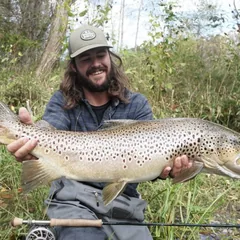
The first hour. Cast, drift, recast. Nothing for 20 minutes. The river is quiet. Then the indicator twitches and a 16-inch holdover rainbow comes to the net. The fish is colder than spring fish, slower fight, but solid. Photograph quickly, release in the current.
Mid-day. The sun warms the water from the surface down. Trout activity ticks up between 11 a.m. and 1 p.m. A small midge hatch starts on a sheltered bend. Two more fish. Both quality. The river is still empty.
The wrap-up. By 3 p.m. the air temperature drops again as the sun moves. The bite slows. You walk back to the car as the light fades, soaked in cold but warm under the layers. Drive back to Atlanta with a thermos of tea and a memory of a 4-fish day on a river that produced 30-fish days six months earlier.
The trade-offs are real. The reward is too.
Winter month-by-month patterns
Each winter month has its own character on the Toccoa.
December: the transition month. Brown trout spawn typically peaks (avoid targeting fish on redds). Egg patterns produce fishing for non-spawning fish. Mild early-December days fish similarly to late-November conditions; late-December cold snaps require the full winter approach. Pressure drops dramatically after early-month holiday season.
January: deep winter. Midges dominate. Egg patterns continue producing during brown trout post-spawn. The coldest days of the year are typically in January — pick warmer days carefully. The most-empty river of the year — solitude is a feature, not a bug.
February: warming trend starts late month. Stoneflies emerging. Brown trout post-spawn aggression continues for trophy hunters. Late February is one of the best windows of the winter season — not yet crowded but conditions improving.
Early March (still winter pattern): the shift toward spring begins. First caddis emerging late month. Water temperatures start trending up from winter low. Pressure remains low. The last of the true winter fishing windows before the spring crowd arrives.
The seasonal arc: December starts mild and trends colder; January is the coldest; February starts warming late month; March is transitional. Pick your trip dates within each month based on weather patterns.
Frequently Asked Questions
Can you fly fish the Toccoa River in winter?
Yes. Blue Ridge Dam's release from deep in the lake keeps the Toccoa tailwater steady through the winter, so trout keep feeding. Winter fishing is more technical and slower than spring/fall but consistently productive for prepared anglers. Best windows: mid-day on warmer days (highs over 50°F), with midges and small olives as the primary patterns.
What flies work in winter on the Toccoa?
Midges (size 18–22) are the dominant winter pattern. Zebra midges in black and red. Sowbugs (size 14–18) continue to produce. Small BWOs (size 18–20) on milder afternoons. Egg patterns during brown trout post-spawn (December–January). Small streamers on warmer overcast days. Lighter tippet (6X–7X) and smaller flies than spring/fall.
What time of day fishes best in winter?
Late morning through early afternoon (11 a.m.–3 p.m.) when water is at its warmest. Skip dawn fishing in winter — productivity is poor. Late afternoon produces on milder days. The pattern is opposite of summer (which fishes best dawn and dusk) — winter fishes best at mid-day.
How cold is too cold to fly fish the Toccoa?
Forecast highs below 40°F produce minimal fishing — water warming insufficient for trout activity. Above 45°F is fishable; above 50°F is good winter fishing weather. Single-digit cold snaps shut down even the cold-water release advantage.
What gear do I need for winter Toccoa fishing?
Synthetic or merino base layers (no cotton), fleece or synthetic mid-layer, breathable or insulated waders, fingerless gloves, hand warmers, insulated hat, polarized sunglasses, heavy synthetic socks, hot drink in thermos. Investment in real winter gear is non-negotiable for productive winter fishing.
Is winter the worst time to fish the Toccoa?
No. Winter is technical and slow but produces quality fishing for prepared anglers. The Toccoa's cold-water release keeps it fishable when most North Georgia streams are unfishable. The trade-offs (lower catch counts, cold weather) are real, but the benefits (no crowds, quality fish, technical satisfaction) make winter a legitimate fishing season for committed anglers.
Should I book a guided trip in winter?
Yes if you want to learn the technical winter game from a guide. Bowman runs winter trips for anglers who want the empty river and quality fishing experience. Self-guided winter fishing works for experienced anglers willing to do the homework. Guide trips are dramatically less crowded than peak-season; same per-day rate.
Book a winter Toccoa trip
Less crowds, quality fish, technical fishing. Use the trip finder or call (706) 963-0435.
Toccoa River float trip, from $425 per boat · 4.9 stars on Google
See the trip or Find Your Trip →