North Georgia Rivers
Toccoa River Fly Fishing: Access, Flows & Seasons (2026)
 Daniel Bowman
Updated October 1, 2026
10 min read
Daniel Bowman
Updated October 1, 2026
10 min read

The short version
The Toccoa River is North Georgia's longest trout fishery, fed by a tailwater release from Blue Ridge Dam that keeps the lower river cold year-round. The tailwater section below the dam holds rainbow and brown trout, and the delayed-harvest stretch above the lake is catch-and-release from November 1 to May 14. Wade access is decent at multiple points, but TVA's generation schedule changes daily, and wading during generation is dangerous and the most-overlooked planning detail. Drift boat floats are the easier way to fish the lower miles. Best months: April-May (caddis), October-November (streamers for trophy browns). Booking a guided Toccoa trip is the simplest first introduction, because the river rewards local knowledge.
What is the Toccoa River?
The Toccoa River runs about 56 miles in Georgia. It rises in the Chattahoochee National Forest south of Blue Ridge, flows north through Blue Ridge Lake, exits the Blue Ridge Dam as cold tailwater (about 14 miles of it hold trout year-round), and continues to the Tennessee state line where it becomes the Ocoee River. If you'd rather fish it with a guide, Bowman runs guided Toccoa River float trips from $425 per boat for a half day.
The river splits into three distinct sections for a fly angler:
- Upper Toccoa: small streams in the national forest above Blue Ridge Lake, primarily wild rainbow and brook trout, technical small-water wade fishing
- Toccoa above Lake Blue Ridge — small to medium river, mixed warm and coldwater, less consistent trout fishing
- Toccoa Tailwater (below Blue Ridge Dam) — cold tailwater, stocked and holdover rainbow and brown trout, the section most guided trips fish
This guide focuses on the tailwater section because that's where guided trips, drift boat floats, and the best year-round trout fishing live. If you're looking at a guided Toccoa trip, you'll be on the tailwater.
Toccoa Tailwater — what makes it fish so well
Blue Ridge Dam was finished in 1930 and is now run by TVA. TVA lists it at 175 feet high. It holds back Lake Blue Ridge and lets water out from near the bottom of the lake, where it stays cold even in July. That cold release turns 13+ miles of river into trout water in a part of Georgia that would otherwise get too warm for trout every summer.
The Georgia DNR stocks the tailwater with rainbow trout multiple times per year. Wild and holdover brown trout live here too, and some grow large.
Key fishing characteristics:
- Cold water year-round: one of two big Georgia tailwaters (with the Chattahoochee below Buford Dam) that keep trout alive through summer
- Generation-driven flows — TVA generates water for power, and the flow can swing from 175 cfs (no generation) to 1,800+ cfs (full generation) in 30 minutes
- Tailwater food base — sowbugs, midges, caddis, sulphurs, and (in fall) streamers
- Drift boat-friendly — the lower miles below the dam float well for half-day or full-day floats
- Delayed-harvest stretch above the lake: catch-and-release with single-hook artificial lures from November 1 to May 14 (the tailwater below the dam follows general trout rules)
For a first-time visitor, the tailwater is the right water to fish.
Generation schedule — the most important Toccoa planning detail
If you only remember one thing about the Toccoa, remember this: TVA's generation schedule changes daily and you cannot wade safely during generation.
Blue Ridge has one generating unit. TVA runs it according to power demand and the lake level, and when it starts, the river can come up about 3 feet in an hour. That is fast enough to strand someone standing in the middle, and it happens on ordinary days, not only in floods. TVA usually posts the next day's planned schedule by 6 p.m., and it warns that the plan can change without notice, so check the observed release on the morning you fish too.
Checking the schedule:
- TVA's lake-level page for Blue Ridge Dam lists generation schedules. Check the morning of the trip.
- TVA's observed Blue Ridge outflow (live data) shows the actual flow. Below 175-200 cfs = no generation. Above 1,000 cfs = generation is on.
- Local outfitters post generation alerts on social media and websites. Bowman's fishing report email covers recent conditions.
For a guided trip, the guide handles the generation logistics. They'll move you to wade water if generation is off in the morning, switch to a drift boat float if generation is on (you can fish from a boat through generation, just not wade), or move you to a tributary if generation is unpredictable.
Fishing on your own, choose one of two days: wade the early hours before a release, or float a day when the unit runs. The mixed day, when the release starts while you are standing in the river, is the dangerous one. If the schedule shows generation for most of your day, a guided Toccoa float fishes straight through it, from $425 per boat for a half day.
Wade fishing the Toccoa Tailwater — access and best runs
Several public access points give wade anglers entry to the tailwater. The most-used:
Tammen Park (just below the dam): The closest public access to the dam. Holds heavy public pressure on weekends. Fishes well in the morning before crowds arrive.
Curtis Switch Bridge: a few miles downstream of the dam, with wading on both sides of the bridge. General trout rules apply on the tailwater, since Georgia lists no catch-and-release section there; check current rules at Georgia Wildlife.
Horseshoe Bend: Wadeable access via a short walk down a marked trail. Less pressure than Tammen.
Lower Toccoa near Mineral Bluff: Mixed access; private water in stretches. Local knowledge or a guide is the easier path here.
Delayed-harvest stretch (above the lake): this one is not on the tailwater. It sits upstream of Lake Blue Ridge on Forest Service land, from 0.4 mile above Shallowford Bridge up to the Sandy Bottom Canoe Access. From November 1 to May 14 it is catch-and-release, single-hook artificial lures only, and signs mark both ends.
For a wade angler new to the Toccoa, the move is to fish either Tammen or Curtis Switch in the early morning (no generation, fewer crowds), focus on the runs and pocket water around the bridges, and be off the water by mid-morning when generation typically starts.
Drift boat floats on the Toccoa Tailwater
A drift boat float is a strong choice for a guided Toccoa trip. Here's why:
- Covers 5-9 miles of water in a half-day or full day
- Reaches runs and seams that wading anglers can't access (the middle of the river, deep slots between boulders)
- Fishes through generation events safely (you're in a boat, not wading)
- Lets you fish multiple tactics — nymphs in the morning, dries through hatches, streamers in lower light
- Better experience for two anglers (one fishing the bow, one resting)
Bowman runs Toccoa floats out of the standard drift boats, with the guide rowing and one or two anglers fishing. Half-day floats are typically 5-6 miles; full-day floats cover 8-12 miles depending on flow.
The cost is a flat rate regardless of one or two anglers — see the guided trip cost article for the full breakdown. Half-day Toccoa float is $425 for 1-2 anglers in 2026; full-day is $575.
If it's your first time on a drift boat, expect a brief learning curve. Casting from a moving boat is different from wade casting — the guide will coach you through it in the first 30 minutes. Most clients are dialed in by the second mile.
Toccoa hatch chart — what to fish by season
The Toccoa is a tailwater, so its hatches are slightly off the standard wild-river timing. The cold dam release pushes hatches later in spring and earlier in fall.
March-April: Blue-winged olives (size 18-22), early black caddis (size 14-16), midges all winter and spring. Nymphs the rest of the time — sowbugs (size 16-18), zebra midges (size 18-20), pheasant tails.
May: Caddis hatches dominate (Apple caddis, October caddis ironically in May, multiple species). This is the peak dry-fly month. Tan and olive caddis size 14-16. Sulphurs (size 16) start late month.
June-July: Sulphurs continue. Light cahills. Terrestrials start — ants, beetles, hoppers along the banks. Nymphs deep through the heat of the day, dries early and late.
August: Terrestrials peak — hoppers, ants, beetles. Tricos in the morning on calm pools. Sulphurs taper. Best dry fishing is first light.
September-October: Streamer season for big browns. Articulated streamers, sculpins, woolly buggers. Trout get aggressive pre-spawn. Olives return.
November-December: Streamers continue. Midges and small olives on warmer days. Browns spawn — fish around redds carefully and avoid the redds themselves.
January-February: Midges (size 18-22), the occasional warm-day olive hatch. Slow, technical fishing. Streamers on overcast days.
For a complete hatch chart with specific patterns and sizes, the dedicated Toccoa hatch chart article goes deeper.
Best time to fish the Toccoa River
Three windows stand out for the Toccoa:
Late April through May is peak. Caddis and sulphurs are hatching, water temps are perfect, generation is more predictable, and the river is at its prettiest. The post-spawn rainbows and post-winter browns are aggressive.
October through mid-November is the second window — streamer fishing for big browns, fall colors on the river, and consistent generation patterns. This is the trophy-brown window.
Mid-summer (July-August) fishes well early and late but can be tough mid-day. The Toccoa stays cold from the dam, but air temps make terrestrials interesting and the river is less crowded than spring.
Winter (December-February) is real but requires commitment — midge fishing, slow water, cold mornings. Fewer anglers, no crowds, and surprisingly good streamer fishing on warm overcast days.
For a first-time visitor, target late April or October if you can. Both windows produce.
Float trips on the Toccoa for beginners — what to expect
If you've booked a guided drift-boat float as your first Toccoa trip, here's what the day looks like:
- 8 AM meeting at the put-in — usually a dirt parking area or boat launch below the dam. The guide has the boat trailered.
- Quick gear briefing — rod and line setup, how to manage line in the boat, where to cast, when to mend. About 15 minutes.
- First mile is the learning curve — you'll cast off-target, the boat will move under you, you'll mis-mend. Normal. The guide is rowing slowly and coaching.
- By mile 2-3, you're fishing — actually catching fish, knowing where to drop your fly, working with the rower instead of against them.
- Lunch break on a gravel bar (full-day only) — pulled out for 30 minutes, sandwiches.
- Take-out 5-6 miles downriver for a half-day, 8-12 miles for a full day.
What to bring: layers, polarized sunglasses, hat, snacks, water. The guide has the rest. See the what to wear article for the full packing list.
Toccoa trophy browns — the streamer game
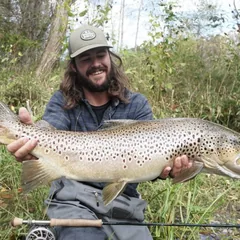
The Toccoa produces several 22-26" wild brown trout each year. They live in the deepest runs, behind the largest boulders, and come out for streamers in low-light conditions.
The pattern that catches them:
- Articulated streamers in olive, brown, or black, 4-6 inches
- Sink-tip line to get deep fast
- Stripped retrieves with pauses — fast, faster, pause, jerk
- Low-light windows — first light (5:30-7:30 AM) and last light (6:30-8:30 PM in spring/fall)
- Pre/post-spawn windows — late October into early December, then late February into March
A trophy brown on the Toccoa is a multi-trip pursuit for most anglers. Booking a guided streamer trip in October-November is the highest-percentage shot for a one-day attempt.
Do stripers run up the Toccoa?
Not into the tailwater. A striper spawning run moves upriver out of a reservoir, and the tailwater sits below Blue Ridge Dam, downstream of the lake, so lake fish can't migrate up into it. Our article on Toccoa River stripers explains why, and where to fish for stripers instead.
If you want a striper on the fly, Bowman runs river striper floats from late March into summer, mostly on rivers around Dahlonega. It's a separate trip from the trout fishing, with heavier rods, sink lines, and big streamers.
Frequently Asked Questions
When is the best time to fly fish the Toccoa River?
Late April through May for caddis and sulphur hatches with consistent generation; October through mid-November for streamer fishing for trophy browns. Both windows offer the best combination of weather, water conditions, and fish activity. Summer fishes well early and late; winter is technical midge fishing for committed anglers.
Can I wade fish the Toccoa Tailwater?
Yes, as long as you check TVA's release schedule first. Standing in the river during a release is dangerous because the water can come up about 3 feet in an hour. The safest wading is early in the morning before TVA starts generating, and Tammen Park and Curtis Switch Bridge are the access points most people use.
What flies work on the Toccoa River?
Year-round nymphs: zebra midges (18-20), sowbugs (16-18), pheasant tails (16-18). Spring caddis (14-16) and sulphurs (16). Summer terrestrials. Fall streamers. Winter midges. Local fly shops carry the patterns dialed for current conditions.
How do I check the Toccoa generation schedule?
Check the TVA Blue Ridge Dam page for scheduled generation, and TVA's observed outflow for actual flows. Below 200 cfs = no generation. Above 1,000 cfs = generation is on. Local outfitters post current patterns, and Bowman's fishing report email covers recent conditions.
Are guides necessary on the Toccoa?
Not strictly required, but the Toccoa is the most logistics-heavy river to fish self-guided in North Georgia. Generation schedules, access points, and drift boat floats are easier with a guide for the first visit. Most return visitors fish self-guided after their first trip.
Can I fly fish the Toccoa in winter?
Yes — midge fishing in slow water and streamer fishing on overcast days both work. Water temps stay in the high 40s/low 50s from the dam. Dress for cold (waders + thermal layers), expect technical fishing, and you'll have the river mostly to yourself.
What's the catch-and-release section on the Toccoa?
There isn't one below Blue Ridge Dam: the tailwater follows Georgia's general trout rules. The Toccoa's special-regulation water is above the lake: a delayed-harvest stretch on Forest Service land between a point 0.4 mile above Shallowford Bridge and the Sandy Bottom Canoe Access. There, from November 1 to May 14, you may only use artificial lures with a single hook and must release every trout. Confirm the current rules with the Georgia Wildlife Resources Division before you go.
Ready to fish the Toccoa?
Book a guided wade or float trip on the Toccoa — use the trip finder or call (706) 963-0435.
Toccoa River float trip, from $425 per boat · 4.9 stars on Google
See the trip or Find Your Trip →