Fly Fishing 101
Is Fly Fishing Hard for Beginners? An Honest Answer
 Daniel Bowman
Updated October 2, 2026
11 min read
Daniel Bowman
Updated October 2, 2026
11 min read

The short version
Fly fishing is moderately hard to learn but easy to start. The basic skills needed to catch a trout — cast 25–30 feet, manage line, set on a take, land a fish — are achievable in a single guided day for roughly 95% of new anglers. The harder skills — reading water consistently, hatch matching, technical drifts on selective fish, casting accurately in tight cover — take 1–3 years of regular fishing to develop. The fastest learning path is a guided half-day on stocked or high-density water (the Etowah or Toccoa). You learn the basics while actually catching fish, which is a much better feedback loop than DIY-ing your way through fishless days. Don't buy expensive gear before your first trip — Bowman provides everything, and gear decisions become much easier after one day on the water.
What "hard" actually means in fly fishing
Fly fishing has a reputation for being intimidating. Some of that reputation is real; some is mythology built up by traditionalists who like the gatekeeping. The honest answer is that fly fishing has multiple layers of difficulty, and which layer matters depends on your goal:
Layer 1 — Catching any fish. Easy with a guide. Most beginners catch their first trout within an hour of their first guided trip.
Layer 2 — Catching multiple fish in a day. Easy by trip 2 or 3. Once basic mechanics click, a half day on the right water usually brings a steady run of fish.
Layer 3 — Catching fish without a guide on familiar water. Achievable after 5–10 guided trips or equivalent self-taught experience. The water reading and rig adjustments that the guide handled are now your job.
Layer 4 — Catching wild trout consistently on technical water. Genuinely hard. Takes years of regular fishing, often a decade or more for true mastery. This is where the gatekeeping reputation comes from.
Layer 5 — Catching trophy fish in difficult conditions. Hard for anyone, beginner or expert. Even excellent anglers have slow days.
For most beginners, Layers 1 and 2 are the goal. Layer 3 happens naturally over time. Layers 4 and 5 are optional if you want to get serious.
What's actually hard about it
The genuinely difficult parts of fly fishing, ranked roughly by how long each takes to learn:
1. The cast (medium difficulty, weeks to dial in)
The fly fishing cast is genuinely different from spin casting. The rod loads with the weight of the line, not the weight of the lure. The motion is a back-and-forth pause-and-load rather than a chuck-and-wind.
Three things make casting feel hard at first:
- Timing. The rod has to load before the forward stroke. Rushing creates collapsed casts.
- Line management. Your line hand and rod hand have separate jobs. Coordinating them takes practice.
- Wind. Even moderate wind disrupts the cast in ways that don't affect spin tackle.
The good news: the basic 25–30 foot cast is achievable in 30–60 minutes of focused practice. Anyone can get there. Long casts (50+ feet), accurate casts in tight cover, and cross-wind casts take longer.
2. Reading water (medium difficulty, months to years)
Knowing where fish are holding requires understanding how water flows around obstacles, how trout use current, and how depth and structure interact. Beginners often cast to where fish "should" be (the obvious-looking spots) rather than where they actually are (the seams, structure edges, and drop-offs).
A guide accelerates this dramatically — you watch them point at lies you wouldn't have seen and then catch fish from those lies. After 3–5 guided trips, the patterns start becoming visible.
3. Hookset timing (medium difficulty, days to weeks)
Setting too early, too late, too hard, or too soft all cost fish. Different presentations require different sets:
- Indicator nymph fishing: Lift the rod immediately when the indicator dips
- Dry-fly fishing: Slight delay so the trout has the fly fully in its mouth
- Streamer fishing: Strip-set with the line hand, not the rod
- Tight-line nymphing: Set on any sense of weight or hesitation
Beginners often default to one set type and miss fish on others. By trip 3, most anglers have the right set for the right rig.
4. Mending line (medium difficulty, weeks)
Mending is the act of throwing line upstream or downstream after the cast to manage drift speed. Without mending, the line creates drag that pulls the fly unnaturally. Trout refuse drag.
The mechanics aren't hard; the timing and reading-the-need is. After 2–3 trips, basic mending becomes intuitive.
5. Knot tying (easy, hours)
Three knots cover 90% of fly fishing situations: improved clinch knot (fly to tippet), surgeon's knot (tippet to leader), nail knot or loop-to-loop (leader to fly line). Most beginners learn these in 30 minutes.
6. Hatch matching and technical drifts (hard, years)
Knowing what bug is on the water, what stage it's in, and what fly to throw is genuinely hard. Beginners mostly rely on the guide for this. After 1–2 years of regular fishing, anglers start matching hatches semi-independently. After 5+ years, it becomes intuitive.
What's not actually hard
A few things beginners worry about that turn out to be easy:
Casting in front of other people. Everyone learning to fly fish casts badly at first. Other anglers don't care. Guides have seen worse.
Hurting yourself with the hook. Modern fly fishing rarely involves embedded hooks in skin if you cast correctly. Wear sunglasses (protects eyes) and a hat. The guide manages risky moments.
Equipment damage. Rods break occasionally. It's not a big deal. Use the guide's equipment on your first few trips and you don't even need to think about it.
Falling in. Beginners worry about this more than experienced anglers do. Felt or studded soles, a wading staff, and going slow eliminate most risk. If you do fall, you stand up wet and continue fishing.
Looking foolish in waders. Everyone looks slightly foolish in waders. It's part of the experience.
What makes it click for beginners
A few patterns observed across many first-time clients:
1. Catching a fish unlocks everything. Once a beginner catches their first trout, the rest of the experience reorganizes around that moment. Casting starts feeling purposeful, mending makes sense, hookset timing settles in.
2. The guide's confidence transfers. When the guide says "fish here, this rig, this presentation," and a fish appears, the angler internalizes that the system works. Self-doubt drops.
3. Repetition is the actual teacher. No amount of book reading replaces 50 casts on real water. The first trip is mostly about repetitions.
4. Same water, multiple trips. Most anglers learn fastest by fishing the same water 3–4 times rather than rotating through different rivers. Familiarity compounds.
5. Watching a more experienced angler. Even watching the guide cast for 10 minutes provides a model that words can't convey.
For complete coverage of what to expect on your first guided trip, see the dedicated article.
Common beginner mistakes (and how to avoid them)
Patterns that slow down learning:
1. Buying expensive gear before knowing you'll stick with it. A first-time angler often spends $800–$1,500 on rod, reel, line, waders, vest, flies, and accessories before their first trip. About 30% of those anglers never use the gear again. Use the guide's gear for the first 1–3 trips. Buy your own once you know what you want.
2. Reading too much before fishing. Books and YouTube videos are valuable but they don't replace water time. Two hours on a river with a guide teaches more than 20 hours of reading.
3. Booking technical water for the first trip. Bowman says Noontootla Creek is technical and not for beginners. A first-timer does better on the Etowah or Soque private water, which Bowman calls beginner friendly, or on a Toccoa float.
4. Casting too far. Beginners often try to cast 60 feet when 25–30 feet is what's needed. Most fish are caught within 30 feet.
5. Not practicing the cast at home. A 30-minute backyard practice session before the trip pays off. The first hour on the water is more productive when you're not learning to cast from scratch.
6. Trying to learn alone first. Some beginners want to "figure it out themselves" before booking a guide. This is the slowest path. A first guided trip teaches the basics in 4 hours that would take 30+ hours of solo trial-and-error.
7. Comparing yourself to experienced anglers. A first-timer's casting and catch rate compared to a 20-year veteran is unfair. Compare yourself to where you were yesterday, not to someone with two decades of practice.
Will I catch a fish?
The odds of catching fish on a first guided trip are good: Bowman says first-timers on its Etowah and Soque water have great success catching both quantity and big fish. For a deep dive into catch rates by water and conditions, see will I catch a fish on my first trip.
The short answer: yes, most likely. The guide's job is to put you on water that holds fish, supply the right gear, and call the casts. Your job is to make the cast and set when told. That combination produces fish on the vast majority of first-timer days. The usual first trip is a half-day on the Etowah River private water, from $400 for one angler with all the gear supplied.
Cost vs DIY learning
Two paths exist for learning fly fishing:
Path A: DIY. Buy a starter kit ($150–$400), watch YouTube videos, drive to public water, learn through trial and error. Total cost is lower up front (~$300) but the learning curve is steep — many DIY beginners catch zero fish in their first 5–8 outings.
Path B: Guided. Book a half-day or two ($400–$675 each). Catch fish on day one. Learn casting, reading water, and hooksetting from a professional. Buy gear after you know you'll continue. Total cost for trips 1–2 is higher (~$900–$1,300) but the learning is faster and more enjoyable.
For most adults considering fly fishing as a hobby, Path B is the better value despite the higher upfront cost. The faster learning curve, the certainty of catching fish, and the social experience of fishing with a guide produce a better introduction than the DIY route.
For a complete cost breakdown, see what's included in a guided trip.
How long until I can fish on my own?
Rough timeline for someone fishing 6–10 days per year:
- After trip 1: Can cast 25–30 feet, can hookset on stocked fish, has caught fish. Cannot fish productively alone.
- After trips 2–3: Casting feels natural, knows basic rigs, can read obvious water. Could fish stocked public water alone with low success rate.
- After trips 4–6: Can fish familiar water alone with moderate success. Still benefits from a guide on new water.
- After trips 8–12: Can fish most regional water alone successfully. Learning specific water at depth.
- After 2–3 years: Functional intermediate angler. Can travel to new water and figure it out.
- After 5+ years: Genuine expertise on familiar water. Can teach beginners.
For an angler fishing 20–30 days per year, this timeline compresses dramatically. The two variables are repetition and instruction quality.
What surprises beginners most
Patterns observed across many first-time Bowman clients — what beginners didn't expect:
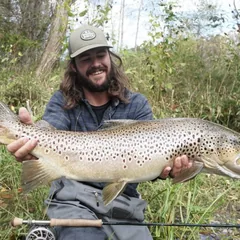
1. How quickly the first fish comes. Most beginners assume catching a trout takes hours of struggle. On stocked or high-density water with a guide, the first fish often appears within 30–60 minutes of the first cast. The relief and excitement is real.
2. How much the guide does. First-timers expect the guide to "show them how" and step back. In practice the guide is actively rigging, reading water, calling casts, mending, netting, photographing — for 4–8 hours straight. The intensity of the service surprises most clients.
3. How peaceful it is despite the activity. Standing in a moving river casting to a specific lie, watching the water, focusing on a single fly, dissolves the rest of the day's mental load. Many first-timers come back saying it was the most calming experience they'd had in years — and that surprises them.
4. How tired their casting arm gets. Casting for 4 hours is more physical than it looks. Most first-timers feel arm fatigue by the 3-hour mark. The fix is technique, not strength — better casts use less effort.
5. How small the productive zone is. Beginners often assume the "fishing" part of the river is the obvious deep middle. Actually most fish hold in 2–5 foot zones along seams, drops, and structure edges. The water that produces is often the water beginners would have walked past.
6. How much the guide knows. The volume of detail an experienced guide carries about a specific river — the lies, the bug life, the water temperature thresholds, the historical patterns — surprises every first-timer.
Resources beyond Bowman
A few legitimate resources for beginners building skills outside of guided trips:
- Trout Unlimited — local chapter meetings, conservation events, and beginner clinics in the Atlanta area. The Georgia chapter network runs free instructional events seasonally.
- American Fly Fishing Trade Association — industry organization with resources for new anglers.
- YouTube channels — Orvis Learning Center, Tom Rosenbauer's podcast, Pete Kutzer's casting videos. All free, all high-quality.
- Local fly shops — most carry beginner classes, often $50–$150 for a 2–4 hour session covering casting, gear basics, and entomology.
- Books — Curtis Creek Manifesto (illustrated, friendly) and Tom Rosenbauer's Orvis Fly Fishing Guide are the most-recommended starter texts.
Frequently Asked Questions
Is fly fishing harder than regular spin fishing?
The casting is genuinely different and takes more practice. The bait and lure presentations are simpler with spin tackle. But fly fishing offers presentation options spin tackle can't match (delicate dries, technical nymph rigs, controlled streamer drifts). For trout in streams, fly fishing is often more effective than spin fishing despite being harder to start. Both have learning curves.
How long does it take to learn fly fishing?
Basics in one guided day. Solid intermediate skills in 8–12 days on the water (could be 1 year of weekend fishing or 6 months of intensive practice). Genuine expertise in 3–5+ years. The good news: catching fish happens at every stage from day one onward.
Do I need to be athletic to fly fish?
No. Fly fishing is genuinely accessible across age and fitness levels. Most water Bowman fishes is wadeable for anyone reasonably mobile. The Noontootla wading day is more demanding; the Etowah private water and Toccoa float trips are accessible for anglers with limited mobility. Mention any concerns when booking and the guide will match the trip.
Should I take a class or book a guided trip first?
Book a guided trip first. A class teaches casting in a vacuum; a guided trip teaches casting plus reading water plus hookset plus playing fish — all in real fishing context. After your first guided trip, a class makes more sense because you have context for what's being taught.
Can older beginners learn fly fishing?
Yes. Some of the best learners are 50+ adults who pick it up after retirement. Patience, willingness to follow instruction, and stable casting motion all favor older beginners.
Can kids learn to fly fish?
Yes — typically starting around age 8. Younger kids do better with spinning tackle until they have the patience and coordination for the fly cast. Bowman runs family trips where kids fish alongside parents on appropriate water; the guide adjusts pacing and water selection for younger anglers.
What's the best first investment if I want to start fly fishing?
A guided half-day trip — typically $400–$550. After that trip, you'll know whether you want to continue, what kind of water you like, and what level of investment makes sense. Spending the same dollars on gear before the trip is a worse investment because you don't yet know what you'll actually use.
Ready to find out for yourself?
Book a half-day with a guide who teaches as you fish — use the trip finder or call (706) 963-0435.
Etowah River private water trip, from $400 · 4.9 stars on Google
See the trip or View Rates →