North Georgia Rivers
Fly Fishing Noontootla Creek: Water, Rules & Seasons (2026)
 Daniel Bowman
Updated October 2, 2026
10 min read
Daniel Bowman
Updated October 2, 2026
10 min read

The short version
Noontootla Creek is North Georgia's best small wild-trout stream: a naturally reproducing population of brown trout in cold, clear mountain water on the Blue Ridge Wildlife Management Area in Fannin County. Georgia's rules on the creek are short: artificial lures only, and every trout under 16 inches goes back. The water is 8 to 25 feet wide under hemlock and rhododendron, so it calls for a short rod, a short leader, a low approach, and drag-free drifts of 3 to 8 feet. Fish it April to early June for hatches and October to November for pre-spawn browns. Bowman's guided trips run $450 for a half day and $600 for a full day for one angler.
What is Noontootla Creek?
Noontootla Creek is a freestone mountain stream in Fannin County, draining part of the Blue Ridge Wildlife Management Area in the Chattahoochee-Oconee National Forest. It runs about 12 miles from its headwaters to the Toccoa River near Blue Ridge. Bowman runs guided Noontootla Creek trips from $450 for a half day.
Most of the fishable trout water is on national forest land, so public access is unusually good for a wild-trout creek. There are several trailheads, dirt-road pullouts, and longer hike-in stretches that see only a few anglers a week.
The creek changes from top to bottom:
| Section | What you'll find |
|---|---|
| Headwaters and high tributaries | Tiny, steep water with native brook trout and small wild rainbows. Mostly hike-in. |
| Middle creek | The regulated wild-brown water, 12 to 25 feet wide under hemlock and rhododendron. |
| Lower creek | Broader and a little warmer, with mixed wild and stocked fish as it nears the Toccoa. |
The middle creek is the water people drive up for. Outside of guided private leases, it holds some of the biggest wild browns in North Georgia, and it fishes like a miniature Western spring creek: clear, slow pools and fish that watch every fly.
What are the rules on Noontootla?
Georgia lists Noontootla Creek and its tributaries on the Blue Ridge WMA under two special rules:
- Artificial lures only. No bait on that water.
- A 16-inch minimum size. Every trout under 16 inches goes back right away, which makes the creek nearly catch-and-release in practice.
Everything else, from the license to the creel limit on a fish you're allowed to keep, follows Georgia's general trout rules. Boundaries are posted at the trailheads. Read the creek's own entry on the Georgia Wildlife Resources Division regulations before a self-guided trip, and check the national forest's Chattahoochee-Oconee site for road and trail closures. Our breakdown of the Noontootla special regulations goes deeper.
What makes the brown trout special?
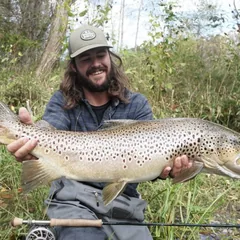
They're wild. The state doesn't stock the regulated water, so every brown there came from a nest of eggs laid in the creek or one of its feeders.
| Trait | What to expect |
|---|---|
| Typical size | 7 to 13 inches for most fish; 14 to 18 inches for a good one |
| Trophy | A 20-inch wild brown is a once-a-season fish; only a handful turn up each year |
| Numbers | Roughly 800 to 1,500 catchable trout per mile in good years, far fewer than a stocked stream |
| Behavior | Eager in good conditions, nearly uncatchable on a sloppy drift |
| Spawn | October and November, on clean gravel in shallow runs |
Wild rainbows share the lower regulated water with the browns. Brook trout, the only trout native to Georgia, live in the highest tributaries above it.
When do the hatches come off?
Noontootla's insects are typical of a Southern Appalachian freestone: lots of kinds, rarely in big numbers. Reading the hour matters more than chasing one hatch.
| Months | Main bugs | How it fishes |
|---|---|---|
| February–March | Black stoneflies, midges, early Blue-winged Olives | Mostly nymphing; a warm afternoon brings a few risers |
| April | Quill Gordons and Hendricksons (12–14), Blue Quills (16–18), early caddis | The best dry-fly month; browns wake up hungry |
| May | Sulphurs (14–18), March Browns (12), more caddis | Late afternoons get reliable |
| June | Light Cahills (14–16), Yellow Sallies (14), Slate Drakes (12–14) | Beetles, ants and inchworms start falling from the canopy |
| July–August | Terrestrials | Fish mid-morning and late afternoon; middays get warm up high |
| September | Tricos, caddis | Cooler nights restart the creek |
| October–November | Pre-spawn browns | Streamers (4–8) worked slowly through the deep runs |
| December–January | Midges, small mayflies | Slow nymphing in the deeper pools; few bites, real chances |
What gear works on Noontootla?
Leave the 9-foot 5-weight at home. This creek punishes long rods and long leaders.
| Item | What to use |
|---|---|
| Rod | 7 to 8 feet, 3-weight; glass or slow graphite both work |
| Line | Weight-forward floating, or a short-headed double taper |
| Leader | About 7 feet; longer leaders tangle in the rhododendron tunnels |
| Tippet | 5X for nymphs and dry-droppers, 6X for smooth-water dries, 4X for streamers in high water |
| Dries | Parachute Adams, Elk Hair Caddis (tan, olive) |
| Nymphs | Pheasant Tail, Hare's Ear |
| Terrestrials | Foam beetle, foam ant, inchworm |
| Streamers | Woolly Bugger (black, olive), a small sculpin pattern for fall |
| Feet | Studded or felt soles, plus a wading staff on the steep sections |
| Eyes | Polarized sunglasses, without exception |
The rocks stay slick all year, and the creek drops faster than the Etowah or the Toccoa, so footing deserves real thought. On a guided trip all of this is supplied.
How do you approach and fish Noontootla?
These fish see you long before you see them. Most of the gap between a slow day and a great one comes down to how you walk up to a pool, then how clean your drift is, then where you put the fly.
Getting into position:
- Keep your profile down. Crouch on the approach. On the small upper water, kneeling to cast is normal.
- Work upstream. Trout hold facing the current, so coming from below keeps you behind them.
- Treat the first cast as the best one. A wild brown often takes the first decent drift and ignores the rest. Choose the lane and the landing spot before you lift the rod.
Keeping the drift clean. Tiny amounts of drag cause most refusals here. Crossing currents in pocket water pull on the line just enough to speed the fly up or slow it down, and wild fish notice.
- Short drifts. Three to eight feet of natural drift through the seam is worth more than a long drift that drags. Pick up and recast early.
- Reach cast. Lay the line upstream of the fly as it lands to buy slack.
- Rod high in the pockets. Keep line off the fast water between you and the fly.
- Small mends. Gentle nudges, never big loops.
- Change the drift before the fly. A fish that rises and turns away usually saw drag, not the wrong bug. Our guide to reading a rise explains the clues.
Where trout sit:
- On the seam, just inside the slow side of the line where fast and slow water meet. The deep middle of a pool rarely holds anything.
- At the head of the pool, where the current pouring in brings food and oxygen.
- In the soft water behind boulders, where a fish can rest and still watch the food go by.
Pace yourself. Three good drifts on a seam is plenty. By then a wild fish has either eaten or gone on alert, so move up to the next lie and keep going. If you'd rather learn this with a guide beside you, guided Noontootla trips start at $450 for a half day for one angler.
What does a guided Noontootla day look like?
You can book a half day ($450 for one angler) or a full day ($600). The full day lets you walk farther from the trailhead, which is where the better water is. Two anglers pay $585 for a half day or $780 for a full day, and three pay $725 or $980.
- Booking. Pick a date on the Noontootla trip page. Your guide sends directions and a meeting time the day before.
- The start. You meet at a Forest Service trailhead and gear up at the truck. The guide lays out which stretch you'll fish and what the water and weather are doing, then you walk 15 to 25 minutes in.
- The morning. The first fish usually comes within an hour. The guide moves you through 6 to 10 pools and runs, coaching the approach, the drift and the hook set.
- The afternoon (full day). Lunch on the bank, then the deeper pools and pocket water. Spring and fall light can bring a dry-fly window; colder months lean toward streamers.
- The finish. Walk out, break down at the truck, and tip the guide (15 to 20% is standard).
Expect 4 to 10 wild browns on a good day and 2 to 5 on a slow one. On this creek a 14-inch wild brown makes the day, and anything past 17 inches is a story.
Should you choose Noontootla or another river?
Each of Bowman's home waters suits a different day:
| Choose | When you want |
|---|---|
| Noontootla | Wild fish in wild country, technical short casts, and you can handle 3 to 4 hours of careful wading |
| Soque | The most trophy fish per mile, on private water, and bigger average fish |
| Toccoa | Big tailwater, a drift boat, or a group of more than two |
| Etowah | A shorter drive from Atlanta, a gentler learning curve, a mix of wild and stocked fish |
Experienced anglers often call Noontootla their favorite day. First-timers usually do better starting on the Etowah.
How do you read the water level?
Noontootla has no public USGS gauge of its own. Guides go by recent rainfall and use nearby gauges as a rough guide.
| Recent rain | What the creek does |
|---|---|
| None for two weeks or more | Low and gin-clear; sight fishing is possible but fish spook easily |
| About a quarter inch in a day | A small bump and a touch of color; fish get bold, often the best day of the month |
| Half an inch to an inch in a day | Higher and faster; streamers and heavy nymphs take over |
| More than an inch in a day | Often unfishable for one to two days until it clears |
If the forecast is unsettled, the guide calls the day before with a water update and a recommendation.
How should you plan a first trip on your own?
If you're heading up without a guide, a little planning saves a wasted drive.
- Check the rain. Look at the last few days of rainfall for the area. A dry spell means spooky, clear water; a soaking rain the night before can blow the creek out for a day or two.
- Check the roads. The access is by Forest Service roads off Doublehead Gap Road, which can wash out or close after storms. The national forest site lists closures.
- Leave early. It's roughly 90 minutes north of Atlanta via GA-400 and US-76, and the last stretch is slow gravel. Arriving by mid-morning gives you the best light on the water.
- Buy your license first. Every angler 16 and older needs a Georgia fishing license plus the trout license. There's no reliable signal at the creek, so buy online before you leave.
- Pack light and walk. A short rod, one fly box, a wading staff and water. Plan to walk at least 15 minutes past the first pullout before you start fishing.
- Read the signs. The rules apply on the Blue Ridge WMA water; private land borders parts of the creek. Fish where the signs say you can.
- Set a turnaround time. The walk out is uphill in places and slower than the walk in. Leave yourself daylight.
What should you expect on a first visit?
Expect fewer fish than you're used to and a slower pace. A first self-guided day often means a handful of small wild fish, a few that refuse at the last second, and a lot of learning about how close you can get. That's normal. The anglers who do best treat the first trip as scouting: they note which pools held fish, how the light hit the water, and which flies got a look, then come back better prepared.
What mistakes cost anglers fish here?
- Casting too far. Forty-foot casts don't fit this creek. Pick each pool apart with short casts of 8 to 15 feet.
- Bringing a big-river rod. A 9-foot 5-weight overpowers the water. A 7'6" 3-weight is the right tool.
- Wading where the fish are. Walking up the very slot you meant to fish empties it for an hour. Use the bank and step in only when you have to.
- Fishing the deep middle. The fish are on the seam edge.
- Staying too long. After a few refusals a wild fish is educated. Move on.
- Fishing only near the truck. The first couple hundred yards from parking get the most pressure. A 15 to 30 minute walk finds better water.
- Skipping local reports. Georgia's Trout Unlimited chapters post stream notes and rule changes worth reading before a trip.
Frequently Asked Questions
Where is Noontootla Creek?
In Fannin County, on the Blue Ridge Wildlife Management Area in the Chattahoochee-Oconee National Forest, about 90 minutes north of Atlanta. Access is by Forest Service roads off Doublehead Gap Road.
What gear do I need for Noontootla Creek?
A 7- to 8-foot 3-weight, a floating line, a leader of about 7 feet to 5X or 6X, studded or felt soles, and polarized sunglasses. A small box of Parachute Adams, Elk Hair Caddis, Pheasant Tails, foam beetles and a few streamers covers most days. Guided trips include all gear.
Are Noontootla brown trout wild or stocked?
Wild. The browns in the regulated water reproduce on their own, and the state doesn't stock it. Wild rainbows share the lower regulated water, and native brook trout live in the highest tributaries.
What are the special regulations on Noontootla?
On the creek and its tributaries on the Blue Ridge WMA: artificial lures only, and every trout under 16 inches must be released right away. Boundaries are posted at the trailheads. Check the Georgia Wildlife Resources Division regulations before you fish on your own.
When is the best time to fly fish Noontootla?
April to early June for the best hatches, and October to November for streamers and aggressive pre-spawn browns. Winter midge fishing rewards experienced anglers. In summer, fish early and late.
Can beginners fish Noontootla?
Yes, with a guide. The casts are short and accurate rather than long and powerful, so the mechanics are learnable. Reading water and approaching wild fish are harder, and that's where a guide helps most. Plan on 3 to 4 hours of careful wading on slick rocks.
How much does a guided Noontootla trip cost?
$450 for a half day and $600 for a full day for one angler; $585 and $780 for two; $725 and $980 for three. All gear and instruction are included.
Ready for technical wild trout?
Book a guided Noontootla trip — wild brown trout, special-regs water, and small-stream tactics.
Noontootla Creek wade trip, from $450 · 4.9 stars on Google
See the trip or Find Your Trip →