North Georgia Rivers
Fly Fishing the Soque River: Water, Seasons & Access (2026)
 Daniel Bowman
Updated October 1, 2026
10 min read
Daniel Bowman
Updated October 1, 2026
10 min read

The short version
The Soque River in Habersham County is Georgia's trophy trout fishery: rainbows and browns averaging 18 inches or better, with fish up to 28 inches. The fishable Soque is mostly private water, accessed through outfitters with leased water rights. Bowman's Soque private water covers multiple beats including the standard Soque trip ($400-675 half-day for 1-3 anglers) and the premium Dragonfly beat for the largest fish ($520-920 half-day). Spring (March to May) and fall (October and November) are the peak seasons, winter often brings the biggest fish, and Bowman pauses from June 10 to September 20. Bowman calls it great for all skill levels.
What is the Soque River?
The Soque River is a small to medium freestone river in Habersham County, North Georgia, flowing south from the foothills of the Blue Ridge into the Chattahoochee River system. It rises near Batesville and runs south to meet the Chattahoochee at Clarkesville. Most of that water is private, and Bowman runs guided Soque River trips on it from $400 for a half day.
The river divides functionally into:
- Upper Soque (above Clarkesville) — small, cold, mostly private headwaters
- Middle Soque (Clarkesville to Demorest) — the trophy water; private leases and the most-fished beats
- Lower Soque (below Demorest) — warmer, less consistent trout, some public access
The fishable trout water — the part that draws anglers from across the Southeast — is the middle stretch, and almost all of it is privately owned or leased. To fish it, you book through an outfitter with water rights or you pay for a private lease yourself.
For a guided trip, Bowman's Soque trip accesses multiple beats on the middle river, including the standard private water and the premium Dragonfly beat.
Why the Soque produces Georgia's biggest trout
Three factors stack to make the Soque exceptional:
1. Private riverbed. In Georgia, a landowner can own both banks and the whole bed of a stream that isn't navigable, so the only legal way onto most of the Soque is the owner's permission. Bowman leases more than 4 miles of it across 7 properties, built up over the last 10 years.
2. Every fish goes back. All fishing on Bowman's leased water is catch and release, and the number of anglers is kept low. Fish that are never kept and rarely bothered keep growing. The Soque River Watershed Association works to keep the river cold and clean.
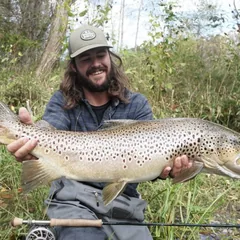
3. Size. On Bowman's water the average fish runs 18 inches or better. Rainbows average about 17 to 18 inches with some much larger, browns are about the same, and Bowman lists trout up to 28 inches.
That combination of private access, catch and release, and light pressure is why the Soque has its reputation for very big rainbows and browns.
For comparison with Georgia's other premier trout fishery, see the Toccoa River guide. The Toccoa is a dam-fed tailwater, while the Soque is a smaller river fished on foot.
How private water access works on the Soque
Most first-timers ask: "Can I just show up and fish?" Mostly, no. Here's how access works:
Private leases. Landowners along the Soque can lease fishing rights to an outfitter or a club. An outfitter then includes that access in the price of a guided trip. This is how Bowman, Soque River Outfitters, Brigadoon Lodge, and a few others operate.
Outfitter day rates. When you book a guided Soque trip, the trip fee includes private water access for that day. You're paying for the guide AND the water access bundled together.
Private fishing clubs. Some stretches belong to clubs, and only members fish them.
Public water. A few small stretches are public, but the trout density and quality is dramatically lower than the leased water. Most serious Soque anglers don't fish the public stretches.
For a fly angler new to the Soque, booking through an outfitter is the path. The day rate covers the trip and the water — see the guided trip cost article for the full pricing breakdown.
Standard Soque trip vs Dragonfly trophy beat
Bowman runs two tiers of Soque trips:
Standard Soque private water:
- Half-day wade for $400 (1 angler), $550 (2 anglers), $675 (3 anglers)
- Full-day wade for $550 (1 angler), $725 (2 anglers), $900 (3 anglers)
- Bowman's main Soque water: rainbows and browns averaging about 17 to 18 inches, with some much larger
- Best for: first-time Soque anglers, trip gifts, return visitors who want consistent trophy water
Dragonfly trophy beat:
- Half-day for $520 (1 angler), $720 (2 anglers), $920 (3 anglers)
- Full-day for $645 (1 angler), $900 (2 anglers), $1,150 (3 anglers)
- The headwaters of the Soque, with more wild, naturally reproducing fish than Bowman's other Soque properties
- Groups up to 10 anglers (the standard Soque water takes up to 12)
- Best for: serious anglers, milestone trips (anniversary, retirement, 50th birthday), return visitors looking for a personal-best fish
Bowman calls the Soque great for all skill levels, and both waters are wade trips with all gear provided. The difference is the setting and the fish: the Dragonfly is the more exclusive headwater beat, with more big wild trout. For a first visit, the standard Soque water is the usual choice; the Dragonfly suits a milestone trip.
Soque hatch chart and what to fish
The Soque has consistent year-round food and a few defining hatch events:
January-February: Midges (size 18-22), sowbugs (size 14-18), San Juan worms after high-water events. Slow, technical fishing. Streamers on warm overcast days.
March: Blue-winged olives in afternoon (size 18-20). Sowbugs and midges as nymphs. Stoneflies start. Streamer fishing improves as days lengthen.
April: Caddis (size 14-16) starts mid-month. Olives continue. Sulphurs late month. Sight fishing improves with clearer water.
May: Peak hatch month. Caddis, sulphurs (size 14-16), light cahills, multiple species. Top-water fishing is at its best. Sight fishing for trophy browns in shallow water.
June: Sulphurs continue. Terrestrials start — beetles, ants, hoppers. Mornings best for hatches; afternoons best for terrestrials.
June 10 to September 20: Bowman typically doesn't fish the Soque in this window because the water runs warm.
September: Olives return. Streamers begin to shine pre-spawn for browns.
October-November: Streamer season. Articulated streamers, sculpins, woolly buggers in olive, brown, black. Browns get aggressive pre-spawn. Trophy window peaks late October through mid-November.
December: Streamers continue. Midges in slow runs. Browns post-spawn — fish around redds carefully.
For the deep cut on Soque flies and tactics, the best flies for the Soque article goes by-pattern. The standard Soque trip with a guide handles fly selection — you don't need to bring your own.
Best time to fly fish the Soque River
Three windows produce:
Spring, March to May, is one of the two peak seasons. Water levels and temperatures keep the fish at their most active, and the spring hatches bring trout up.
Fall, October and November, is the other peak. Pre-spawn browns chase streamers, and the cooling water wakes the river up after summer.
Winter, December to February, fishes slower, but Bowman notes it often brings some of the largest fish of the whole year.
June 10 to September 20 is the summer break. Bowman doesn't fish the Soque then, because the water runs warm. The Toccoa tailwater is the summer trout option.
For a one-trip-a-year visitor, target May or late October. For someone with two trips a year, hit both windows.
Sight fishing the Soque — the technique that defines the river
The Soque is a sight-fishing river. In clear water you can often see the fish before you cast to it, and the big ones reward a careful approach and a clean drift.
The basic sight-fishing technique:
- Stay low. Big fish in clear water see you before you see them. Keep your outline small, stay back from the edge, and only wade when you need the angle. The USGS streamflow gauge tells you if the river is up before you drive.
- Find the fish before you cast. Wear polarized sunglasses and look for a shape or a shadow that moves.
- Watch it feed. Note which way it faces and whether it moves to take things drifting by.
- Land the fly upstream of it. Use a leader long enough that the line never crosses over the fish.
- Kill the drag. A fly that drags gets ignored. Mend as soon as the line lands and again during the drift.
- Lift, don't yank. You will often see the fish take the fly. A smooth lift or a strip sets the hook; a hard swing breaks fine tippet.
For the sight-fishing technique, the dedicated article walks through specific drift mechanics.
What does a Soque trip cost?
Bowman prices Soque trips by the party, not per person, so the cost per angler drops as you add people. These are the prices on the rates page:
| Trip | 1 angler | 2 anglers | 3 anglers |
|---|---|---|---|
| Standard Soque, half day (4 hours) | $400 | $550 | $675 |
| Standard Soque, full day (8 hours, lunch) | $550 | $725 | $900 |
| Dragonfly, half day | $520 | $720 | $920 |
| Dragonfly, full day | $645 | $900 | $1,150 |
Worked out per person, two friends on a standard half day pay $275 each, and three pay $225 each. A full day for two on the standard water is $362.50 each, and the same day on the Dragonfly is $450 each. Every price includes the private water access, the guide, and the gear for anyone who needs it. The guide supplies the flies, leaders and tippet too. The only extras are your fishing license and a tip.
What should you bring, and which license do you need?
Bowman provides rods, reels, waders and boots, so most people bring very little. If you own a rod or waders and want to use them, bring them along. Pack these:
- Polarized sunglasses. On the Soque they matter twice over: for safety, and for spotting fish in clear water.
- Sunscreen and layers for the weather. Bowman fishes rain or shine, so pack a rain shell if the forecast is mixed.
- A Georgia fishing license plus the trout license. Both are sold at Go Outdoors Georgia. A Georgia resident pays $15 for the annual fishing license and $10 for the annual trout license. A visitor from out of state can buy a one-day license for $10 plus a one-day trout license for $10, so $20 covers a single day on the river.
Buy the licenses before the trip, because there is no counter at the water.
How big can a Soque group be?
The standard Soque water takes groups of up to 12 anglers, and the Dragonfly headwater beat takes up to 10. That makes the Soque a fit for a family trip, a bachelor party or a small company outing, not only a one-on-one day. For group pricing and planning, see corporate and group fly fishing.
What to expect on a Soque guided trip
A typical guided Soque day:
- Meet at the water. Most trips meet at the water you'll fish, and your guide sends exact directions before the day.
- Gear check. If you need gear, it's provided: rods, reels, waders and boots, plus all flies, leaders and tippet. Bring polarized sunglasses, sunscreen and layers.
- On the water. A half day is 4 hours and a full day is 8, all wading.
- Lunch. Full days include a riverside lunch.
- The end. Back at the cars, with a fish photo or two if things go well. Tipping is covered in how much to tip a fly fishing guide.
Bowman fishes rain or shine and only cancels or moves a trip for dangerous conditions such as lightning, flooding or extreme cold. Light rain often makes the fishing better.
Soque vs Toccoa — which should you fish?
The most common cross-comparison question. Quick answer:
Fish the Soque if:
- You want big fish: an 18-inch-plus average, with trout up to 28 inches
- You're comfortable spending more for private water access
- You want a slower, sight-fishing-focused day
- You've fished a few times before (intermediate or better)
Fish the Toccoa if:
- You want a higher-volume catch day
- You want the option of a drift boat float
- You'd rather sit in a drift boat than wade
- You're price-sensitive (the Toccoa float is the cheapest guided option per angler)
For the deep comparison, see the dedicated Toccoa vs Soque article.
Frequently Asked Questions
What's the biggest trout caught on the Soque River?
Bowman lists rainbow and brown trout up to 28 inches, with browns of 27 inches or more possible. The average on Bowman's water is 18 inches or better.
Can I fish the Soque without a guide?
Some small public stretches exist, but the trophy water — where the largest fish live — is private. To fish it, you book through a guide service or a private lease. For first-time visitors, a guide is the easier path.
What does a guided Soque trip cost?
Standard Soque private water half-day starts at $400 for 1 angler, $550 for 2 anglers, $675 for 3 anglers. The premium Dragonfly trophy beat half-day is $520 for 1 angler and $720 for 2 anglers. See the full pricing breakdown for guided trips.
What's the best month to fish the Soque?
May for hatches and sight fishing, late October through mid-November for trophy streamer fishing. Both produce. May is the more reliable month for active fishing; late October-November is the trophy window.
How is the Soque different from the Toccoa?
The Toccoa is a tailwater released from a dam: bigger water, drift boat floats, generation schedules, and stocked stretches. The Soque is a smaller river fished on foot, almost all of it private, with a higher average fish size. The Toccoa has more variety; the Soque has bigger fish.
Is the Soque good for first-time fly anglers?
Yes. Bowman guides complete beginners as well as experienced anglers on the Soque and calls it great for all skill levels; all gear is provided and the guide teaches as you go. For a first trip, the standard Soque water is the usual choice, and the Dragonfly headwater beat suits a milestone trip.
What flies should I bring to the Soque?
If you're booking a guided trip, you don't need to bring flies — the guide supplies them. If self-guided, year-round nymphs (sowbugs 14-18, midges 18-20, pheasant tails 16-18), May caddis (14-16), summer terrestrials, and fall streamers (articulated, 4-6 inches in olive/brown/black) cover the base.
Do I need a license on Bowman's private Soque water?
Yes. Everyone 16 or older needs a Georgia fishing license and the trout license, even on private water. Buy both online before the trip.
Ready for trophy water?
Book a guided Soque trip — private water access, wild browns, and the Dragonfly trophy beat.
Soque River private water trip, from $400 · 4.9 stars on Google
See the trip or Find Your Trip →