Seasons & Conditions
Etowah River Fall Fly Fishing: Streamers & Browns
 Daniel Bowman
Updated October 1, 2026
12 min read
Daniel Bowman
Updated October 1, 2026
12 min read

The short version
Fall is the best season of the year to fly fish the Etowah River. As water temperatures drop back through the 50s in late September and October, the trout that spent summer hunkered in the coolest tributary mouths spread out and feed hard before winter. Pre-spawn brown trout get aggressive and chase streamers — the single most productive fall tactic — while October caddis (size 8-10) and blue-winged olives (size 18-22) bring fish up to dries on cloudy afternoons. The middle Etowah near Dahlonega fishes best, with the private vineyard water holding the larger holdover browns. Target 140 to 400 cfs on the GA 9 gauge (Bowman's good range), fish low-light windows, and downsize tippet on bluebird days. Fall is also when the Etowah's small size becomes an asset — short casts, tight pocket water, and trout that are finally willing to move for a fly.
Why is fall the best time to fly fish the Etowah?
Fall is the best time to fish the Etowah because cooling water flips the trout from survival mode to feeding mode. Through July and August, the middle Etowah climbs into the upper 60s and low 70s — warm enough that trout slide into the spring-fed feeder mouths, eat sparingly, and refuse to chase. The first cold nights of late September drop water temperatures back into the high 50s, and the whole river resets. Fish leave the thermal refuges, redistribute into runs and pockets they abandoned all summer, and start eating with the urgency of animals that know winter is coming.
Three things stack up in the angler's favor:
- Cooler, more oxygenated water lets trout hold in faster, more obvious lies — heads of pools, riffle tailouts, and pocket water you can actually fish.
- The brown trout pre-spawn turns normally cautious fish aggressive. Browns stage in deeper runs ahead of their late-fall spawn and attack streamers, defending territory and feeding up.
- Falling angler pressure. The summer crowds and the spring stocking circus are over. By mid-October the public Etowah access points are quiet on weekdays, and the fish are less educated.
The cooling trend matters more than any single date. A warm, dry September can push the good fishing into late October; a cold snap in mid-September can start it early. Watch overnight lows and water temperature rather than the calendar. For a broader look at how the whole region changes when the leaves turn, the North Georgia fall fly fishing guide covers the seasonal pattern across the Toccoa, Soque, and Etowah together.
What water temperature triggers the fall bite?
The fall bite turns on when daytime water temperatures settle into the 52-62°F range — the metabolic sweet spot for trout. Above about 65°F, fish are still in summer mode and you should target only the coldest water early and late in the day. Below about 48°F, the bite slows and shifts toward midday warmth and slower presentations. The heart of fall on the Etowah lives right in that 52-62 band.
A simple temperature playbook for the season:
- 65°F+ (early September): Fish dawn and dusk only, stick to tributary mouths and shaded runs, and keep streamers slow.
- 58-64°F (late September into October): Prime. Fish all day, expect dry-fly windows on cloudy afternoons, and start swinging and stripping streamers in earnest.
- 52-58°F (mid-to-late October, November): Peak streamer window for pre-spawn browns. Dries still happen midday; nymphing is reliable all day.
- 48-52°F (late November): Slow down. Midday is best. Deeper, slower presentations and smaller flies.
Carry a stream thermometer and take a reading in the morning and again mid-afternoon. A two- or three-degree swing tells you when the daily feeding window is opening. This temperature-first habit is the same one that separates consistent fall anglers on every North Georgia stream — it matters even more on a small river like the Etowah, where the water reacts fast to air temperature.
Fall hatches and what to fish on the Etowah
The Etowah's fall hatches are sparse compared to spring, but a few are reliable and worth fishing dry. Below is the practical fall fly selection — what's actually emerging and what consistently moves fish month by month.
| Period | Primary hatch / forage | Patterns & sizes | Best presentation |
|---|---|---|---|
| Early-mid September | Tricos, late terrestrials | Trico spinner (20-24), foam beetle/ant (14-16) | Spinner falls at dawn; terrestrials along banks |
| Late September | Blue-winged olives, caddis | BWO (18-22), Elk Hair Caddis (14-16) | Cloudy afternoons, dead-drift |
| October | October caddis, BWOs | Stimulator/orange Stimi (8-10), BWO (18-22) | Skitter the big caddis; dead-drift BWOs |
| Late Oct-November | Streamers, midges | Woolly Bugger, sculpin (4-8); midge (20-24) | Strip/swing streamers; nymph midges deep |
The two fall hatches worth planning a trip around are blue-winged olives and the October caddis. BWOs love the gray, drizzly afternoons that make fall fishing so good — when the light flattens and the temperature sits in the upper 50s, watch the soft water at the tails of pools for noses. The October caddis is the Etowah's biggest mayfly-season dry, a size-8 to size-10 orange-bodied moth of a bug that brings even reluctant fish to the surface; fish it dead-drift, then twitch it on the swing to imitate the egg-laying skitter. When nothing is hatching, a Pheasant Tail or Hare's Ear nymph (size 14-18) under an indicator covers you, and a squirmy or egg pattern still produces near stocked fish.
For the full month-by-month emergence timing on this river, the dedicated Etowah River hatch chart breaks down every hatch with patterns and sizes.
How to fish streamers for fall browns
Streamer fishing is the highest-percentage fall tactic on the Etowah, because pre-spawn browns are territorial and predatory. The brown trout spawn in North Georgia runs late October into early December, and in the weeks before it, mature browns stage in deeper runs and pool heads, feed aggressively to build energy, and aggressively defend space from intruders. A streamer stripped through that water reads as both a meal and a rival.
The fall streamer game on a small river:
- Downsize from western streamers. The Etowah is 30-50 feet wide. A size 4-8 Woolly Bugger, sculpin, or small articulated pattern in black, olive, or brown out-fishes the big articulated flies that work on bigger water.
- Cast to the bank and the wood. Big browns hold tight to undercut banks, root wads, and boulder shadows. Cast within inches of the structure and strip the fly away from it.
- Vary the retrieve until something follows. Start with short, sharp strips, then try a slow swing, then a jerk-pause. The pause on the drop draws more eats than the strip. The mechanics of an effective fall retrieve are covered in depth in how to strip a streamer.
- Set with a strip set. When a fish eats, pull hard on the line with the rod low — don't lift the rod like you would on a nymph. A trout-style hookset pulls the fly out of a brown's mouth.
- Fish the low-light windows. First light and the last hour of day are when the biggest browns leave cover. An overcast day extends that window to all afternoon.
One ethical note that matters in fall: do not fish to spawning fish on visible redds. As the spawn ramps up in November, browns dig pale gravel nests in shallow tailouts. Stepping on a redd or harassing fish over it kills the next generation. Walk around bright gravel, target staging fish in the deeper runs above and below the spawning water, and you'll catch bigger fish anyway. Much of the Etowah's catchable trout population comes from the federal National Fish Hatchery System, which raises and stocks the rainbows that fill out the river each year — protecting the wild browns' fall spawn is what keeps the fishery from depending on stocking alone.
What flows should you fish in the fall?
Target the good range, 140 to 400 cfs, for fall fishing on the middle Etowah. Fall is typically the lowest-water season in North Georgia — the summer thunderstorms have tapered and the fall rains haven't started — so the river often runs skinny and clear, which demands a careful approach. Use the USGS gauge as a directional signal and pair it with what you see on the water.
| Flow (GA 9 gauge) | Fall conditions | How to fish it |
|---|---|---|
| Below 140 cfs | Low and very clear | Long leaders, 6X tippet, fish from below, dawn/dusk |
| 140 to 400 cfs (prime 200 to 340) | Good fall range | Full toolbox — dries, nymphs, streamers all produce |
| 400 to 550 cfs | High (after rain) | Streamers shine; trout move to slower edges |
| Over 550 cfs | Blown out, muddy | Skip or wait 1-2 days for clarity to return |
Real-time numbers are published on the USGS Etowah River gauge for station 02389150, at the GA 9 crossing near Dawsonville, and on Bowman's river conditions page. The gauge reads the main river; the small headwater creeks carry far less water than the number shows. The most productive fall scenario is a small bump of color from an overnight rain on a falling, clearing gauge — slightly stained water makes browns bold and forgives a sloppier approach.
Where to fish the Etowah in the fall
The middle Etowah between Dahlonega and Dawsonville fishes best in the fall, with the private vineyard water holding the river's larger browns. As the water cools, fish that were locked into the summer thermal refuges spread back across the whole zone, so you have more productive water than you did in July. The three areas to focus on:
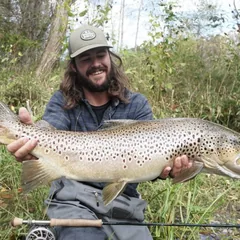
- The vineyard private water. Bowman's marquee Etowah beat holds the highest density of holdover browns — the larger, wilder fish that survive year to year and reach the 14-18 inch range, with the occasional 20-incher. Limited pressure means fall fish there are far less educated than on public water. This is the water you book for a serious shot at a big fall brown.
- Public middle-river access (Dawson Forest WMA, Castleberry Bridge, Auraria Road). These stretches get stocked and hold trout into fall. They see less pressure on weekdays once summer ends. Fish the water above the bridges, which fishes better than below.
- The upper headwaters and feeder creeks. The wild rainbow and brook trout water above Dahlonega fishes well all fall and is gorgeous when the leaves turn. Small dries and a short rod are all you need.
If a big brown is the goal, the private vineyard water is the highest-percentage choice — fewer rotations, bigger fish, and a guide who knows exactly which runs the staging browns are using week to week. The same fall streamer logic plays out on the Soque, where the fall streamer bite produces the river's giant browns, if you want to compare the two trophy fisheries.
Fall gear adjustments for the Etowah
The Etowah's small-stream gear setup carries into fall with a few seasonal tweaks. Your spring rod and line still work — what changes is your tippet, your leader length, and the streamer kit you carry.
- Rod: A 7'6" to 8'6" rod in 3 or 4 weight for dries and nymphs. Step up to a 9-foot 5 or 6 weight if you're committing to streamers all day — it turns the heavier flies over and fights bigger fish.
- Leader and tippet: Go longer and lighter for low fall water. A 9-foot leader to 5X for nymphs and dries, dropping to 6X on bright, low days. Bump up to 3X or 4X for streamers.
- Line: A weight-forward floating line covers most fall fishing. A short sink-tip or a sinking poly-leader helps get streamers down in the deeper runs without changing rods.
- Streamer box: Woolly Buggers and sculpin patterns (4-8) in black, olive, and brown. A few articulated patterns for the deepest runs.
- Layers: Fall mornings start in the 30s and 40s and warm into the 60s. Dress in layers, bring a packable rain jacket for the BWO drizzle, and add fingerless gloves for cold November starts.
- Wading: Felt or studded soles — the Etowah's rocks are slick and the low fall flows expose more of them. A wading staff helps in the colder water where a slip is more consequential.
The single most useful fall addition is a stream thermometer. Knowing the water temperature tells you whether to lead with streamers, dries, or deep nymphs on any given morning — and on a river that swings several degrees between sunrise and mid-afternoon, that read changes how you fish the day.
A worked fall day on the Etowah
Here is how a strong late-October day actually unfolds on the vineyard water, so you can picture the rhythm of a fall trip:
- 8:00 AM — Cold start, slow water. Air is 42°F, water reads 51°F. Too cold for surface action, so you start deep: a Pheasant Tail and a small midge under an indicator through the slower pool heads. A couple of stocked rainbows and one chunky 15-inch holdover come to the net in the first hour.
- 10:30 AM — Water warms, switch to streamers. Water has crept to 55°F. You tie on a size-6 olive sculpin, cast tight to an undercut bank, and strip it away with sharp pulls. Two browns chase; the second commits on the pause and turns out to be a 17-inch buck colored up for the spawn. Strip set, not a rod lift.
- 1:00 PM — Clouds roll in, BWOs pop. A gray front drops the light and a sparse blue-winged olive hatch starts on a long flat. You switch to a size-20 BWO, lengthen to 6X, and pick three fish off noses sipping in the soft tailout.
- 3:30 PM — Last push, big-fish window. Back to the streamer for the deeper runs as the afternoon light fades, working the pool heads where browns stage. One more solid brown before you walk out.
That arc — nymph deep early, streamer the mid-day warmup, dries on the afternoon front, streamer again at last light — is the template for a fall Etowah day. Adjust the timing to the day's temperature curve and you'll be fishing the right tactic at the right hour.
Frequently Asked Questions
When does fall fishing start on the Etowah River?
Fall fishing on the Etowah turns on when water temperatures drop back into the 50s, which usually happens in late September after the first cold nights. A warm September can delay good fishing into October; an early cold snap can start it in mid-September. Watch overnight lows and water temperature rather than the calendar. Peak fall fishing typically runs from the first week of October through mid-November.
What's the best fall tactic on the Etowah?
Streamer fishing for pre-spawn brown trout is the best fall tactic. As browns stage for their late-fall spawn, they get aggressive and territorial — a downsized streamer (size 4-8) stripped tight to banks and wood draws hard strikes. Vary the retrieve, set with a strip set, and fish low-light windows. On cloudy afternoons, blue-winged olive and October caddis dry-fly fishing is the backup plan.
What flies should I use on the Etowah in the fall?
Carry Woolly Buggers and sculpin patterns (size 4-8) for streamers, blue-winged olives (size 18-22) and an orange October caddis (size 8-10) for dries, and Pheasant Tail and Hare's Ear nymphs (size 14-18) for searching. Add midges (size 20-24) for cold late-fall days and egg patterns near stocked fish. Black, olive, and brown are the streamer colors that produce.
Is the Etowah good for brown trout in the fall?
Yes — fall is the best brown trout season on the Etowah. Browns spawn in North Georgia from late October into early December, and in the weeks before, mature browns feed aggressively to build energy and defend territory. The private vineyard water holds the highest density of larger holdover browns. Fish staging browns in the deeper runs, and never cast to fish on visible spawning redds.
What water level is best for fall fishing on the Etowah?
Target 140 to 400 cfs on the USGS gauge at GA 9 near Dawsonville (Bowman's good range; 200 to 340 is prime). Below 140 cfs the river runs low and clear, demanding long leaders, fine tippet, and a stealthy approach. The best scenario is a small bump of color from an overnight rain on a falling, clearing gauge — lightly stained water makes browns bold.
Do I need different gear for fall fishing the Etowah?
Mostly the same small-stream setup with seasonal tweaks. Keep your 7'6"-8'6" 3-4 weight for dries and nymphs, but add a 5-6 weight if you're streamer fishing all day. Go longer and lighter on leaders for low water (9 feet to 5X, 6X on bright days), carry a sink-tip for deep streamers, and dress in layers for cold mornings that warm into the afternoon. A stream thermometer is the most useful fall addition.
Is the upper Etowah worth fishing in the fall?
Yes. The wild rainbow and brook trout water in the headwaters above Dahlonega fishes well all fall and is at its most scenic when the leaves turn. These fish are small — wild rainbows run 7-11 inches — but willing, and a short rod with a few small dries is all the gear you need. The upper river also stays cold and fishable on warmer early-fall days when the middle river is marginal.
Can I book a guided fall Etowah trip?
Yes. Bowman runs guided fall trips on the private vineyard water, where the larger holdover browns live and pressure is limited. A guide handles the fall logistics — reading the daily temperature window, picking the right tactic by the hour, and knowing which runs the staging browns are using that week. Use the trip finder to book, or reserve a date directly for the fall window.
Fish the Etowah this fall
Cool water, aggressive browns, and the year's prettiest river — book a guided fall day on private vineyard water.
Etowah River private water trip, from $400 · 4.9 stars on Google
See the trip or See Fall Private Water Trips →