Trip Types
How to Catch a 20-Inch Wild Brown Trout
 Daniel Bowman
Updated October 1, 2026
13 min read
Daniel Bowman
Updated October 1, 2026
13 min read

The short version
To catch a 20-inch wild brown trout, stack the odds: fish the October-November pre-spawn window or the low-light hours (dawn, dusk, overcast), on cold, food-rich water that actually grows big fish — in North Georgia that's the Soque, the Toccoa tailwater, and private leases, not pressured public stockers. Throw bigger flies (articulated streamers 3-5 inches, large stoneflies, crayfish), present them tight to cover with an injured-baitfish action, and strip-set hard on heavier tippet (1X-3X). A 20-inch brown is a different animal than a 12-inch stocker — it eats other fish, holds in specific lies, and feeds on its own schedule. Book a guided trophy trip on private water and a guide puts you on the right beat in the right window. That's the shortcut.
A 20-inch wild brown trout is the fish most North Georgia anglers chase for years. It's not a number you stumble into on a stocked stretch in the middle of a sunny afternoon. A brown that long has survived three or four years in the river, learned to feed when nobody's watching, and claimed the best lie in the run. Catching one is a deliberate act, not luck — and after more than 10 years guiding these rivers, I can tell you exactly what separates the anglers who land them from the ones who keep saying "next time."
This is the playbook. Follow the steps in order and your odds go from "lottery ticket" to "real possibility on the right day."
What makes a 20-inch brown trout so hard to catch?
A 20-inch brown is hard to catch because it didn't get big by being easy. To reach that length in a Southern river, a brown trout has to survive multiple years of high water, drought, herons, otters, and every fly that's drifted past it. The fish that make it become predators — they switch from eating bugs all day to eating other fish at specific times, they claim the most defensible lie in the run, and they shut down completely when the conditions are wrong.
Three things define a true trophy brown and explain why the standard "match the hatch and dead-drift a nymph" approach so rarely produces one:
- They're predators, not grazers. A 12-inch trout eats midges and mayflies all day. A 20-inch brown eats sculpins, smaller trout, crayfish, and the occasional mouse. Big meals, fewer times per day. You have to fish to the predator.
- They feed on their own schedule. Trophy browns are crepuscular and nocturnal — they do their serious hunting at dawn, dusk, after dark, and under heavy cloud cover. The middle of a bluebird day is their nap time.
- They own the best real estate. The biggest brown in a run holds in the spot with the most cover, the deepest water, and the best ambush angle. You have to put the fly into that exact lie, not just somewhere in the river.
Get those three things right and the rest of this guide is about execution.
When is the best time to catch a big brown trout?
The best time to catch a big brown trout is the pre-spawn window in October and November, with low-light hours (dawn, dusk, and overcast days) producing year-round. Browns spawn in late fall, and in the weeks beforehand they feed aggressively to pack on weight and stake out spawning territory. They lose some of their caution, they chase streamers, and the biggest fish of the year come to the net in this window.
Here's how the year breaks down for trophy browns in North Georgia:
| Window | Conditions | Why it produces | Best method |
|---|---|---|---|
| Oct–Nov (pre-spawn) | Cooling water, shorter days | Browns feed hard and turn aggressive before spawning | Big articulated streamers |
| Dec–Feb (winter) | Cold, low, clear | Low pressure; midday warm spells trigger feeds | Streamers on overcast days; deep nymphs |
| Mar–May (spring) | Warming, hatches building | Post-spawn recovery, then heavy bug activity | Streamers + large nymphs |
| Jun–Sep (summer) | Warm, low light at edges | Dawn/dusk feeding; midday shuts down | Early/late streamers, mouse patterns at night |
Within any of those windows, the single most reliable variable is light. Big browns hate bright sun. An overcast day in any month fishes like the magic hour all day long, and the first and last 90 minutes of daylight are worth more than the entire middle of the day. If you can only fish a few hours, fish the edges. The pre-spawn streamer bite for Toccoa trophy browns is the clearest example of this in our area — the same fish that ignore you in September will eat a six-inch fly in late October.
Where do you find water that grows 20-inch browns?
You find trophy browns in water that's cold, stable, food-rich, and deep enough to hold a big fish through low water — and that's a much shorter list than the rivers that simply hold trout. A stocked stretch full of 10-inch rainbows will almost never give up a 20-inch wild brown, because the conditions that grow a fish that large just aren't there.
What to look for:
- Cold, stable water year-round. Browns grow fastest in water that stays in the 50s and low 60s. Tailwaters hold those temperatures when freestone creeks warm up in summer.
- A rich food base. More sowbugs, scuds, crayfish, and baitfish means faster growth.
- Deep structure and cover. Undercut banks, log jams, boulder slots, and deep pools — a 20-inch fish won't live anywhere it can't hide. No cover, no big fish.
- Low fishing pressure. Fish that see a hundred anglers a week get educated and stop eating. Private and lightly-pressured water lets browns grow old and stay catchable.
In North Georgia, three waters check those boxes. The Soque River in Habersham County is the state's best-known trophy fishery; on Bowman's leases the average fish runs 18 inches or more (see why the Soque grows such big trout). The Toccoa tailwater below Blue Ridge Dam stays cold all year and grows browns that hold deep through summer. And the private leases we fish concentrate big fish on water that sees a handful of anglers a week instead of hundreds. If you're serious about a personal-best brown, private trophy water is the highest-percentage place to do it — that's the whole reason these beats exist.
What flies catch big brown trout?
Big brown trout eat big flies, so the single biggest adjustment most anglers need to make is to size up. A 20-inch predator isn't going to abandon its lie to chase a size-18 midge — it wants a meal worth the effort. The fly box for trophy browns looks different from a standard trout box.
The trophy brown arsenal:
- Articulated streamers (3–5 inches) in olive, brown, black, and white. These imitate sculpins, baitfish, and smaller trout — the bulk of a big brown's diet. Two hinged sections give the fly a swimming, injured action a single-hook fly can't match — the fly-tying guides on how articulated streamers swim break down why that jointed profile triggers predatory browns.
- Sculpin patterns (woolly buggers, sculpzillas, conehead muddlers) fished on or near the bottom — browns key on sculpins because they're a year-round, easy-to-ambush meal.
- Large stonefly nymphs (size 6–10, black and brown) — the biggest natural nymph in the river, dead-drifted deep through trophy lies on days they won't chase.
- Crayfish patterns — an underused big-meal option, especially in summer and on warmwater-influenced stretches.
- Mouse patterns for after-dark fishing — the ultimate big-meal calorie bomb when trophy browns hunt the surface at night.
If you're fishing a guided trip, the guide brings all of this and ties on the right one for the conditions — you don't need to build a trophy box yourself. If you're going on your own, carry streamers in two sizes and three colors, a few big stoneflies for the days they won't chase, and heavier tippet to turn them over.
How do you present a fly to a trophy brown?
You present to the lie, not to the river — meaning you put the fly tight to the specific piece of cover a big brown is holding under and make it look like wounded prey trying to escape. The cast that catches a 20-inch brown is precise, close to structure, and followed by an action that triggers the predator response. A streamer dragged down the middle of the run will catch small fish and spook the big one.
The presentation that works:
- Identify the lie before you cast. Look for the deepest, most-covered ambush spot — under a bank, beside a log jam, at the head or tail of a deep slot. That's where the big fish lives.
- Cast tight to the cover. Within inches of the bank or structure, not a foot off it. Big browns won't move far from cover in daylight. Accuracy beats distance.
- Give it injured-baitfish action. Strip, pause, strip-strip, pause. The pause is when most eats happen — a fleeing baitfish that suddenly stops looks vulnerable. Vary the cadence until you find what they want.
- Swing and dangle the seam. On a tailwater like the Toccoa, swinging a streamer through a deep seam and letting it hang at the end of the swing draws follows and eats from fish you never see.
- Cover water, then move on. Make a few good presentations to each lie. If the big fish doesn't react, it's either not home or not feeding — move to the next spot rather than flogging dead water.
The mechanics of working a streamer — strip cadence, depth control, the swing — are the heart of trophy fishing. Our full breakdown of how to strip a streamer walks through the retrieves step by step, and MidCurrent's library on streamer presentation for brown trout is worth reading before a serious trophy trip. Dial in the retrieve and you turn follows into eats.
How do you set the hook and land a 20-inch brown?
You land a trophy brown by setting hard with a strip-set, fishing tippet heavy enough to turn the fish, and steering it away from the cover it will instantly try to dive into. More 20-inch browns are lost in the first three seconds of the fight and at the net than are ever lost to a broken tippet mid-fight. The hook-set and the endgame are where trophies get away.
The rules that save fish:
- Strip-set on streamers, every time. When a brown eats a stripped fly, keep stripping hard and let the rod load — do not lift the rod tip like a trout-set. A trout-set pulls the fly out of the fish's mouth; the strip-set drives the hook home and keeps the fly in the strike zone if you miss. (Our guide on setting the hook covers the difference in detail.)
- Fish heavier tippet. 1X to 3X fluorocarbon for streamers. A 20-inch fish surging into a log jam will snap 5X instantly. The bigger fly hides the heavier tippet, so you're not sacrificing eats.
- Turn the fish immediately. The instant it's hooked, a big brown bolts for cover. Get its head turned and lead it to open water with side pressure before it reaches the structure.
- Don't rush the net. The last lunge at the net breaks off more trophies than anything else. Let the fish tire, lead it head-first over a big rubber net, and net it in one motion.
- Protect the fish. Wet hands, keep it in the water, a quick photo, and a full revival facing upstream. A wild 20-inch brown is a four-year investment in the river — it should swim away strong.
A worked example: a November Soque trophy morning
The clearest way to see the playbook in action is a real trophy morning, start to finish. Picture late November on a private Soque beat. Air temp 38 at first light, heavy overcast, water clear and at a stable winter flow. Every variable favors big browns: it's the tail of the pre-spawn window, the light is low and staying low, and the water is cold and stable.
We rig a 6-weight with a sink-tip and 2X fluorocarbon, tie on a four-inch olive-and-white articulated streamer, and start at the head of a deep pool where a log jam meets an undercut bank — textbook trophy real estate. The first cast lands two inches off the bank. Strip, strip, long pause. Nothing. Second cast, same line, slower cadence — on the pause, the water boils and the line comes tight. Strip-set, hard, and the rod buckles.
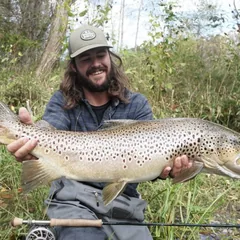
The fish does exactly what big browns do: it bolts straight for the log jam. We drop the rod tip to the side and put on hard left pressure, turning its head before it reaches the wood, and lead it out into the open pool. Two long runs, no panic, side pressure the whole way. When it tires, we lead it head-first over the net in a single scoop. Twenty-one inches of wild Soque brown, hook-jawed and dark. Wet hands, one photo, full revival, gone.
Nothing about that morning was lucky. The window was right, the water was right, the fly was right, the cast was tight to cover, the set was a strip-set, the tippet held, and the fish never reached the structure. That's the whole playbook in five minutes — and it's exactly the trip a guide is built to set up for you.
Should you book a guide for your first trophy brown?
For your first serious shot at a 20-inch wild brown, a guided trip on private water is the highest-percentage path, by a wide margin. Everything in this playbook — reading the lie, the streamer cadence, the heavy-tippet hook-set, turning a fish out of cover — is learnable, but learning it on your own on pressured public water can take seasons. A guide compresses that timeline into a single day.
What a guide actually does for trophy fishing:
- Puts you on the right beat in the right window. Access to private water that concentrates big browns, fished at the time of year and time of day they're feeding.
- Reads the water for you. Twenty years of knowing which lie on which run holds the big fish, and which days they'll chase.
- Rigs it correctly. The right streamer, the right sink rate, the right tippet — dialed for that morning's conditions, not a generic setup.
- Coaches the moment. The strip-set, the fight, the net — a guide talks you through the three seconds that decide whether you land it.
If your goal is a personal-best brown rather than a high fish count, this is the trip to book. Use the trip finder to start, or go straight to private trophy water for the beats that hold the biggest fish. A 20-inch wild brown is absolutely catchable in North Georgia — you just have to do everything right at the same time, and that's what a guide is for.
Frequently Asked Questions
How do you catch big brown trout on the fly?
You catch big brown trout by fishing the right window (pre-spawn fall and low-light hours), on cold, food-rich water that grows large fish, with bigger flies (articulated streamers, large stoneflies, crayfish) presented tight to cover and worked like injured prey, then setting hard with a strip-set on heavy tippet. Big browns are predators that feed on their own schedule, so you fish to the predator rather than dead-drifting small bugs and hoping.
What is the best time of year to catch a 20-inch brown trout?
October and November — the pre-spawn window — is the best time of year. Browns feed aggressively and turn less cautious as they fatten up and stake out spawning territory before their late-fall spawn, and the biggest fish of the year come to streamers in this window. Year-round, the low-light hours (dawn, dusk, and overcast days) produce far better than bright midday.
What size fly do you use for trophy brown trout?
Size up to 3–5 inch articulated streamers in olive, brown, black, and white for the big-meal feeders, plus size 6–10 large stonefly nymphs for days they won't chase and crayfish or mouse patterns as situational big meals. A 20-inch brown eats other fish, so it wants a meal worth leaving its lie for — small midges and mayflies rarely move a true trophy.
Where can you catch a 20-inch brown trout in North Georgia?
The Soque River in Habersham County is North Georgia's premier trophy brown fishery, where Bowman's fish average 18 inches or better, with trout up to 28 inches, followed by the Toccoa tailwater below Blue Ridge Dam and the private leases that concentrate big fish on lightly-pressured water. Public stocked stretches almost never produce a 20-inch wild brown because they lack the cold, stable, food-rich, low-pressure conditions that grow a fish that large.
What tippet should you use for big brown trout?
Use 1X to 3X fluorocarbon when streamer fishing for trophy browns. A 20-inch fish surging into a log jam or undercut bank will snap light tippet instantly, and the larger streamer profile hides the heavier line, so you're not sacrificing eats by sizing up. Light tippet is the most common reason a hooked trophy gets away.
How do you set the hook on a brown trout eating a streamer?
Use a strip-set: when the brown eats, keep stripping hard and let the rod load rather than lifting the rod tip. A lifted rod-tip set pulls the fly out of the fish's mouth, while the strip-set drives the hook home and keeps the fly in the strike zone if you miss the eat. The strip-set is the single most important habit for landing streamer-eating browns.
Are wild brown trout harder to catch than stocked ones?
Yes — wild and holdover browns are considerably harder than freshly stocked fish. A wild 20-inch brown has survived years of pressure, learned to feed in low light, and claimed the best-defended lie in the run, so it eats selectively and shuts down in bright conditions. Stocked rainbows feed throughout the day and aren't lie-bound, which is why a high-volume stocked day and a trophy-brown day are completely different pursuits.
Should I bring my own gear for a guided trophy brown trip?
No — on a guided trip the gear is included. The guide supplies the rods, reels, streamers, leaders, and heavy tippet matched to the day's conditions, so you don't need to build a trophy streamer box or own a sink-tip line. Bring polarized sunglasses, layers for low-light cold mornings, and a valid fishing license; the guide handles everything technical. Confirm exact inclusions at booking.
Want a real shot at a 20-inch brown?
Book a guided trophy trip on private North Georgia water — wild and holdover browns, the right beat, the right window.
Private water trophy trout trip, from $400 · 4.9 stars on Google
See the trip or See Trophy Water Trips →