Trip Types
Trophy Trout Fly Fishing in Georgia: Where & How
 Daniel Bowman
Updated October 2, 2026
14 min read
Daniel Bowman
Updated October 2, 2026
14 min read

The short version
A trophy trout in Georgia means a wild or holdover brown trout over 20 inches, and they come from a short list of waters: the Soque River (the state's most consistent producer of 24–28 inch browns), the Toccoa tailwater (22–26 inch wild browns on streamers in fall), Noontootla Creek (a wild 20-incher is the fish of the year), and private leases like Bowman's Etowah water, where trophy rainbows and browns reach 28 inches. The fish are real but they are not accidents — they live in cold, food-rich water, and catching one takes a deliberate plan around water, season, and presentation. The two highest-percentage shots in Georgia are sight-fishing the Soque's private beats in spring or stripping streamers for pre-spawn browns in late October through mid-November. Match the right water to your target and a 20-inch Georgia trout stops being luck and starts being a fishable goal.
What counts as a trophy trout in Georgia?
In Georgia, a trophy trout is a brown trout over 20 inches — and on most waters, that is a genuinely big fish. Georgia is not Montana. The state sits at the warm southern edge of trout range, so the bar for "trophy" is calibrated to what the water can actually grow, not to a 30-inch Western standard.
Three rough tiers help set expectations before you book:
- Quality fish (16–19 inches). A good day's reward on most North Georgia water. Caught regularly on the Soque, the Toccoa, and the better Etowah and Noontootla runs.
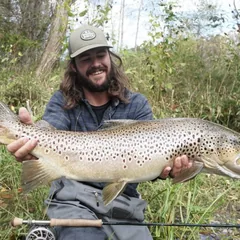
- Trophy fish (20–24 inches). A real accomplishment. Produced consistently only on the Soque's private beats and the Toccoa in the fall streamer window, plus private leases like Bowman's Etowah water.
- Giant fish (25 inches and up). A handful come out of Georgia each year. Almost all are wild and holdover browns from the Soque's premium beats or from private leased water managed specifically to grow them.
Rainbows complicate the math. Stocked rainbows rarely exceed 14–16 inches in public water, but a few private beats hold rainbows that have grown for years on a heavy food base and push 22 inches. The wild fish that earn the trophy reputation, though, are almost always browns — they live longer, eat bigger prey, and turn a rich food base into length and shoulder.
Why does Georgia grow trophy trout at all?
Georgia grows trophy trout in the narrow band of water that stays cold and food-rich year-round despite a Southern climate. Trout need water below roughly 68 degrees to thrive, and most Georgia rivers blow past that in summer. The waters that produce big fish all solve the temperature problem in one of two ways, and the best ones also solve the food problem.
Two kinds of water stand out:
- Private, catch-and-release water. The Soque is a freestone that warms in summer, so Bowman fishes it only from September 20 to June 10. Its big fish come from access, not chemistry: most of the river is private, every fish on Bowman's leases is released, and few anglers fish it, which Bowman credits for fish much larger than public streams grow.
- Bottom-release tailwaters. The Toccoa exits the bottom of Blue Ridge Lake through the Blue Ridge Dam, so the water leaving the dam stays in the low 50s in summer regardless of air temperature. That creates 13-plus miles of cold trout habitat in a stretch that would otherwise be too warm by June.
Size comes from time and food. A trout in cold, clean water feeds and grows for more of the year, and a river full of bugs gives it plenty to eat. The third piece is being left alone: a fish that is released every time and rarely sees an angler gets years to keep growing. Few Southeast rivers offer all three, which is why Georgia's short list of trophy waters is so short.
Where are the trophy trout in Georgia? A water-by-water breakdown
The trophy fish concentrate on four waters plus private leased beats, and each one produces a different kind of big fish. Use this table to match your target to the right river before you read the detail underneath it.
| Water | Trophy fish | Realistic shot at 20"+ | How you catch them | Best window |
|---|---|---|---|---|
| Soque River (private beats) | Wild & holdover browns to 28"+ | Highest in Georgia | Sight-fishing nymphs, clean drifts | April–June, Oct–Nov |
| Toccoa tailwater | Wild browns 22–26" | Moderate, fall only | Stripped streamers, low light | Oct–mid Nov |
| Noontootla Creek | Wild browns to 20" | Low (fish of the year) | Small-stream dries & streamers | April–June, Oct–Nov |
| Etowah (vineyard water) | Trophy rainbows and browns to 28" | High | Pocket-water nymphing | Spring and fall |
The Soque River — Georgia's best trophy water
The Soque River in Habersham County is Georgia's best-known trophy water. Bowman puts the typical fish on its leased Soque beats at 18 inches or more. Bowman lists trout up to 28 inches.
Why there? Most of the river is private, because Georgia lets a landowner own the bed of a stream that isn't navigable. Bowman leases more than 4 miles across 7 properties, every fish on that water is released, and fishing pressure is kept low. Give a trout years of feeding without being kept, and it has time to grow. For the full picture on this fishery, the complete Soque River guide covers access, hatch timing, and trip tiers, and the dedicated piece on Soque trophy brown trout goes deeper on the fish themselves.
The Toccoa tailwater — the fall streamer brown
The Toccoa produces several 22–26 inch wild brown trout each year, and they come on streamers in a tight fall window. These are not stocked fish. They are wild browns that live in the deepest runs and behind the largest boulders, and they come out for big patterns in low light, particularly in pre-spawn aggression from late October into early December.
A trophy Toccoa brown is a multi-trip pursuit for most anglers, which is exactly why the fall streamer trip is the right way to chase one — it concentrates your effort in the highest-percentage window. The deep dive on trophy browns on the Toccoa breaks down the runs, the retrieves, and the timing.
Noontootla Creek — the wild trophy
Noontootla is the wild-trout purist's trophy. The brown trout there reproduce naturally; the special-regulations stretch is never stocked. Most fish run 7–13 inches, quality wild fish run 14–18 inches, and a genuine 20-inch wild brown is the trophy of the year for most anglers — a few are caught annually. A 20-incher that grew up in a 15-foot-wide mountain creek under hemlock and rhododendron is, fish-for-fish, the hardest trophy on this list to earn.
Private trophy leases — the managed giants
The fish that pull people up from Atlanta and Florida specifically to break a personal best almost always come off private leased water. These beats are managed to grow trout to true giant size: low angler rotation, heavy food base, and stock that holds over for years. The most-direct path to a private water trophy trout is booking a guide who holds access to one of these beats, because the water and the trip fee come bundled and you skip the years it takes to build a private lease relationship yourself.
How do you actually catch a trophy Georgia trout?
You catch a trophy Georgia trout by matching one of two proven games to the season — sight-fishing in spring or streamer-stripping in fall — and executing the fundamentals more carefully than the average angler does. Big trout did not get big by eating sloppy presentations. Here is the playbook that produces them.
The spring sight-fishing game
From April to early June the Soque's clear water lets you spot fish, read their behavior, and feed them a precise drift. This is the single highest-percentage trophy tactic in Georgia because you are casting at a specific known fish rather than fishing water blind.
Big fish in clear water see you first, so keep low, move slowly and wade only when the angle demands it. Find the fish with polarized sunglasses before you cast, and watch it long enough to see where it faces and whether it is feeding. Then put the fly far enough upstream that it drifts down to the fish with no drag and without the line ever crossing it. When it takes, and you will often see it take, lift smoothly; a hard swing snaps light tippet. The step-by-step version, with leader setups, is in sight fishing the Soque.
The fall streamer game
From late October through mid-November, pre-spawn browns on the Toccoa, the Soque, and Noontootla turn aggressive and territorial. This is the time to put down the nymph rig and throw meat. MidCurrent's streamer tactics archive is a deep well of presentation theory, but the Georgia version comes down to a handful of moves:
- Articulated streamers in olive, brown, or black, 4–6 inches, with a sculpin profile.
- Sink-tip line to get the fly down fast in deep runs.
- Stripped retrieves with pauses — fast, faster, pause, jerk — to trigger a territorial strike rather than a feeding one.
- Low-light windows. First light (roughly 5:30–7:30 AM) and last light produce far better than midday.
- Hit the structure. The biggest browns hold behind the largest boulders and in the deepest slots. Cover the obvious holding water methodically and be ready for the eat on the pause.
The gear that doesn't lose the fish
A trophy hooked is not a trophy landed. The losses almost always come from light tackle and a rushed fight. Step up to a 5- or 6-weight rod for streamer work, fish fluorocarbon tippet no lighter than the presentation requires, check your knots, and let the fish run on a smooth drag instead of horsing it. If you tend to default to the same fine tippet for everything, Simms's guide to matching tippet to the fish walks through sizing up for the bigger, harder-pulling browns these waters hold. More giant Georgia browns are lost at the net than are ever refused at the fly.
When is the best time for trophy trout in Georgia?
The two trophy seasons are spring (April–June) and fall (late October through mid-November), and they reward different tactics. Picking the right window for your target is the highest-leverage decision you make before the trip.
- Spring (April–June). Peak sight-fishing on the Soque. Dense hatches, cool but not cold water, and visible feeding fish in shallow water. May is the single most reliable month for active trophy fishing in the state.
- Fall (late October–mid November). The streamer trophy window. Pre-spawn browns on the Toccoa, Soque, and Noontootla get aggressive on big patterns. Big browns are on the move, and Bowman counts fall as one of the Soque's two peak seasons. This is the window to target a personal-best Toccoa brown.
- Winter (December–March). Technical, low-pressure, midge-and-streamer fishing. Fewer but sometimes larger fish, and you will often have the water to yourself. A warm overcast winter day can produce a sleeper giant on streamers.
- Summer (July–August). Tougher in the heat of the day, but the cold Toccoa tailwater still fishes, best early and late. The Soque is rested from June 10 to September 20. Terrestrials and low-light streamer windows are the play. Skip midday on the smaller, warmer creeks.
If you get one trophy trip a year, take it in May for sight-fishing or late October for streamers. If you get two, hit both windows — they target different fish in different ways, and doing both is the fastest way to put a 20-incher in the net.
A worked example: planning a single trophy day
Say you have one day, you have fished a few times, and your goal is your first 20-inch Georgia brown. Here is how the decision tree plays out.
If your day falls in May, book a private-water Soque trip and plan to sight-fish. You will move slowly, the guide will spot fish before you do, and your job is to land a clean drag-free drift on a fish you can see. Every fish is a candidate for the wall.
If your day falls in late October or early November, book a Toccoa or Soque streamer trip and plan to throw big flies in low light. You will cover water, strip streamers through the deep runs, and accept long stretches of nothing in exchange for the chance at one violent pre-spawn eat. This is a lower-numbers, higher-ceiling day.
If your day falls in midsummer or midwinter, plan around the calendar. In midsummer, book a Toccoa float, because Bowman rests its private water from mid-June to September 20. In midwinter, the private water is open, and Bowman says winter can bring some of the largest fish of the year.
In all three cases the limiting factor is access to the water that holds the fish — which is why the trophy game in Georgia runs through private beats and the guides who hold them.
Why does trophy trout fishing in Georgia run through private water?
Trophy trout fishing in Georgia runs through private water because the conditions that grow giant trout — cold, food-rich flow and low fishing pressure — exist almost entirely on leased and privately managed beats. The state's public water gets fished hard, stocked rainbows get harvested before they can grow, and the few wild trophies in public rivers are scattered and well-educated.
Private beats flip every one of those variables:
- Low rotation. A leased beat sees a few guided clients per week, not hundreds. The fish stay catchable instead of getting hammered into refusal.
- Managed stock. Some beats stock fish specifically to hold over and grow, and protect them from harvest so they reach trophy size.
- Habitat investment. Private owners and guides keep the water cold, the banks intact, and the food base healthy.
The practical consequence: the fastest path to a Georgia trophy is to book a guide who holds access to the right beat. The trip fee bundles the water and the local knowledge, and you skip the multi-year process of building a private lease relationship on your own. For most anglers chasing a 20-incher, private trophy water is not a luxury upgrade — it is the only realistic path.
Common mistakes that cost anglers trophy trout
Most trophy days get blown on fundamentals, not bad luck. These are the patterns that cost experienced anglers the fish of the trip.
- Fishing the wrong season for the tactic. Throwing streamers in May or sight-fishing in a fall high-water event wastes the day. Match the water and tactic to the window.
- Sloppy approach. A trophy brown that sees you before it sees the fly is a trophy brown you will not catch. Slow down, stay low, fish from below.
- Drag. The number-one reason a big fish refuses a good fly. Mend, lead the fly, and accept a short clean drift over a long dragging one.
- Tippet too light for the fish. Hooking a 24-inch brown on 6X and trying to muscle it in ends one way. Match tippet to the fish, not just the fly.
- Beating one spot to death. Three or four good presentations, then move. A run that has refused you has been educated.
- Skipping the guide on unfamiliar trophy water. The trophy beats are knowledge-driven — where the fish hold, how to approach them, which fly on which day. A guide for the first trip on new trophy water pays for itself in fish landed.
How does Georgia compare to nearby trophy fisheries?
Georgia's trophy fishing holds its own against the wider Southeast, with the Soque as the standout. The state's neighbors offer different strengths, and a serious trophy angler should know the trade-offs.
- vs. North Carolina (Tuckasegee, delayed-harvest water). The Tuck is a numbers-and-float fishery — 15–40 trout on a strong delayed-harvest day, most 10–14 inches, with the occasional 18-inch holdover. It is a better high-volume day than a trophy day; Georgia's Soque produces bigger average fish.
- vs. Tennessee tailwaters. Tennessee's larger tailwaters grow some genuine giants, but they are big, technical, generation-driven systems. The Soque's private beats give a more intimate, higher-percentage shot at a 24-inch brown.
- vs. the rest of Georgia. Within the state, the best trout fishing in Georgia for sheer trophy potential begins and ends with the Soque's private water and the Toccoa's fall streamer game. Everything else is quality water, not trophy water.
The honest summary: for a Southeastern angler who wants the best realistic shot at a 24-inch-plus brown without flying west, the Soque is the destination, and the fall Toccoa streamer trip is the best secondary option.
Frequently Asked Questions
What is the biggest trout caught in Georgia?
On Bowman's Soque water the average fish is 18 inches or better, and Bowman lists trout up to 28 inches. These are fish that have lived for years in catch-and-release water. Public-water trophies exist but are far rarer and smaller on average.
Where is the best place to catch a trophy trout in Georgia?
The Soque River's private beats, by a wide margin. Bowman's Soque fish average better than 18 inches, with browns to 27 inches and up. The Toccoa tailwater is the best secondary option; Bowman lists browns up to 26 inches, and fall streamers are the usual way to find them. Both are best fished with a guide who holds private or local access.
Do I need a guide to catch a trophy trout in Georgia?
Functionally, yes, for most anglers. The water that holds Georgia's trophy trout is almost entirely private or knowledge-driven. A guide bundles private water access with the local knowledge of where the fish hold and how to approach them. You can chase wild trophies on public water like Noontootla without a guide, but your odds on a single trip are much lower.
When is the best time of year for trophy trout in Georgia?
Two windows. April to early June for sight-fishing the Soque's clear private water, with May the most reliable month (Bowman typically doesn't fish the Soque from June 10 to September 20). Late October through mid-November for streamer fishing to pre-spawn browns on the Toccoa and Soque. On the Soque, Bowman also notes that winter, December to February, often brings some of the largest fish of the year. Winter produces sleeper giants on streamers for committed anglers.
What flies catch trophy trout in Georgia?
In spring, technical nymphs fished drag-free — sowbugs (size 14–18), midges (18–20), and pheasant tails (16–18) on the Soque. In fall, articulated streamers 4–6 inches in olive, brown, and black, fished on a sink-tip with stripped-and-paused retrieves. On guided trips the guide supplies the right flies for current conditions, so you do not need to build a trophy box yourself.
How big does a trout have to be to count as a trophy in Georgia?
A brown trout over 20 inches is the working trophy threshold in Georgia. Given the state's warm southern latitude, a 20-inch brown is a genuinely big fish here. Fish in the 24-inch-plus range are the giants — a handful come out of the state each year, almost all from the Soque's premium beats or managed private leases.
Can I catch a trophy trout on public water in Georgia?
Occasionally, but it is far harder than on private water. Public rivers get heavy pressure, stocked rainbows are harvested before they grow, and wild trophies are scattered. Noontootla Creek is the best public-water shot at a genuine wild trophy, but a 20-inch wild brown there is the fish of the year, not a daily expectation.
How much does a trophy trout trip in Georgia cost?
Standard Soque private water runs $400 (1 angler) to $675 (3 anglers) for a half day and $550 to $900 for a full day. The premium Dragonfly trophy beat is $520 (1 angler) to $920 (3 anglers) for a half day. A Toccoa float for one or two anglers is $425 half-day and $575 full-day. Rates can change, so confirm current pricing at booking.
Ready to hunt a personal-best Georgia trout?
Tell us your target — wild Soque browns, a Toccoa streamer brown, or a private-water giant — and we'll match you to the right water and guide.
Private water trophy trout trip, from $400 · 4.9 stars on Google
See the trip or See Trophy Water Trips →