Fly Fishing 101
How to Fight and Land a Big Trout on a Fly Rod
 Daniel Bowman
Updated November 4, 2026
11 min read

The short version
When a big trout eats, let it run. Take your hand off the reel handle and let the drag do the work. Once the run slows, keep the rod low and to the side, pulling with the thick lower part of the rod, and steer the fish's head away from snags. Bring it close on a short line, never lift it with the rod tip, and lead it head first into the net while it's still in the water. Then keep it wet. Trout Unlimited's guidance is to keep air time to 15 to 20 seconds, and the shorter the fight, the better the fish recovers.
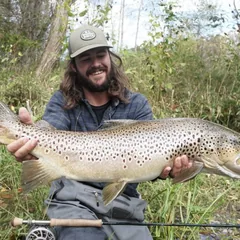
Hooking a big trout is the part people picture. Landing it is the part they don't. On a stream full of 17- and 18-inch fish, the first good hookup tends to surprise people: the rod bends to the handle, line leaves the reel, and for a few seconds the fish is in charge.
That's normal. This guide walks through the fight in the order it happens, from the take to the release, so you know what to do with your hands at each step. It's written for a first-timer or someone who hasn't fished for trout this size before. If you'd like to try it on water built for big fish, our private water trips are where we'd send you.
How big are the trout on Georgia private water?
Bigger than most people expect. On our private water, the trout run large:
| Water | Size |
|---|---|
| Our Etowah water | Average size "often being 17+ inches," with "fish two feet long or bigger often ending up in the net" |
| Our Soque water | "Rainbows average around 17-18 inches with some much larger," and browns up to 27 inches or more |
The difference comes from how the water is managed. On our private trophy water, the trout see fewer flies, are never harvested, and grow significantly bigger. The Soque in particular is a good place for learning to play large trout.
A fish that size pulls differently. You can't just reel it in. It will run, and then you steer it in and end the fight.
What happens in the first few seconds after a big trout eats?
It runs. A big trout that feels the hook usually bolts for deeper water or the far bank. Your job in those first seconds is to stay connected without breaking it off.
What to do:
- Set the hook, then stop. Once the fish is on, don't keep yanking. Our guide to setting the hook covers that part.
- Let go of the reel handle. Fly Fisherman magazine's tips on fighting trout say to "keep your hand off the reel handle" when a fish runs.
- Get the fish on the reel. If loose line is lying at your feet or in the water when the fish runs, let it slide out through the fingers of your rod hand, keeping light tension, until the fish is pulling straight off the reel. When the fish stops running, reel up any slack so the line stays tight.
- Let the drag work. The reel's drag gives line at a steady pull. The magazine puts it simply: "Most often it's best to let the reel do the job it was designed for."
- Keep the rod bent. A bent rod acts like a shock absorber. A straight rod pointed at the fish puts all the pull on the knot.
If a fish breaks off on that first run, it's not a disaster. Your guide provides the flies and tippet, so you'll be re-rigged and casting again.
Where should the rod be during the fight?
Low and to the side works well once the first run slows, and your guide will coach the angle on the water.
The idea is to pull the fish sideways, not up. Fly Fisherman's tips say "another great angle is low side pressure, as this controls the head of the fish," and "don't lift with the tip of the rod, pull with the butt section." The butt section is the thick lower third of the rod, near your hand. It has the strength. The thin tip is for casting and protecting light tippet, not for hauling.
A few cues that help:
- Turn the head, and the body follows. If the fish swims left, pull right, low to the water.
- Switch sides when it turns. The same magazine calls this "Switch Angles." Each time the fish changes direction, change yours.
- Use your whole body. An Orvis lesson on big fish in small streams shows the angler keeping "her rod at a horizontal angle" and using "her entire body to fight the fish, moving quickly along the bank when needed."
- Watch where the fish wants to go. If it heads for a log or an undercut bank, pull the other way, low and steady.
How hard should you pull on a big trout?
Hard enough to end the fight, gentle enough not to break the tippet. That balance is why guides think about tippet strength before you ever cast.
Tippet is the thin last section of line the fly is tied to. Heavier tippet lands fish faster. Orvis's tippet chart lists approximate breaking strengths by size, from about 1.75 pounds for very fine 8X up to 15.5 pounds for 0X. Orvis also gives the reasoning: smart anglers "go to a heavier (stronger) tippet than they would normally use," which allows "them to play fish quicker instead of playing them to exhaustion."
You don't have to choose any of that on a guided trip. Your guide will provide all flies, leaders, and tippet. Our guide to leaders and tippet explains the sizing system if you're curious.
For you, the rule of thumb is simple. Keep steady pressure the whole time. A fish that gets to rest in slack line gets its strength back.
Why does a short fight matter for the fish?
Because a long fight is hard on a trout, and harder on a big one. Trout Unlimited's 2014 summary of fish stress research says "angling duration and air exposure often have the largest influence on fish stress and can be controlled by anglers."
What the science in that summary shows:
- Stress starts early. In a rainbow trout study cited by TU, cortisol, a blood marker of stress, "began to increase beyond base levels after 2 to 3 minutes of a fish being angled and handled for hook removal," and kept rising out to six minutes.
- A quick fight is easier on the fish. TU puts it plainly: "a fish that is retrieved immediately experiences much less stress than one that is played to exhaustion."
- Bigger fish have it harder. The same summary says the stress of being caught can "be greater for larger fish."
The National Park Service's catch and release page says the same in fewer words: "Land the fish as quickly as possible. A tired fish takes longer to recover." It also warns that "long struggles on light fishing gear can tire and stress fish unnecessarily."
No study we found sets a safe fight time in minutes. The direction is clear, though. Shorter is kinder, and that's another reason a heavier tippet makes sense.
What do you do when the fish gets close?
Shorten up and stay calm. Close to the net, control matters more than speed.
Things to do:
- Keep a short line. Fly Fisherman calls it "Keep a Short Leash." Less line out means more control.
- Keep the rod bent and to the side. The same low angle that worked in the middle still works here.
- Let the fish come to the net. The net goes under the fish, not over it. Fly Fisherman's tip: "Always try to net the trout headfirst and when it's near the surface."
Things not to do:
- Don't lift the fish with the rod tip. Fly Fisherman's tip again: pull with the butt section, not the tip.
- Don't grab the line or leader. A big fish that kicks at the last second will break it.
- Don't lunge. Swiping at a fish with a net usually spooks it into one more run.
If the fish makes one more run near the net, let it go, the same way you did at the start.
How should a big trout be netted?
Head first, in one move, while it's still in the water. The net goes in the water ahead of the fish, and the fish is led in head first.
The type of net matters too. The Park Service says "landing nets reduce handling time, reduce stress and the potential for injury," "especially for large fish that are difficult to manage." It recommends "large net frames with shallow nets made of rubber or small, soft, knotless mesh." TU's summary also lists "rubber nets void of knots that protect fish scales and mucous."
Virginia's wildlife agency says the same on its catch and release page: "A soft rubber net is preferable to knotted nylon nets," and "a large net will allow you to keep the fish wet while you prepare to remove the lure, fly, or hook."
Once it's in the net, the fish can rest in the water while the hook comes out.
How long can a big trout be out of the water for a photo?
As short a time as you can manage. TU's guidance is to "minimize air exposure (15-20 sec) by removing hooks with the fish in water and photographing fish quickly."
The best-known study on this is a 1992 lab experiment by Ferguson and Tufts on rainbow trout, summarized in TU's annotated bibliography. Fish that were exercised and then held in the air for 60 seconds showed more signs of stress and survived at a lower rate than fish that were only exercised. Two honest limits: the experiment used small groups of fish in a lab, and the bibliography notes "the authors cautioned, however, that their experiment was not designed to evaluate post-release survival."
So it doesn't tell you an exact number of seconds that's safe. It does show why the camera should be ready before the fish comes up.
The same bibliography summarizes a 2016 field study by Lamansky and Meyer that watched 280 trout anglers in Idaho and Oregon. Fights ran from 7 to 128 seconds, with an average of 53, and taking pictures added about 18 to 20 seconds of air time. The authors concluded that few of the trout they watched were out of the water long enough to cause harm. The habit is what keeps it that way.
A simple routine:
- Get the camera out first, while the fish rests in the net.
- Wet your hands. Virginia's agency says "never handle a fish with dry hands."
- Lift, shoot, lower. A few frames, then back into the water. Our guide to photographing a fish covers phone settings like focus lock and burst mode that cut those seconds down.
- Hold your breath as a timer. Maryland DNR's catch and release page suggests it: "try holding your own breath while you handle the fish."
- Never squeeze or touch the gills. The Park Service says "never hold a fish by the gills."
Our private water is catch and release, so every fish goes back. Our guide to trout survival after release covers the revival step in detail.
What are the common mistakes, and the fix for each?
Most of them come from instinct. Here's each one beside what the sources above say to do instead:
| The instinct | What to do instead | Where it comes from |
|---|---|---|
| Grab the reel handle when the fish runs | Hand off, let the drag give line | Fly Fisherman, "keep your hand off the reel handle" |
| Pull with the tip | Pull with the butt section | Fly Fisherman |
| Play the fish until it's worn out | Land it as quickly as you safely can | National Park Service, Trout Unlimited |
| Swing the fish onto the bank | Net it in the water | National Park Service |
| Hold it up for a long photo | Camera ready first, keep the photo quick and the fish back in the water as soon as you can | Trout Unlimited, Virginia DWR |
They're worth knowing before the fish is on, and your guide will help with the rest on the water.
What do you need to bring, and what's provided?
Very little. On our private water trips, we provide "all gear—rods, reels, flies, waders, boots," and full-day trips include lunch. You bring:
- Polarized sunglasses
- Sunscreen
- A Georgia fishing license with the trout license (trout stamp)
That's it. You don't need to own a rod, waders or a box of flies. Our rates page lists half and full days for one to three anglers.
Can a beginner land a big trout?
Yes. Our Etowah and Soque water is beginner friendly, and first-timers there land big fish as well as plenty of them. If you've never held a fly rod, we'll teach you.
That's why this article matters more than it seems. A beginner on big-fish water will probably hook a fish that pulls harder than anything they've felt. Knowing the steps ahead of time makes that moment fun instead of frantic.
Where to start depends on you:
- New to fly fishing: the Etowah or Soque, both open to all skill levels.
- A big-fish goal and a flexible date: the Dragonfly, our premium section on the upper Soque, with more big wild trout and a limited calendar.
- Wild fish on technical water: Noontootla, which we recommend for anglers with some fly fishing experience.
Our article on what to expect on a first trip covers the rest of the day.
Frequently Asked Questions
How long should it take to land a big trout?
As short as you safely can. Trout Unlimited cites a rainbow trout study where stress markers began rising after 2 to 3 minutes of being caught and handled. No study sets a safe time, but shorter is better.
Should I let a big trout run?
Yes. Take your hand off the reel handle and let the drag give line. Trying to stop a big fish's first run is the fastest way to break it off.
Where should I hold the rod when fighting a fish?
Low and to the side, once the first run slows. Pull with the thick lower part of the rod, not the tip, and change sides when the fish changes direction.
What kind of net is best for big trout?
A large net with a shallow rubber or soft, knotless bag. The National Park Service and Trout Unlimited both recommend them because they're easier on the fish.
How long can I keep a trout out of the water for a photo?
Keep it short. Trout Unlimited's guidance is 15 to 20 seconds, with the hook removed while the fish is still in the water.
Do I need my own gear for a private water trip?
No. Rods, reels, flies, waders and boots are provided. You bring sunglasses, sunscreen and a Georgia fishing license with the trout license.
Can beginners catch big trout on private water?
Yes. Our Etowah and Soque water is beginner friendly, and first-timers there catch big fish as well as plenty of them.
Hook a big one
On our Etowah and Soque water, the average fish is often 17 inches or more. Beginners welcome, all gear provided.
Private water trophy trout trip, from $400 · 4.9 stars on Google
See the trip or View Rates →