North Georgia Rivers
Noontootla Creek Wild Brown Trout: A Field Guide
 Daniel Bowman
Updated October 2, 2026
13 min read
Daniel Bowman
Updated October 2, 2026
13 min read

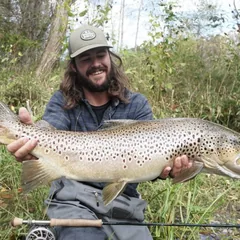
The wild brown trout of Noontootla Creek are the closest thing North Georgia has to a true wilderness trout — fish that hatched in the gravel, grew up dodging herons and otters, and have never seen a hatchery truck. This is a field guide to those fish: where they hold, how big they actually get, what they eat through the calendar, and how to put one in your net on the special-regulations water above the Toccoa.
The short version
Noontootla Creek holds a naturally reproducing population of wild brown trout in the Chattahoochee-Oconee National Forest in Fannin County, roughly 90 minutes north of Atlanta. Most fish run 7–13 inches; a quality fish is 14–18 inches; a genuine 20-inch wild brown is a once-a-season trophy. The marquee water is managed under special regulations — artificial lures only, with a 16-inch minimum. These fish hold on current seams in pocket water 8–25 feet wide, eat mayflies and caddis April–June, terrestrials all summer, and turn aggressive and territorial for streamers in October–November during the pre-spawn. Catch them with a short rod, a careful low approach, and a drag-free first cast. Bowman guides Noontootla as a half day from $450 or a full day from $600 for one angler ($780 for two).
What makes Noontootla's brown trout "wild"?
A wild brown trout is one that hatched from an egg in the stream — not one that came off a stocking truck. Noontootla's brown trout reproduce naturally in the creek's clean gravel, and while Bowman notes the occasional stocked fish turns up, the wild browns are the fishery. Every brown you catch there was born in that water or in one of its tributary feeders.
That distinction is not academic. It changes how the fish behave, where they live, and how you have to fish for them. A stocked brown raised in a concrete raceway has eaten pellets its whole life and will chase almost anything that moves for its first few weeks in a stream. A wild Noontootla brown has eaten tens of thousands of natural insects, survived multiple winters, and learned that a fly dragging unnaturally across the current is a threat, not a meal. Wild fish are spookier, pickier about drift, and far less forgiving of a sloppy cast — and they are also stronger, better-colored, and far more rewarding to catch.
Three things sustain the wild population:
- Cold, clean water. The creek drains high country on the Blue Ridge Wildlife Management Area in the Chattahoochee National Forest and stays cold enough to support trout year-round, with summer temperatures that rarely become lethal on the upper stretches.
- Spawning gravel. Browns need clean, oxygenated gravel to dig redds. Noontootla's freestone bottom provides it through the middle and upper creek.
- Protective regulations. A 16-inch minimum size on the regulated water means nearly every fish stays in the creek to grow and spawn rather than going home in a creel.
Wild rainbows share the lower regulated water, and native brook trout — Georgia's only native trout — hold in the highest tributary headwaters. But the brown is the headliner: it grows the biggest, fights the hardest, and defines the character of the fishery.
How big do Noontootla brown trout get?
Most Noontootla browns run 7 to 13 inches, with quality fish in the 14- to 18-inch range and a rare 20-inch trophy caught each year. This is small-stream wild-trout sizing, not tailwater sizing, and calibrating your expectations is the difference between a great day and a disappointing one.
Here is the realistic size distribution on a typical day of fishing:
| Size class | What it means | How often you'll see one |
|---|---|---|
| 5–7 inches | Young wild fish, 1–2 years old | Common — a healthy sign |
| 8–11 inches | The bread-and-butter Noontootla brown | The majority of your catch |
| 12–14 inches | A good fish anywhere in this creek | A few per strong day |
| 15–18 inches | A genuinely big wild brown | One is a great day |
| 19–20+ inches | Trophy of the year | A handful caught creek-wide annually |
If you are coming off the Soque or a stocked-trophy program and expecting 18-inch averages, the Noontootla will humble you. But a 16-inch brown that was born in the creek, holds in two feet of gin-clear pocket water, and ate your size-16 dry on a perfect drift is worth three stocked 20-inchers. The trophy here is measured in difficulty, not just inches — which is exactly why experienced anglers keep coming back. For sheer numbers of large browns, the Soque grows Georgia's biggest browns on private water; the Noontootla offers something the Soque cannot — a wild fish in wild surroundings.
Where do the brown trout hold?
Wild Noontootla browns hold on current seams and structure, almost never in the open middle of a pool. Learning to read these lies is the single most valuable skill on the creek, because the fish are not where most anglers cast.
The high-percentage water, in rough order of productivity:
- Current seams. The line where fast water meets slow water is the number-one lie. A brown sits in the slow water just off the seam, lets the current deliver food, and ducks back to cover when threatened. Fish the seam edge, not the fast tongue and not the dead water.
- Plunge-pool tailouts and heads. Where a small waterfall or steep run dumps into a pool, the oxygenated head and the smooth tailout both hold fish. The deepest middle of the pool is usually the least productive part.
- Undercut banks. Big browns love overhead cover. An undercut bank on the outside of a bend, especially under rhododendron, is a classic trophy lie.
- Boulder pockets. Behind and in front of mid-stream boulders are soft-water cushions where a fish can hold with minimal effort. These pockets, often the size of a bathtub, hold the eager fish.
- Log jams and root wads. Wood gives cover and collects drifting food. Approach carefully — these are snaggy but high-value.
Bigger fish claim the best lies. A 16-inch brown will own the prime seam in front of a midstream boulder and chase smaller fish off it. When you find a piece of water that looks too good — deep, shaded, structured, with a clean seam — slow down and fish it like the best fish in the creek is home, because it might be. For a full breakdown of the stalking sequence, see our guide on approach and technique on Noontootla.
What do Noontootla browns eat through the year?
Noontootla browns eat a classic Southern Appalachian freestone diet — mayflies and caddis in spring, terrestrials all summer, and other trout and sculpins when they turn predatory in fall. Matching the season is more important than carrying every fly pattern ever tied.
| Season | Primary forage | Go-to flies (sizes) |
|---|---|---|
| Feb–Mar | Black stoneflies, midges, early BWOs | Pheasant Tail, Zebra Midge (16–20) |
| April | Quill Gordons, Hendricksons, Blue Quills | Parachute Adams (12–18), early caddis |
| May | Sulphurs, March Browns, caddis | Sulphur dry/emerger (14–18), Elk Hair Caddis |
| June | Light Cahills, Yellow Sallies, terrestrials | Cahill (14–16), foam beetle, inchworm |
| Jul–Aug | Terrestrials: ants, beetles, inchworms | Foam beetle (14–16), ant (16–18), hopper |
| September | Tricos, returning caddis, smaller baitfish | Trico spinner, Elk Hair Caddis, small streamer |
| Oct–Nov | Sculpins, smaller trout, eggs | Wooly Bugger, Sculpzilla (4–8) |
| Dec–Jan | Midges, small mayflies | Zebra Midge, small Pheasant Tail (18–20) |
The hatch-matching detail that matters most: the hemlock and rhododendron canopy that shades the creek also feeds it. All summer long that canopy drops inchworms, beetles, ants, and small caterpillars onto the water, and the browns key on these terrestrials hard. A well-placed foam beetle tight to the bank in July will out-fish a perfectly matched mayfly nine times out of ten. For a month-by-month fly box built specifically for this creek, see our best flies for Noontootla by season.
In fall the diet shifts entirely. As water cools and days shorten, pre-spawn browns become territorial and predatory, hammering streamers that imitate sculpins and smaller trout. This is the window to fool the biggest fish in the creek — the ones too smart to chase a dry fly all summer.
How to catch a Noontootla brown: the field sequence
You catch a wild Noontootla brown by approaching low, casting first to the closest fish, and getting a drag-free drift on the first presentation. The mechanics below are the difference between a 4-fish day and a 14-fish day on this creek.
- Approach from downstream, stay low. Trout face into the current, so come up from below where they can't see you. Crouch. On the smaller upper runs, cast from one knee. Your silhouette against the sky spooks more fish than any other single mistake.
- Read the water before you cast. Stand back and find the seam, the soft pocket, the undercut bank. Pick your target lie and your drop point before a single false cast. The fish you're after has probably already clocked motion if you've moved carelessly.
- Fish the close water first. Anglers blow the near seam by casting past it to the far one. Work from your feet outward, nearest fish first, so a hooked or spooked fish doesn't blow up the rest of the run.
- Make the first cast count. A wild brown will frequently eat the first decent drift and ignore everything after. There is no warm-up cast here. The first presentation is the one that matters most — make it your best.
- Drift drag-free. Micro-drag the angler never notices is the number-one cause of refusals. Lead the fly with the rod tip, throw a soft reach mend, and accept short 3- to 8-foot drifts over long, dragging ones.
- Set on anything. Wild fish eat and reject fast in clear water. A subtle pause, a flash, a hesitation in your dry — set on it. You'll set on a lot of nothing; the takes you'd otherwise miss are worth it.
- Three drifts, then move. If a good lie hasn't produced in three clean drifts, the fish either isn't home or has refused you. Beating the pool to death only educates it. Move up, find the next seam, repeat.
A worked example: you reach a classic plunge pool — fast water dumping over a ledge into a four-foot pool with a smooth tailout and a boulder on the right creating a soft pocket. Most anglers wade to the head and cast into the foam. Instead, you stop 15 feet below the tailout, kneel, and drop a beetle into the soft pocket behind the boulder on your first cast — the easiest fish to reach without spooking the rest. You take a 9-inch brown, slide it back quietly, then work the seam along the right bank, then finally the head. Same pool, three fish, because you fished it in the right order from the right position. That sequencing is the whole game on Noontootla.
Gear that matches the creek
Small-stream gear is mandatory on Noontootla — a 7- to 8-foot 3-weight, a short leader, and light tippet. A 9-foot 5-weight is the wrong tool and will cost you fish in the tight rhododendron tunnels.
The essential setup:
- Rod: 7' to 8', 3-weight. Glass or slow-action graphite. Accuracy beats line speed in close quarters.
- Line: Weight-forward floating line, or a short-headed double taper for delicate presentations.
- Leader: 7-foot tapered leader to 5X or 6X. A 9-foot leader just adds wind-knot risk in tight canopy.
- Tippet: 5X for nymphs and dry-dropper, 6X for technical dries on smooth water, 4X for streamers in higher flows.
- Wading: Studded or felt soles — the rocks are slick year-round — plus polarized glasses to read the water and a wading staff for the steeper gradients.
Carry a focused fly box, not your entire collection: Parachute Adams (12–18), Elk Hair Caddis (14–18), Pheasant Tail and Hare's Ear nymphs (14–18), foam beetles and ants (14–18), an inchworm pattern (12–14), and a few Wooly Buggers and sculpin patterns (4–8) for fall. That box covers ninety percent of the creek's situations across the calendar.
Fishing the spawn responsibly
Noontootla browns spawn in October and November, and protecting them during that window is what keeps the wild population strong. The special-regulations water exists precisely so these fish can reproduce — and your conduct on the creek matters as much as the rules.
The ethics that keep the fishery wild:
- Don't wade through redds. Spawning gravel shows up as clean, light-colored oval patches in shallow runs where a female has fanned away silt. Walk around them. A footstep can crush an entire year's eggs.
- Don't target actively spawning fish. A brown sitting on a redd is vulnerable and not feeding for food — leave paired-up fish alone. Plenty of pre-spawn and post-spawn fish in the runs and pockets are fair, aggressive game.
- Handle every fish for release. Wet hands, keep the fish in the water, pop the barbless hook, and let it recover facing upstream before it swims off. These are catch-and-release fish under the regulations and irreplaceable to the population.
This stewardship is bigger than one creek. The cold, clean headwaters that grow wild browns depend on protected public land and healthy flows, and national coldwater-conservation groups have spent decades defending exactly these kinds of streams. The Theodore Roosevelt Conservation Partnership's work on protecting coldwater habitat and public-land access covers the broader policy fight that keeps freestone fisheries like the Noontootla wild. The Forest Service, which manages the surrounding land, posts current access, road, and seasonal information for the Chattahoochee-Oconee National Forest — worth checking before you drive up, especially after storms when roads can wash out.
How a guided Noontootla day works
A guided Noontootla day with Bowman runs as a half day from $450 or a full day from $600 for one angler ($780 for two). The value of a guide here is not the gear; it's compressing years of water-reading into a single day.
What the day looks like:
- 8:00 AM meet at the Forest Service trailhead, rod up at the truck, and a 15- to 25-minute walk to the first fishable water.
- Morning working through six to ten distinct pools and runs, with the guide coaching approach, presentation, and hookset in real time — and pointing out the seams and lies you'd otherwise walk right past.
- Bank lunch, then an afternoon that shifts toward the deeper pools and pocket water as the light and bug activity change.
- Take-out down the same trail, gear breakdown at the truck, and the drive home.
Catch expectation is honest: four to ten wild browns on a strong day, two to five on a slow one. The guide reads the day's conditions, picks the right one to two miles of creek for the water level, and switches rigs as the hatch dictates. If you've fished the Toccoa or Etowah and want a step up in difficulty — and a wild fish at the end of it — this is the day to book. New to fly fishing entirely? A guide makes Noontootla approachable, but the easier learning curve of a tailwater might serve you better first. Use the complete Noontootla Creek guide to decide which water fits you, and confirm the current rules in our Noontootla special regulations breakdown before you fish on your own.
Frequently Asked Questions
Are Noontootla Creek brown trout wild or stocked?
Wild. The brown trout in the special-regulations stretch reproduce naturally in the creek's gravel. Bowman notes the occasional stocked fish turns up, but the browns you're after hatched in the creek or a tributary. Wild rainbows share the lower regulated section, and native brook trout hold in the higher headwater tributaries above the regulated zone.
How big do Noontootla brown trout get?
Most run 7 to 13 inches. A quality fish is 14 to 18 inches, and a genuine 20-inch wild brown is the trophy of the year — only a handful are caught creek-wide each season. This is small-stream wild-trout sizing; the reward is the difficulty and the quality of the fish, not raw inches. Confirm specifics with your guide at booking.
When is the best time to catch a big Noontootla brown?
October and November, during the pre-spawn, when wild browns turn territorial and aggressive and will chase streamers that imitate sculpins and smaller trout. This is the prime window to fool the biggest, smartest fish in the creek. April through early June is the best time for numbers and dry-fly action on hatching mayflies and caddis.
What flies work best for Noontootla brown trout?
Match the season: Parachute Adams and caddis in April–May, foam beetles and ants and inchworms through summer, and Wooly Buggers or sculpin patterns (sizes 4–8) for fall streamers. A foam beetle fished tight to the bank is one of the most reliable summer patterns on this creek because of the terrestrials the canopy drops onto the water.
Where do brown trout hold on Noontootla Creek?
On current seams — the line where fast water meets slow — and around structure: undercut banks, boulder pockets, plunge-pool heads and tailouts, and log jams. The deep open middle of a pool is usually the least productive spot. The biggest fish claim the best-protected, best-fed lies.
Do I need a special license to fish for Noontootla browns?
You need a valid Georgia fishing license plus a trout license if you're 16 or older. The special-regulations water is artificial lures only, and trout under 16 inches must be released. Verify the current rules before fishing on your own, and buy your license online before the trip.
How many brown trout can I expect to catch in a day?
On a strong day, four to ten wild browns; on a slow day, two to five. Noontootla is a quality-over-quantity fishery. The fish are harder to fool than stocked trout, so a good guide who can read the water and coach your approach makes a significant difference in your catch.
Can I keep a Noontootla brown trout?
No. The marquee special-regulations stretch is catch-and-release for all trout. These wild browns are protected so they can spawn and sustain the population. Handle every fish with wet hands, keep it in the water, and release it facing upstream to recover. Always confirm current regulations before you fish.
Is Noontootla good for a first-time fly angler?
Yes, with a guide. The casting is short and accurate rather than long and powerful, so beginners can learn the mechanics here, but the water-reading and stealthy approach are genuinely harder — which is exactly where a guide adds the most value. Be honest about wading fitness, since the day involves three to four hours of careful wading on slick rock.
Want a shot at a wild Noontootla brown?
Book a guided day on the special-regs water — and learn to read a wild trout stream from someone who fishes it weekly.
Noontootla Creek wade trip, from $450 · 4.9 stars on Google
See the trip or Reserve Your Trip →