North Georgia Rivers
Noontootla Creek Special Regulations Explained
 Daniel Bowman
Updated October 1, 2026
10 min read
Daniel Bowman
Updated October 1, 2026
10 min read

The short version
Georgia's special rule for Noontootla Creek covers the creek and its tributaries on the Blue Ridge Wildlife Management Area. It has two parts: artificial lures only, and a 16-inch minimum size, so every trout under 16 inches must be released right away. That makes it nearly catch-and-release in practice, because a 16-inch wild brown is a big fish for this creek. The rule protects a wild, naturally reproducing brown trout population. Anglers 16 and older need a Georgia fishing license plus the trout license. Verify the current wording at the Georgia DNR before you fish on your own.
What are Noontootla Creek's special regulations?
Georgia lists Noontootla Creek twice in its trout regulations, and both entries say the same thing in different words.
- Artificial lures only. "Noontootla Creek and its tributaries on Blue Ridge WMA" is on the state's artificial-lures-only list. No bait of any kind, and you can't carry bait on that water.
- A 16-inch minimum size. The state's note reads: all trout less than 16 inches caught from this section of Noontootla Creek must be released immediately. The size-limit table lists Noontootla at 16 inches for all mountain trout.
That's the whole special rule. Everything else, including license requirements and the daily creel limit for a fish you're allowed to keep, follows Georgia's general trout rules. You can read the current text in the Georgia trout regulations.
A few things the rule does not say, because they show up in other articles and forum posts:
- It doesn't require single hooks. A single barbless hook is still the smart choice, for reasons below.
- It doesn't ban all harvest. A trout 16 inches or longer may be kept under the general rules.
- It doesn't create a slot limit. It's a straight minimum size.
On Noontootla, the rule is short: artificial lures only, and anything under 16 inches goes back.
Where does the rule apply?
The regulation covers Noontootla Creek and its tributaries on the Blue Ridge Wildlife Management Area, which sits on national forest land; the Noontootla stretch is in Fannin County. The best-known public water is reached on Forest Service roads off Doublehead Gap Road. Those roads can wash out or close after heavy weather, so check access before you drive up.
Two points worth knowing on the ground:
- The boundaries are posted. Read the signs at the access point. On the ground, the sign is the authority.
- Not all of Noontootla is WMA land. Private property borders parts of the creek. Stay on public water unless you have permission. Bowman's guided Noontootla trips run on private access, which is a separate arrangement from the public WMA water.
Why does Noontootla have special regulations?
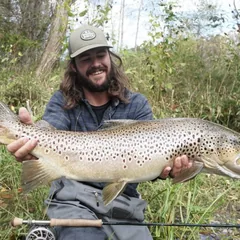
The rules exist to protect a wild, self-reproducing trout fishery instead of a stocked one. The browns in the regulated water hatched in the creek itself, and wild fish in cold, nutrient-thin mountain water grow slowly. A 14-to-18-inch wild brown here can be several years old. You can't replace that fish from a hatchery truck.
Each part of the rule does a job:
- The 16-inch minimum keeps nearly every fish in the creek to grow and spawn. Most Noontootla trout never reach 16 inches, so in practice almost everything you catch goes back.
- Artificial lures only cuts down deep hooking. Bait gets swallowed far more often than a fly, and a deep-hooked trout is much less likely to survive release. A fly or lure usually sticks in the corner of the jaw and comes out in seconds.
The payoff is a fishery that fishes like no stocked stream in the state. The trout have eaten thousands of natural insects, they refuse sloppy drifts, and they reward the careful angler.
How does Noontootla compare to other regulated water?
North Georgia anglers run into three kinds of trout rules, and they're easy to mix up. Here's the side-by-side, using the current Georgia and North Carolina rules:
| Rule | Noontootla (Blue Ridge WMA) | Delayed-harvest water | General Georgia trout water |
|---|---|---|---|
| Bait | Not allowed | Not allowed in the catch-and-release season | Generally allowed |
| Hooks | Artificial lures | One single hook per lure in season | General rules |
| Keeping fish | Only trout 16 inches or longer | None in season (GA: Nov 1 to May 14) | Creel limits allow harvest |
| Fish | Wild, naturally reproducing | Heavily stocked for the season | Mostly stocked |
| License | Georgia license plus trout license | Georgia or NC license, depending on the state | Georgia license plus trout license |
The big difference is intent. Noontootla's rule protects wild fish all year. A delayed-harvest stream like the Tuckasegee in North Carolina is catch-and-release only from October 1 until the evening before the first Saturday in June, on stocked fish, then opens to harvest. The Tuck also needs a North Carolina license; a Georgia license doesn't cover it.
How do you fish Noontootla within the rules?
The good news: the setup that keeps you legal on Noontootla is also the setup that catches fish there. The creek is 12 to 25 feet wide, mostly pocket water under rhododendron, which suits a short fly rod far better than anything else.
The rig:
- A 7-to-8-foot 3-weight rod
- A 7-foot leader to 5X or 6X
- Dry flies like the Parachute Adams and Elk Hair Caddis
- Nymphs like the Pheasant Tail and Hare's Ear
- Foam beetles and ants for summer
- A couple of small streamers for fall
Habits that matter:
- Pinch your barbs. Barbless hooks come out fast, which makes releasing the small fish quicker and easier on them. It's not required, but it's the right call on wild-fish water.
- Land fish fast. A wild brown worn out by a long fight on light tippet may not survive the release.
- Keep fish wet. Wet your hands, keep the fish in the water, and let it swim off on its own. Our guide to releasing trout covers the full handling routine.
- Measure before you think about keeping one. If you plan to keep a fish, it has to be 16 inches or longer. A guess doesn't count.
- Match the season. Quill Gordons and Hendricksons in April, sulphurs and caddis in May, terrestrials through summer, and streamers in the October and November pre-spawn. Our list of the best flies for Noontootla has sizes.
- Mind the spawn. Browns spawn in October and November. Their nests, called redds, look like clean, light-colored ovals of gravel in shallow runs. Don't wade through them.
Where do you check the current Noontootla rules?
Rules change, and roads close. Check official sources before a self-guided trip instead of trusting last year's memory or a forum post.
- Georgia Wildlife Resources Division. The state's trout regulations list every special-regulation stream with current wording. Read the Noontootla entry itself; the rules are set stream by stream.
- U.S. Forest Service. The Chattahoochee-Oconee National Forest site lists road and trail closures, parking, and seasonal restrictions on the national forest land around the creek.
- The signs at the access point. If the sign and your memory disagree, the sign wins. Take a photo of it when you arrive.
- Local Trout Unlimited chapters. Georgia TU chapters often flag road closures and rule changes early.
- A guide. Bowman's guides know the water and the current rules. A guided Noontootla trip runs $450 for a half day or $600 for a full day for one angler, all gear included. See the Noontootla Creek trip page for two- and three-angler rates.
Common mistakes anglers make with the Noontootla rules
The rules are short, which makes them easy to break by accident. These are the mistakes that cost self-guided anglers a ticket or a dead wild fish.
- Keeping a fish that's "about 16 inches." Under 16 inches means release right away. If you're not sure, it goes back.
- Carrying bait "just in case." Artificial lures only means bait stays in the truck. Having it on the water is enough for a citation.
- Assuming the rule is single hooks only. It isn't. The rule is artificial lures. Single barbless hooks are a good choice, not a legal requirement.
- Assuming the rule bans all harvest. It doesn't. It sets a 16-inch minimum. Most anglers release every fish anyway, and on a wild fishery that's a good habit.
- Fishing past the posted boundary or onto private land. The rule covers the creek on the Blue Ridge WMA. Read the signs and stay on public water.
- Treating an open creek as a fishing report. After an inch of rain the creek can blow out for a day or two, and summer middays on the lower water run warm. Pick your days.
- Skipping the trout license. A general Georgia fishing license isn't enough on trout water. Anyone 16 or older needs the trout license on top of it.
How do you approach a Noontootla run?
Wild fish in small, clear water see you before you see them. Most blown chances on Noontootla happen before the first cast, so the approach is half the game.
- Stop and look first. Stand back from the bank and watch the run for a minute. Look for a rise, a flash, or a fish holding in the slower water beside the current.
- Come from downstream. Trout face into the current, so moving upstream keeps you behind them.
- Stay low and keep your shadow off the water. On a sunny day, a shadow across the run will empty it.
- Wade as little as you can. Every step sends a pressure wave and a puff of silt downstream. Cast from the bank or the edge whenever you can.
- Make the first cast count. Cast to the closest likely spot first, then work farther out. A wild brown often eats the first good drift and ignores everything after it.
- Keep the line short. Short casts with most of the line off the water give you a drag-free drift through pocket water. Long casts across mixed currents drag the fly almost at once.
- Move on. After a few good drifts, head to the next pocket. Fresh water beats more casts at fish you've already spooked.
How do you measure a fish on Noontootla?
If you ever think about keeping a Noontootla trout, measure it, and measure it fast.
- Measure total length, from the tip of the nose to the end of the tail.
- Measure in the net, with the fish in the water, against a ruler, a tape, or marks on your net handle.
- Don't guess. A fish that looks like 16 inches in your hand is often 14 on a tape. If it's close, it goes back.
- Release first, photo second. If the fish is under 16 inches, the rule says release it right away, so skip the long photo session.
What does a year on Noontootla look like?
The rules stay the same all year, but the fishing changes a lot by season. Here's a month-by-month view of what to expect.
| Season | What's happening | How to fish it |
|---|---|---|
| Winter (Dec to Feb) | Cold water, slow fish | Small nymphs, midday only, short days |
| Early spring (Mar to Apr) | First mayfly hatches | Quill Gordons and Hendricksons, dries on warm afternoons |
| Late spring (May to early Jun) | The best dry-fly weeks | Sulphurs and caddis, morning and evening |
| Summer (late Jun to Aug) | Terrestrials under the canopy | Beetles and ants, early and late, rest the fish at midday |
| Fall (Sep to Nov) | Pre-spawn browns get aggressive | Small streamers, and stay off the redds |
For a full day on the creek, plan around the light. Mornings and evenings fish best from late spring through summer, and the middle of the day fishes best in winter.
Who should fish Noontootla?
Noontootla is a connoisseur's creek. It suits some anglers far better than others.
- A good fit: anglers who can already make a short, accurate cast and want wild fish in a beautiful setting. People who'd rather catch five wild browns than thirty stocked rainbows.
- A harder fit: first-time anglers who want steady action. Small water and spooky wild fish punish beginner mistakes. A first-timer usually has more fun on private water or a float.
- A great guided day: anglers who want to learn small-stream technique. A guide on Noontootla teaches approach, short-line drifts, and reading pocket water, skills that carry over to every small trout stream in the Southeast.
What does a guided Noontootla day look like?
A guided day takes the rules, the access, and the gear off your plate, so the whole day goes to fishing and learning.
- Length: a half day is about 4 hours on the water; a full day is about 8 hours with a riverside lunch.
- Price: $450 for a half day for one angler, $585 for two, and $725 for three. A full day is $600, $780, and $980.
- Gear: rods, reels, flies, and waders are included. You bring a Georgia fishing license with the trout license, polarized sunglasses, and layers.
- What you'll learn: how to approach wild fish, how to drift a fly through pocket water, and how to read a small creek, skills that work on every mountain stream in the Southeast.
If Noontootla sounds like your kind of water, the Noontootla Creek trip page has current dates and details.
Frequently Asked Questions
What are the special regulations on Noontootla Creek?
On Noontootla Creek and its tributaries on the Blue Ridge WMA, Georgia allows artificial lures only and sets a 16-inch minimum size: every trout under 16 inches must be released right away. Everything else follows Georgia's general trout rules.
Can you keep trout on Noontootla Creek?
Only a trout 16 inches or longer, under the general creel limit. Everything smaller goes back right away. Because few wild Noontootla trout reach 16 inches, most anglers release every fish, and that's a good habit on wild-fish water.
Can you use bait on Noontootla Creek?
No. The creek and its tributaries on the Blue Ridge WMA are artificial lures only, and you can't carry bait on that water.
Do you need single hooks on Noontootla?
The rule doesn't require them; it requires artificial lures. A single barbless hook is still the best choice, because it comes out fast and makes releasing small wild fish easier on them.
How is Noontootla different from a delayed-harvest river like the Tuckasegee?
Noontootla protects wild, naturally reproducing fish all year with a 16-inch minimum. A delayed-harvest river like the Tuckasegee in North Carolina is catch-and-release only from October 1 until the evening before the first Saturday in June, on heavily stocked fish, then opens to harvest. The Tuck also needs a North Carolina license.
Do I need a license to fish Noontootla Creek?
Yes. Anyone 16 or older needs a Georgia fishing license plus the trout license. Buy it online before the trip, guided or not.
Where can I check the current Noontootla regulations?
Read the Noontootla entry in the Georgia trout regulations from the Wildlife Resources Division, check the Forest Service site for road and trail closures, and read the signs at the access point, which are the authority on the ground.
Fish Noontootla the right way
Our guides know the rules and the wild-trout water. Half day from $450, gear included.
Noontootla Creek wade trip, from $450 · 4.9 stars on Google
See the trip or Reserve Your Trip →