Fly Fishing 101
Catch-and-Release Trout: Best Practices to Keep Fish Alive
 Daniel Bowman
Updated October 1, 2026
15 min read
Daniel Bowman
Updated October 1, 2026
15 min read

The short version
Catch-and-release works when you handle trout gently: pinch your barbs, wet your hands before touching a fish, keep it in the water, limit the fight and air time, use a rubber net, and revive it facing the current until it swims off on its own. Skip catch-and-release entirely when water is over ~68°F — warm-water trout often die after release even if they swim away. Much of North Georgia's best water is catch-and-release (Delayed Harvest stretches in season and the Soque), and Noontootla releases every trout under 16 inches, so good handling keeps the fishery strong.
Why does catch-and-release matter for trout?
Catch-and-release keeps trout populations healthy and the fishing good — especially in pressured or wild fisheries where the same fish get caught repeatedly. Done right, most released trout survive; done carelessly, they die hours later even after swimming off. It matters because:
- It sustains the fishery — fish you release are caught again and reproduce.
- It protects wild and trophy fish — the big, old fish that take years to grow.
- It's required on much of the best water — Delayed Harvest stretches and private water like the Soque are catch-and-release.
- Survival depends on handling — careful release keeps mortality low.
There's a number worth internalizing here. Across decades of fisheries studies on trout caught on flies and artificial lures, post-release mortality typically runs in the low single digits — often cited around 2–5% in cold water with good handling. Bait-caught fish run higher because they swallow the hook more often. That low number is the reason wild fisheries like the Noontootla special-regulations stretch can be fished hard and still hold the same browns year after year: a fish that's caught, handled well, and released is, statistically, going to be there next season. But that 2–5% is a best-case figure. The same fish, played to exhaustion in 70°F water and held out of the air for 45 seconds for a photo, can mortality-rate at five or ten times that. The angler controls almost every variable that moves the number.
Most released trout survive when handled well — but a warm-water fish or one held out of the water too long often dies after it swims off.
That gap between "swam away fine" and "actually survived" is the whole subject of this article. Delayed mortality — a fish that kicks off strong and dies six hours later from lactic-acid buildup, gill damage, or a stripped slime coat — is invisible to the angler. You never see the fish that doesn't make it. So the discipline of good release isn't about the fish you can watch swim off; it's about stacking every odds-in-your-favor habit so the ones you can't watch make it too.
How do you release a trout safely, step by step?
The sequence that gives a trout the best chance:
- Land it quickly — use appropriately heavy gear so you don't exhaust the fish.
- Wet your hands before touching it — dry hands strip the protective slime layer.
- Keep it in the water — unhook it in the net in the water whenever possible.
- Use barbless hooks — pinch the barb; they back out fast with minimal damage.
- Minimize air time — if you photograph it, keep it under a few seconds and over the water.
- Revive it — hold it upright facing into the current until it kicks free on its own.
Each of those steps hides a technique worth getting right, so here is the longer version of how an experienced guide actually does it.
Land it before it's spent. The single biggest lever on survival is fight length. A trout fought for eight minutes on undersized tippet is flooding its muscles with lactic acid and burning the oxygen reserves it needs to recover. Use enough rod and enough tippet to apply real pressure — pull down and to the side, against the direction the fish wants to go, not straight up. On a Soque brown that runs 22 inches, a 4X or 5X tippet and a 9-foot 5-weight will land the fish in a minute or two if you keep the rod low and lead it. Side pressure tires a fish far faster than the classic high "fight-the-fish" rod angle, which mostly just lets it sit in the current.
Wet everything that touches the fish. A trout's slime coat is its immune barrier against fungus and bacteria. Dry hands, a dry net, a dry shirt pressed against its flank — each one wipes a patch of that coat away and opens a path for infection that kills days later. Dunk your hands before you reach in. Never lay a trout on dry gravel, a dry rock, or the floor of a boat.
Unhook it in the net, in the water. The fish doesn't need to come up. Cradle it in a submerged rubber net, reach down with forceps, and back the hook out while the gills stay wet and working. If it's hooked cleanly in the corner of the jaw — which barbless hooks and a tight line tend to produce — this takes two seconds and the fish never leaves its element.
If you must lift it, support it horizontally with two wet hands — one gently around the wrist of the tail, one cradling under the belly just behind the pectoral fins. Never hang a trout vertically by the jaw the way you see in bass photos; a big trout's organs aren't built for it and you can damage the jaw and spine.
What gear makes catch-and-release safer?
A few simple choices dramatically improve survival:
- Barbless hooks (or pinched barbs) — faster, cleaner releases.
- Rubber or rubber-coated net — protects fins and slime far better than knotted mesh.
- Forceps or hemostats — quick hook removal without handling the fish.
- A stream thermometer — to know when water is too warm to fish for trout.
- Appropriately sized rod/tippet — land fish fast instead of playing them to exhaustion.
Two of these deserve more than a bullet. The net is the most under-rated survival tool in the box. Knotted nylon mesh abrades fins and scrapes slime; it also tangles a treble or a dropper rig into a knot that keeps a fish thrashing in the air while you work. A rubber or rubber-coated bag releases hooks instantly and cradles the fish without damage — and a deep enough bag lets you keep the fish fully submerged while you unhook it. The thermometer is the cheapest insurance you can buy. A $10 stream thermometer clipped to your pack turns the single most lethal release variable — water temperature — from a guess into a number. Take a reading first thing in the morning and again at midday; if it crosses into the high 60s, you have a decision to make, which is the next section.
One more gear note that gets argued about: barbless hooks barely cost you fish. The myth is that you'll lose every trout that jumps. In practice, on a fly rod with steady tension and a smooth rod tip, barbless landing rates are within a percentage point or two of barbed — and many anglers land more because the clean point sets deeper and faster. Where barbless genuinely shines is the release. A pinched barb backs out of a jaw, a net, or a thumb in a single motion. It also fits the rules on a lot of the water worth fishing: Delayed Harvest stretches require one single hook per lure, and the Noontootla special-regulations zone is artificial lures only.
When should you NOT catch-and-release trout?
Sometimes the kindest move is to stop fishing for trout entirely:
- When water is over ~68°F — warm water holds less oxygen; exhausted trout often die after release even if they swim off. Fish a cold tailwater instead, or chase warm-water species. (The Soque is rested from June 10 to September 20.) See summer fly fishing North Georgia.
- When a fish is deeply hooked — cut the line near the hook rather than digging it out; the hook often dissolves.
- When a fish is bleeding heavily — survival is low; where legal and ethical, consider keeping it.
- During extreme heat or low flows — give the fishery a rest.
The temperature rule is the one most anglers fudge, so it's worth a clear decision framework. Cold water carries more dissolved oxygen; warm water carries less. A trout fought hard needs a flood of oxygen to clear the lactic acid from its muscles, and in 70°F water that oxygen simply isn't there. The fish swims off looking fine and dies on the bottom hours later. Use these thresholds:
- Below 65°F: Fish normally. Recovery is fast.
- 65–68°F: Caution. Shorten fights, skip photos, release fast, and stop by late morning before the water peaks.
- Above 68°F: Stop targeting trout. This is sometimes called "hoot owl" thinking — borrowed from Western rivers that legally close trout fishing in the afternoons during heat. The trout aren't worth killing for sport.
This is exactly why North Georgia's coldwater options matter in July and August. A bottom-release tailwater like the Toccoa below Blue Ridge Dam stays cold all summer. Even the private Soque warms enough that Bowman typically doesn't fish it from June 10 to September 20. Cold water lets you keep fishing ethically when freestone creeks have warmed past the line. When in doubt, take the temperature — don't guess.
On deep-hooked fish, the instinct to retrieve your fly kills more trout than almost anything else. If a hook is down in the throat or gills, do not dig. Cut the tippet as close to the hook eye as you can reach and release the fish immediately. A small hook left in place is far more survivable than the bleeding and tissue damage from extraction; many dissolve or work free over time. Lose the fly. Keep the fish.
A quick decision table: release, rest, or stop?
When you're standing in the river, the call comes down to a few readable signals. This table is the same logic a guide runs in their head between fish:
| Situation | Water temp | What to do | Why |
|---|---|---|---|
| Cool morning, fish landed fast | Below 65°F | Release normally; quick photo OK | Oxygen is plentiful; recovery is fast |
| Midday warming, fish landed fast | 65–68°F | Skip the photo, release in the net, no air time | Margins are tightening |
| Hot afternoon, low flow | Above 68°F | Stop targeting trout for the day | Delayed mortality is high regardless of handling |
| Deep-hooked anywhere | Any | Cut the tippet at the hook; do not extract | Extraction damage kills; small hooks pass |
| Heavy bleeding (gill/throat) | Any | Survival is low; keep if legal, or release fast | A bleeding fish rarely recovers |
| Long fight on light tippet | Any | Extend revival; hold facing current longer | Exhaustion needs active oxygenation to clear |
The pattern across every row: the colder and faster the encounter, the more latitude you have. The warmer and longer it gets, the more you should be cutting corners off the fish's time, not adding them.
How do you revive an exhausted trout?
Reviving is the step most anglers rush and the one that decides whether a tired fish lives. A trout "breathes" by passing oxygenated water over its gills; an exhausted fish often can't pump water hard enough on its own to recover. Your job is to do it for it.
- Hold it upright, head into the current. Cradle it loosely — one hand at the tail wrist, one under the belly. The current does the work; you just hold position.
- Let water flow through the mouth and out the gills. In a river, face it upstream into moving water. In a slow pool or a lake, do not "pump" it back and forth — that forces water backward over the gills and damages them. Instead, move it slowly forward in a figure-eight or hold it where there's gentle current.
- Wait for it to grip. A recovered trout will clamp its jaw, its gill plates will work strongly and rhythmically, and it will start to push against your hand.
- Let it leave on its own. Don't toss it. When the fish kicks free under its own power, it's ready. If it rolls or floats, it's not — recover it again. A fish that won't right itself after a couple of minutes was fought too hard or the water is too warm.
A worked example: you've landed an 18-inch brown after a longer-than-ideal fight in 66°F water. Don't photograph it. Keep it in the net, slip the barbless hook, and cradle it in the current facing upstream. Watch the gill plates — at first they'll be flared and labored. Hold position, let the river run through it, and after thirty to sixty seconds you'll feel the tail stiffen and the fish start to drive forward. That's your cue. Open your hands and let it go on its terms. The whole sequence costs you under two minutes and roughly doubles that fish's odds.
How should you photograph a trout you're releasing?
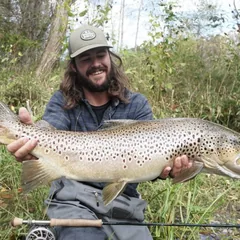
The grip-and-grin photo kills more trophy trout than any other single habit, because the biggest fish are the ones people most want to lift, hold, and pose. Air exposure is the killer: a trout out of water is suffocating, and studies on air time show survival dropping sharply past about 10 seconds. Build the shot around the fish, not the other way around:
- Set up before the fish comes up. Camera ready, settings dialed, the photographer in position — then lift the fish.
- Keep it over the net or the water. If it slips, it drops into water, not onto rocks.
- Three seconds, then back. Lift, one or two frames, return it to the water to breathe. Repeat if you need a better frame rather than holding it in the air longer.
- Shoot it in the net or half-submerged. A "water-line" shot — the fish in the net with the surface across the frame — is often the better photo and the safer one.
- Wet hands, horizontal support, no fingers in the gills. The gills are the most fragile tissue on the fish.
The mental rule that works: hold your own breath when you lift the fish. When you need to breathe, the fish needed to a while ago — put it back.
How does catch-and-release work on North Georgia rivers?
North Georgia has both catch-and-release water and regulated harvest, so know the rules:
- Delayed Harvest stretches — catch-and-release, artificial-only, November through mid-May.
- Private water (Soque, Noontootla beats) — catch-and-release by design. On the public Noontootla water on the Blue Ridge WMA, only trout 16 inches or longer may be kept.
- Check current Georgia trout regulations — limits and tackle rules vary by stretch.
- Conservation groups help — Trout Unlimited works to protect these coldwater fisheries.
Georgia's Delayed Harvest program is the clearest example of why handling matters. From roughly November 1 through mid-May, designated stretches are stocked heavily and managed as catch-and-release with single-hook artificial lures only. The same trout get caught dozens of times over a winter — which only works because the regulations force barbless-friendly tackle and most anglers release carefully. Then in mid-May the water reverts to general regulations and limited harvest opens. Fish those stretches like the fish are reusable, because they are.
The Noontootla special-regulations zone takes it further: a wild, naturally reproducing brown trout population, no stocking, artificial lures only, and a 16-inch minimum size that protects the breeders. Forest-Service signage at the trailheads posts the current boundaries, and the U.S. Forest Service Chattahoochee-Oconee National Forest site lists access and any seasonal restrictions. Just over the line in North Carolina, the Tuckasegee's Delayed Harvest sections run on a similar calendar (October 1 until the evening before the first Saturday in June) under the North Carolina Wildlife Resources Commission — and require a separate NC license. On the private Soque, catch-and-release is the whole model: limited pressure plus careful handling is what lets the river grow and re-grow 24-to-28-inch browns, and groups like the Soque River Watershed Association work to keep the water cold and clean enough to sustain them.
Before you fish on your own, buy your license and trout stamp through Go Outdoors Georgia and read the rules for the specific stretch — tackle restrictions, seasons, and harvest limits change from one beat to the next, and the regulation that applies a hundred yards upstream may not apply where you're standing.
Common catch-and-release mistakes (and the fix)
The difference between "I release everything" and "the fish I release actually live" usually comes down to a handful of habits:
- Fighting fish too long on light tippet. Fix: size up your tippet, apply side pressure, and land the fish in a minute or two.
- Dry hands or a dry net. Fix: dunk both before you touch the fish. Always.
- Lifting trophies vertically by the jaw. Fix: support horizontally, two wet hands, fish over water.
- The 30-second photo. Fix: set up first, three seconds in the air, water-line shots.
- Digging out a deep hook. Fix: cut the tippet; lose the fly, keep the fish.
- Releasing before the fish has recovered. Fix: hold it in the current until it kicks free on its own.
- Fishing for trout in warm water. Fix: carry a thermometer; stop above 68°F and move to cold tailwater or another species.
None of these cost you fish or fun. They cost a few seconds of discipline — and they're the entire difference between a fishery that holds up and one that quietly thins out.
Frequently Asked Questions
How do you keep a trout alive for catch-and-release?
Land it quickly, wet your hands before touching it, keep it in the water, use barbless hooks and a rubber net, minimize air time, and revive it facing the current until it swims off on its own. The biggest killers are dry hands, long air exposure, and warm water. Each of those is fully within the angler's control, which is why careful handling typically holds fly-caught trout mortality in the low single digits.
Why use barbless hooks for catch-and-release?
Barbless hooks (or pinched barbs) come out faster and cleaner, which means less handling, less damage, and a quicker release. They make almost no difference to landing rate if you keep steady tension — many anglers actually land more fish because a barbless point sets deeper. They're also required on most Delayed Harvest and special-regulations water, which restricts you to single-hook artificials.
Is it bad to catch trout in warm water?
Yes. When water is over about 68°F it holds less oxygen, and trout played and released in it often die afterward even if they swim away. The danger is delayed mortality — the fish looks fine on release and dies hours later. In summer, fish cold tailwaters like the Toccoa, fish early before the water peaks, or target warm-water species instead.
How do I revive a tired trout?
Hold it upright with its head facing into the current so oxygenated water flows through its mouth and over its gills. Support it loosely — one hand at the tail, one under the belly — and wait. Don't pump it back and forth in still water; that damages the gills. When the fish clamps its jaw, its gills work strongly, and it pushes against your hand, let it swim off on its own. If it rolls or floats, it needs more time.
Do you have to release trout in North Georgia?
On Delayed Harvest stretches (November–mid-May) and most private water like the Soque, yes — they're catch-and-release. The Noontootla special-regulations water on the Blue Ridge WMA is artificial lures only, and any trout under 16 inches goes back. Other water allows limited harvest under Georgia regulations. Always check the current trout rules for the specific stretch you're fishing, since tackle and harvest rules change from one beat to the next.
How long can a trout be out of the water?
As little as possible — ideally just a few seconds, and over the water so a drop is harmless. Survival drops sharply past about 10 seconds of air exposure. Unhook fish in the net in the water, set up any photo before you lift the fish, and shoot it in three seconds or less. A simple rule: hold your own breath when you lift the fish, and put it back before you need to breathe.
What should I do if a trout swallows the hook?
Don't try to dig it out. Cut the tippet as close to the hook eye as you can reach and release the fish right away. Extraction from the throat or gills causes bleeding and tissue damage that's usually fatal; a small hook left in place is far more survivable and often works free or dissolves over time. Lose the fly, keep the fish.
What's the best net for catch-and-release?
A rubber or rubber-coated net bag, deep enough to keep the fish fully submerged while you unhook it. Knotted nylon mesh scrapes the slime coat and abrades fins, and it tangles hooks so the fish thrashes in the air longer. A good rubber net releases the hook instantly, cradles the fish without damage, and doubles as the place you do the entire unhook-and-revive sequence without the trout ever leaving the water.
Fish (and release) North Georgia's best water
Our guides practice careful catch-and-release on private trophy water — learn the right handling on your trip.
Etowah River private water trip, from $400 · 4.9 stars on Google
See the trip or See Trophy Water Trips →