North Georgia Rivers
North Georgia vs Western North Carolina Fly Fishing: Which to Pick in 2026
 Daniel Bowman
Updated October 2, 2026
11 min read
Daniel Bowman
Updated October 2, 2026
11 min read

The short version
North Georgia offers the Southeast's best private trophy water (Soque) plus a versatile mix of tailwater (Toccoa), small stream (Etowah, Noontootla), and wild trout. Western North Carolina offers the Southeast's best delayed-harvest drift-boat fishing (Tuckasegee) plus Great Smoky Mountains National Park wild trout in iconic small streams. For Atlanta-based anglers, North Georgia is significantly closer (90 minutes versus 3+ hours). For trophy fish: Georgia Soque. For high catch numbers on a float: NC Tuckasegee. For wild brook trout in iconic water: NC Smokies. Bowman guides both regions — the Tuckasegee is part of the Bowman roster, run as a 90-minute drive from Blue Ridge across the state line.
Headline comparison
| Dimension | North Georgia | Western North Carolina |
|---|---|---|
| Drive from Atlanta | 90 minutes | 3+ hours (Tuckasegee), 4+ hours (Smokies) |
| Marquee trophy water | Soque River | Davidson River |
| Best drift boat float | Toccoa | Tuckasegee |
| Best wild trout small stream | Noontootla | Smokies (multiple) |
| Best year-round tailwater | Toccoa | South Holston (extends into TN) |
| License cost (non-resident) | $20 for one day ($10 license + $10 trout) | $29 for 10 days, trout water included |
| Average half-day cost | $400–$550 | $400–$550 |
| Lodging hub | Blue Ridge GA | Bryson City NC |
| Same-day from Atlanta | Yes | Difficult (long days) |
| Multi-day visit | Optional | Often necessary |
The bigger differentiator isn't cost or fish quality — it's drive time and the resulting trip structure.
What North Georgia is good at
Specific strengths of North Georgia for fly fishing:
1. Atlanta accessibility. 90 minutes door-to-door for most North Georgia waters. Same-day return is comfortable. No overnight required for routine trips.
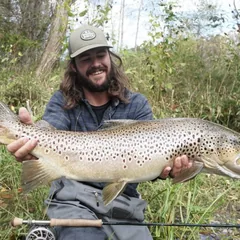
2. The Soque River trophy water. Georgia's Soque produces 20+ inch wild and holdover brown trout with regularity matched by few rivers in the Southeast. The Bowman Soque trip is the answer for trophy hunting.
3. Variety in a small footprint. Within about two hours of Atlanta, you can fish a tailwater (Toccoa), a small wild-trout stream (Noontootla), a vineyard private water (Etowah), and a private trophy fishery (Soque). No comparable density of variety exists in WNC.
4. Drift boat float with shorter drive. The Toccoa is North Georgia's drift boat option. For Atlanta-based anglers wanting a float without an overnight commitment, the Toccoa is the practical answer.
5. Lower regulatory complexity. Georgia's trout regulations are simpler than NC's layered framework. Fewer special-regulations stretches; standard rules apply on most water.
6. Year-round tailwater fishing. The Toccoa tailwater below Blue Ridge Dam fishes year-round on tail-out flows. Even January and February produce technical winter fishing with midges and nymphs.
For details on North Georgia's marquee waters: Toccoa River guide, Soque River guide.
What Western North Carolina is good at
Specific strengths of Western North Carolina:
1. Delayed-harvest density on the Tuckasegee. The Tuck DH stretches are heavily stocked October–May and managed catch-and-release. High catch counts on wide drift-boat-friendly water. The 15–40 fish per day Tuck experience is hard to match in Georgia.
2. Great Smoky Mountains National Park. Iconic small-stream wild trout fishing in some of the most beautiful water in the Eastern US. Park fishing is unique to NC (and TN on the other side of the Smokies divide).
3. Wild brook trout populations. NC has more accessible wild brook trout streams than Georgia — both in the Smokies and in the Pisgah National Forest. Specialty for anglers chasing native brook trout.
4. The Davidson River. Pisgah National Forest's Davidson is a famous wild trout fishery. Technical, low-clarity water, large fish, hard fishing. A different experience from Georgia private water.
5. Multi-day destination logistics. Bryson City and Sylva work as small-town fishing hubs with lodges, restaurants, and shuttle services oriented around fly fishing tourism. North Georgia's Blue Ridge has a similar hub but on a smaller scale.
6. The Cherokee tribal waters. The Qualla Boundary section of the Tuckasegee operates under tribal management with separate licensing and rules. Specialty water for anglers wanting that experience.
For details: Tuckasegee River guide.
When North Georgia is the right answer
Specific scenarios:
Scenario: Same-day Atlanta trip. No overnight commitment. You leave Atlanta in the morning, fish, return for dinner. Only North Georgia supports this comfortably.
Scenario: Trophy fish hunt. The Soque is the Southeast's trophy water answer. NC's Davidson produces large wild fish but at lower density and on much harder water.
Scenario: First guided trip. For a beginner, the Etowah or Toccoa with a guide produces a more accessible learning curve than the Smokies' technical wild trout or the Tuckasegee's longer travel commitment.
Scenario: Booking on shorter notice. Bowman waters in North Georgia have more guide flexibility than the Tuckasegee for last-minute bookings. NC trips typically need more lead time given the drive.
Scenario: Group of 4–8 anglers. Group logistics work better with the shorter drive. Coordinating six anglers on a 3-hour each-way drive is harder than the same group with 90 minutes.
Scenario: Variety in a single visit. A two-day North Georgia trip can fish two distinctly different rivers (e.g., Toccoa + Soque). NC trips typically focus on one river due to driving distance between stretches.
When Western North Carolina is the right answer
Specific scenarios:
Scenario: Maximum catch numbers from a drift boat. Bowman calls the Tuckasegee DH one of its highest-producing trips. 15–40 fish on a strong day, mostly 10–14 inches.
Scenario: National Park fishing. Smokies fishing is a unique experience — stream after stream of wild trout in some of the most photogenic water in the East. Worth the drive for serious anglers.
Scenario: Wild brook trout focus. NC's brook trout stream density is higher than Georgia's. For anglers building a brook trout life list, NC is the answer.
Scenario: Multi-day vacation visit. You're already going to Bryson City for a vacation; adding 2–3 fishing days makes sense. Shorter for a one-day Atlanta trip.
Scenario: Davidson River for technical wild fishing. The Davidson is a destination for experienced anglers who want hard, rewarding wild-trout fishing in iconic water.
Scenario: Winter delayed-harvest peak. January–February DH on the Tuckasegee fishes excellently when most other Southeastern water has slowed. Winter destination for anglers willing to drive.
Cost comparison, fully loaded
A full out-of-pocket comparison for typical trip configurations:
Same-day Atlanta-based, half-day, two anglers:
- GA Etowah/Toccoa: Trip $425 (Toccoa float) or $550 (Etowah, two anglers) + 2 licenses $50 + gas $40 + tip $65–$110 = $580–$750
- NC Tuckasegee from Atlanta: Trip $575 (full day only) + 2 licenses $58 + gas $90 + tip $85–$115 = $808–$838
Overnight visit, full-day, two anglers:
- GA Soque (overnight): Trip $725 (full day, two anglers) + 2 nonresident one-day licenses $40 + lodging $250 + gas $40 + tip $125 = $1,180
- NC Tuckasegee (Bryson City overnight): Trip $575 (full-day float, one boat) + 2 nonresident 10-day licenses $58 + lodging $250 + gas $90 + tip $100 = $1,073
The cost spread is meaningful but not dramatic. The Tuckasegee multi-day visit can come in slightly cheaper than the Soque trophy trip on equivalent dates because of the lower trip rate, even with longer drives factored in.
For a deeper cost breakdown across formats, see guided trip cost.
Drive logistics — the often-decisive factor
For Atlanta-based anglers, drive time tends to drive the decision more than any other factor:
North Georgia from Buckhead:
- Etowah vineyard: 75 minutes
- Soque private water: 90 minutes
- Toccoa float launch: 90 minutes
- Noontootla trailhead: 105 minutes
Western North Carolina from Buckhead:
- Tuckasegee (via Blue Ridge): 3 hours
- Davidson River (via Asheville): 3.5 hours
- Smokies streams (via Cherokee): 4 hours
The practical implication:
A North Georgia same-day trip means 3 hours of total driving and 6–8 hours of fishing — call it a 12-hour day with breakfast at home and dinner at home.
A NC same-day trip means 6+ hours of driving and 6 hours of fishing — call it a 14-hour day, leaving home before dawn and returning after dark.
Most anglers do NC trips as overnights. The math works better with one night in Bryson City or Sylva.
For a comprehensive view of Bowman's Tuckasegee operation, the trip page has logistics specifically.
Lodging by region
If you're staying overnight, the natural hubs:
For North Georgia trips: Blue Ridge GA. Walkable downtown, multiple cabin and lodge options, fly shops, restaurants oriented around outdoor visitors. The Toccoa flows through downtown; the Soque is 30 minutes east in Habersham County. Cherokee Lake area also works for some trip configurations.
For NC Tuckasegee trips: Bryson City NC or Sylva NC. Smaller-town feel than Blue Ridge but similar amenities. Multiple lodges with fishing-friendly check-in/out times. Several spots within walking distance of the river.
For NC Smokies trips: Cherokee NC, Bryson City NC, or Townsend TN (for Smokies access from the Tennessee side). Each town has different access angles into the National Park.
For NC Davidson River trips: Brevard NC. Small town with several inns and B&Bs oriented around the Pisgah National Forest.
License purchase requires the right state's portal: Georgia Wildlife Resources Division for GA, North Carolina Wildlife Resources Commission for NC, Great Smoky Mountains National Park fishing regulations for Park-specific rules.
Combination trip strategies
Some of the best Bowman trips combine both regions:
Two-day GA + 1-day NC: Two days in North Georgia (Toccoa float + Soque trophy), then drive over to Bryson City for a Tuckasegee day. Three different river types across the visit.
One-day GA + two-day NC: A single day on Toccoa or Soque, then a longer NC visit including Tuckasegee plus a Smokies wild-trout day. Best for visitors flying in for a 4-day fishing vacation.
Bachelor party / group retreat: Anchor the trip in Blue Ridge for North Georgia waters, then group bus to Bryson City for the closing day on the Tuckasegee. Multi-river, multi-state coverage.
Instructor's intensive: Three days, three rivers — Etowah for casting and basics, Toccoa for drift boat skills, Tuckasegee for high-volume DH fishing. Designed for serious skill-building over a week.
Climate and weather differences
The two regions sit at similar latitudes but different elevations, which shapes the fishing window:
North Georgia weather. Most Bowman waters sit at 1,200–2,000 feet elevation. Summers are warm but the rivers stay fishable in cooler tailwater stretches and at higher elevations. Winters are mild — most waters fish year-round. Spring and fall are the dominant peak windows. Mountain weather can change fast, but extreme weather events are rarer than in higher Western NC elevations.
Western NC weather. The Smokies sit at 2,000–6,000+ feet elevation; the Tuckasegee runs at 1,800–2,200 feet. Higher elevation means cooler summer water (fishing stays viable mid-day longer), but also means more pronounced winter weather. Snow events on Smoky Mountain access roads can close fishing temporarily. Spring runoff is more pronounced than in North Georgia given the higher headwaters.
Practical implication for trip planning: July–August in North Georgia gets warm enough that mid-day fishing slows on the Etowah, and Bowman typically doesn't fish the Soque from June 10 to September 20. The Tuckasegee at higher elevation stays cooler. December–February in NC has more weather risk; North Georgia is more reliably fishable. Spring and fall both fish well in both regions.
Cultural / community differences
Each region has a distinct fishing culture worth knowing about:
North Georgia: The fishing community is smaller and more guided-trip-oriented. Bowman, Reel Em In, Cohutta Outfitters, and a handful of independent guides cover most of the regional water. Fly shops cluster in Blue Ridge, Helen, and a few other small towns. Trout Unlimited Georgia chapters (especially the Blue Ridge and Atlanta-area chapters) are active in conservation.
Western NC: The fishing community is larger, with deeper conservation infrastructure, more competing outfitters, and a stronger DIY culture. Anglers from across the Eastern US travel to Brevard, Bryson City, and Asheville for fishing-specific vacations. Trout Unlimited NC chapters and the NC Wildlife Resources Commission run extensive habitat programs. The Davidson River and the Smokies have well-established angler communities with their own forums and social media presences.
For most Bowman clients, these cultural differences don't affect a single trip — but they do shape what additional resources are available beyond the booked trip.
Common decision mistakes
Patterns that lead anglers to pick the wrong region:
1. Picking NC because "the Smokies are famous." Famous doesn't mean better fit. Beginners often catch fewer fish in the Smokies than they would on Bowman's North Georgia waters. Match the region to the goal, not the reputation.
2. Picking GA on price alone. GA is closer and slightly cheaper for one-day trips, but the experience differences are real. If a Tuckasegee day better fits your goals, the longer drive is worth it.
3. Skipping the multi-day combination option. Anglers often pick "one or the other" when both makes sense. A 3-day visit covering both regions produces a richer experience than a single-day in either.
4. Underestimating NC drive time. Atlanta to Cherokee is mountain-curve driving, not interstate. Plan 3+ hours minimum, longer in winter weather.
5. Forgetting separate license requirements. Each state issues its own license. A GA license is not valid in NC. Buy the right state's license before the trip.
6. Booking GA in winter and missing NC's DH peak. January–February in North Georgia is technical Toccoa tailwater fishing; in NC it's the heart of the Tuckasegee delayed-harvest peak. The "best winter fishing" tilts toward NC for those months.
7. Forgetting Park-specific Smokies rules. Great Smoky Mountains National Park has its own fishing regulations, separate from state rules. Verify before fishing on Park water.
Frequently Asked Questions
Is North Georgia or Western NC better for fly fishing?
Neither is universally better — they fit different goals. North Georgia is closer to Atlanta, has the Soque trophy water, and offers more variety per drive-mile. Western NC has the Tuckasegee's high-density DH fishing, Great Smoky Mountains National Park, and the Davidson River. For Atlanta-based same-day trips, North Georgia. For multi-day fishing vacations, NC or both. Most serious anglers eventually fish both.
How far is the Tuckasegee River from Atlanta?
Approximately 3 hours from Buckhead via GA-400 to US-76 to US-441. From Blue Ridge GA, the Tuckasegee is about 90 minutes. Bowman's Tuckasegee trips typically meet near Bryson City or Whittier NC, with shuttle and launch logistics handled by the guide.
Do I need separate fishing licenses for GA and NC?
Yes. Each state issues its own license. A Georgia license is not valid in North Carolina and vice versa. Buy the appropriate state's license before fishing — typically online with phone-screenshot delivery. Georgia sells the trout license as a separate add-on; North Carolina's inland license includes trout water.
Can I fish the Tuckasegee from Atlanta in a single day?
Logistically possible but a long day. Plan on 6+ hours of driving plus 6 hours of fishing, leaving home before dawn and returning after dark. Most anglers opt for an overnight in Bryson City to make the trip more enjoyable. If you have flexibility, an overnight trip is the better experience.
Where's the best wild brook trout fishing in the southeast?
North Carolina has more accessible wild brook trout streams than Georgia. Great Smoky Mountains National Park, Pisgah National Forest, and the Nantahala National Forest all hold wild brook trout in cold mountain streams. Georgia's brook trout populations are smaller and concentrated in the Cohutta Wilderness and feeder streams of the Chattahoochee headwaters.
Is the Soque River better than NC's Davidson River for trophy fish?
For density of trophy fish in accessible water, the Soque is better. For the size of the largest individual fish caught annually, the Davidson sometimes produces fish that exceed any Soque catch. Soque is a private-water trophy density play; Davidson is a public-water hard-fishing play. Different experiences with similar trophy ceilings.
Should I book a guided trip in GA or NC for my first guided fly fishing experience?
Georgia, almost certainly, if you're Atlanta-based. The shorter drive, lower friction, and easier learning curve on Bowman's Etowah private water produce a better first-trip experience than committing to an overnight NC trip before knowing whether fly fishing is for you. Save the NC trips for after you have a couple of guided days under your belt.
Ready to plan your trip?
Bowman covers the best North GA waters AND the Tuckasegee in NC from a single Atlanta-area meeting point.
Etowah River private water trip, from $400 · 4.9 stars on Google
See the trip or Tuckasegee River →