Fly Fishing 101
North Georgia Trout Species: Rainbow, Brown & Brook
 Daniel Bowman
Updated October 1, 2026
15 min read
Daniel Bowman
Updated October 1, 2026
15 min read

The short version
North Georgia holds exactly three trout species: rainbow trout (the most common, stocked statewide and wild in cooler streams), brown trout (the largest and wariest, both stocked and naturally reproducing), and brook trout (the only trout native to Georgia, surviving in cold high-elevation headwaters). Tell them apart fast: a rainbow wears a pink-to-red lateral stripe and a heavily spotted tail; a brown is buttery-gold with dark and red spots, often haloed in blue; a brook trout shows worm-like vermiculation on its back, red dots ringed in blue, and white-edged lower fins. Rainbows dominate stocked tailwaters and rivers, browns own the deep undercut lies and grow biggest, and brookies live highest and coldest. On a single guided day across waters like the Toccoa, Soque, and Noontootla you can realistically land all three — the "North Georgia slam."
What trout species live in North Georgia?
North Georgia has three trout species: rainbow trout, brown trout, and brook trout. Only the brook trout is native; rainbows and browns were introduced over a century ago and now reproduce naturally in many of the colder streams. Knowing which species you're likely to encounter — and how to identify the fish in your net — is the foundation of reading any North Georgia water, because each species tells you something about the stream's temperature, elevation, and history.
Here's the at-a-glance breakdown before we go deep on each one:
| Species | Native? | Status in GA | Typical size | Where it lives | Catch difficulty |
|---|---|---|---|---|---|
| Rainbow trout | No (Pacific NW) | Stocked + wild | 8–14 in (stocked), 7–11 in (wild) | Tailwaters, stocked rivers, cool freestone | Easiest |
| Brown trout | No (Europe) | Stocked + wild | 10–18 in, up to 24"+ | Deep runs, undercuts, tailwaters, spring creeks | Hardest |
| Brook trout | Yes (only native) | Wild only | 4–9 in, rarely 11"+ | Cold high-elevation headwaters | Moderate (access is the hard part) |
That table is the spine of this guide. The sections below give you the field marks, behavior, and water for each species, then a worked example of how a guide stacks all three into one day.
How do you tell North Georgia's three trout apart?
You identify a trout by its spot pattern, color, and the markings on its tail and lower fins — and you can do it in two seconds once you know what to look for. The single most reliable tell is the tail: a heavily spotted (radiating) tail means rainbow, a sparsely spotted or clean tail means brown, and a square, unspotted tail with a pale leading edge on the lower fins means brook.
Use this field-ID table:
| Feature | Rainbow | Brown | Brook |
|---|---|---|---|
| Base color | Silver-green, chrome flanks | Golden-brown to bronze | Dark olive-green back |
| Signature mark | Pink/red lateral stripe | Black AND red/orange spots | Worm-like wavy lines (vermiculation) on back |
| Spots on body | Many small black spots | Large dark spots, some red with blue halos | Red dots ringed in pale blue + yellow specks |
| Tail (caudal fin) | Heavily spotted, slightly forked | Few/no spots, squarish | Square, unspotted |
| Lower fins | Pinkish, no white edge | Orange-ish, no white edge | Bold white leading edge, then black, then orange |
| Belly (spawning) | Rosy wash | Buttery yellow-orange | Brilliant orange-red (males) |
A quick mnemonic guides use with first-timers: "Rainbow has the stripe, brown has the bling (red spots with blue halos), brook has the white-edged fins." Hold a fish in the water, glance at the tail and the lower-fin edges, and you'll name it correctly almost every time. The vermiculation on a brookie's back — those maze-like pale squiggles — is unmistakable once you've seen it and exists on no other trout in the state.
One honest caveat: heavily stocked rainbows fresh from a hatchery can look washed-out and fin-worn, and a wild stream-bred rainbow looks far more vivid. A holdover brown that has spent two winters in a river develops richer color and a hooked lower jaw (a "kype") the older males grow. Wild fish wear their colors better than stockers — that alone often tells you whether the trout reproduced in the stream or arrived on a truck.
Rainbow trout — the most common North Georgia trout
Rainbow trout are the species you're most likely to catch in North Georgia because the state stocks them by the hundreds of thousands every year and wild populations have established in many cooler streams. A rainbow is built for moving water — chrome-bright, streamlined, with a magenta-to-crimson band running head to tail and a constellation of small black spots peppering the back, dorsal fin, and that distinctive radiating tail.
Key facts on North Georgia rainbows:
- Origin: Native to the Pacific Northwest; introduced to Georgia mountain streams beginning in the late 1800s.
- Stocked size: Most hatchery rainbows arrive at 9–11 inches. Georgia's Wildlife Resources Division stocks roughly a million catchable trout a year across the mountain counties, which drives the bulk of the put-and-take fishery.
- Reading the rise: Rainbows give themselves away in fast water, and learning to spot the subtle, splashy take in a riffle is a skill worth practicing — this breakdown of how trout feed in moving current walks through the rise forms that tell you a rainbow is working a seam.
- Wild size: Stream-bred wild rainbows typically run 7–11 inches; a 13-inch wild rainbow on a freestone creek is a genuine trophy.
- Behavior: Rainbows hold in faster, more oxygenated water than browns — the heads of pools, riffles, and current seams. They feed aggressively and willingly on dries, nymphs, and small streamers, which is exactly why they're the right target for a first-time angler.
- Where they dominate: Stocked rivers, tailwaters like the Toccoa below Blue Ridge Dam, and the cooler reaches of freestone streams. On the Etowah, the distinction between freshly stocked rainbows and the holdovers that have wintered over is its own subject — covered in detail in our breakdown of wild vs stocked trout on the Etowah.
For an angler learning the water, rainbows are the confidence builders. They eat readily, they fight hard for their size with acrobatic jumps, and they live in the obvious, readable water. A spring stocking schedule plus willing fish makes March through May the high-percentage rainbow window across most North Georgia rivers.
Brown trout — the largest and wariest
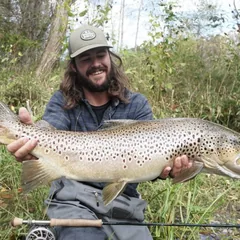
Brown trout grow the biggest of any trout in North Georgia and are the hardest to fool, which makes them the trophy species most experienced anglers chase. A brown is unmistakable in good color: golden-bronze flanks, large dark spots scattered over the body, and — the giveaway — scattered red or orange spots, each often ringed with a pale blue halo. The tail carries few or no spots, unlike the rainbow's busy caudal fin.
What sets browns apart in practice:
| Trait | Why it matters |
|---|---|
| Size ceiling | The largest trout in Georgia. On Bowman's Soque water the average fish is 18 inches or better; Bowman lists Toccoa browns up to 26 inches. |
| Temperature tolerance | Browns tolerate slightly warmer, lower-oxygen water than rainbows or brookies, so they push into water other trout abandon. |
| Lie selection | They hold in deep, structured, low-light water — undercut banks, log jams, the deepest slot of a run — not the open riffle. |
| Feeding window | Disproportionately nocturnal and crepuscular. The biggest browns eat hardest at first light, last light, and after dark. |
| Aggression | Predatory. Big browns eat other fish, which is why streamers fished through fall pre-spawn are the highest-percentage trophy tactic. |
North Georgia holds both stocked and wild brown trout. Stocked browns supplement the put-and-take fishery, but the famous ones are wild: Noontootla Creek runs an entirely naturally-reproducing brown trout population in its special-regulations stretch, and the Soque River's private water is the most reliable big-brown fishery in the Southeast. The Toccoa tailwater grows wild browns to genuine trophy size on its cold, year-round flows.
The brown's October–November pre-spawn is the calendar event of the North Georgia season. As water cools and browns stage to spawn, the largest males turn territorial and aggressive, and a well-fished streamer through a deep run is the best shot most anglers get at a 20-inch fish in a single day. If a true wild trophy is the goal, the move is a guided streamer trip on big-brown water in the fall.
Brook trout — Georgia's only native trout
Brook trout are the only trout native to Georgia, and they're not technically trout at all — they're char, a related cold-water genus, which is why their markings look so different. A brookie's dark olive back is laced with pale, worm-like vermiculation; its flanks carry red dots each circled in sky-blue, scattered among yellow specks; and the lower fins wear a crisp white leading edge backed by a black line. In spawning color, a male brook trout's belly burns brilliant orange-red — the most beautiful fish that swims in the Southern Appalachians.
What you need to know about Georgia's native brookies:
- Range: Restricted to the coldest, highest headwater streams — typically above 2,000 feet of elevation — where summer water stays under the mid-60s Fahrenheit they require.
- Size: Small. Most southern Appalachian brook trout run 4–7 inches; a 9-inch brookie is a good one, and an 11-inch fish is the trout of a season. The small size is a function of the tiny, nutrient-poor streams they inhabit, not the fish's potential.
- Native vs. introduced strain: Georgia's brook trout are the Southern Appalachian strain, genetically distinct from the Northern hatchery brook trout once stocked across the region. Conservation work increasingly focuses on protecting these native populations.
- Why they retreated: Brook trout once occupied far more of the mountains. Logging that warmed streams in the early 1900s, plus competition from introduced rainbows and browns, pushed them into the highest, coldest refuges. Their survival now hinges on keeping headwater streams cold and connected — the kind of coldwater river restoration that conservation groups are working to protect across the Southern Appalachians, since a brook trout's range is only as healthy as the watershed feeding it.
- Behavior: Brookies are willing, opportunistic eaters in their cold home water — a well-presented dry fly draws confident strikes. The challenge is rarely the fishing; it's the hike and the small, brushy, technical casting lanes.
Catching a wild Southern Appalachian brook trout is a rite of passage for North Georgia anglers. You earn it with a steep walk into a hemlock-shaded headwater, a short rod, and a careful approach — and you're rewarded with a fish that has lived in these mountains since the last ice age. Several Bowman waters, including the upper feeders that drain into the Etowah and the Noontootla headwaters, hold native brook trout in their highest reaches.
Where each species lives — a water-by-water map
Each trout species sorts itself by water temperature and elevation, so knowing the species tells you the water, and vice versa. North Georgia's trout streams stack from warm-to-cold and low-to-high, and the three species layer onto that gradient predictably.
| Water type | Example | Dominant species | Why |
|---|---|---|---|
| Cold tailwater | Toccoa below Blue Ridge Dam | Rainbow + trophy brown | Dam releases cold bottom water year-round; supports big fish |
| Private freestone | Soque River trophy water | Trophy brown + rainbow | Stable cold flows + heavy forage grow giant browns |
| Special-regs freestone | Noontootla Creek | Wild brown + wild rainbow | Cold, protected, naturally reproducing |
| Stocked freestone | Middle Etowah, Chattahoochee DH | Stocked rainbow + brown | Regular stocking by the state |
| Delayed-harvest stream | Several DH stretches | Stocked rainbow, brown, occasional brook | Catch-and-release season concentrates fish |
| High headwater | Upper feeder creeks above 2,000 ft | Native brook trout | Coldest water, native refuge |
A few patterns fall out of that map:
- The colder and higher the water, the more likely brook trout. If you're standing in a tiny, shaded, cold stream above 2,000 feet, you're probably in brookie water.
- The bigger and deeper the river, the bigger the browns. Tailwaters and spring creeks grow the trophies because cold water plus abundant food equals size.
- Stocked rainbows are everywhere accessible. If a road crosses a trout stream and it gets stocked, rainbows are the default catch.
- The best multi-species days happen where zones meet — a freestone stream that runs cold enough for a holdover brown but warm enough for a stocked rainbow, with a brookie tributary feeding in up high.
For the full breakdown of which river fishes best for what, our North Georgia rivers guide maps every major water Bowman fishes. And because trout location is driven by hatches and temperature through the year, the North Georgia hatch chart pairs naturally with this species guide for planning a trip.
What flies and tactics work for each species?
The species you're targeting changes your fly selection, your water choice, and your time of day more than almost any other factor. While there's enormous overlap — a Parachute Adams or a Pheasant Tail nymph catches all three — the high-percentage approach differs meaningfully by species.
For rainbows:
- Fish the faster, oxygenated water: riffles, pool heads, and seams.
- Nymphs under an indicator are the workhorse — Pheasant Tail and Hare's Ear (size 14–18), Zebra Midge (size 18–20) on tailwaters.
- Dries during a hatch: Elk Hair Caddis, Parachute Adams, Sulphurs in spring.
- Post-stocking, egg patterns and Squirmy worms produce for the first few weeks.
For browns:
- Streamers are the trophy tactic — Woolly Buggers (size 8–10), articulated streamers (4–6 inches) in olive, brown, and black, fished on the swing or stripped through deep runs.
- Fish low light: first light, last light, and overcast days dramatically outproduce midday.
- Target structure: undercut banks, log jams, the deep slot, the shaded side of a boulder.
- Fall pre-spawn (October–November) is the window for the biggest fish.
For brook trout:
- Keep it simple — brookies in cold headwaters are willing eaters. A bushy attractor dry (Stimulator, Elk Hair Caddis, Yellow Humpy, size 14–16) draws confident strikes.
- A dry-dropper rig covers both the surface eaters and the fish holding deeper in tiny plunge pools.
- Short, accurate casts in tight cover matter far more than fly choice. Approach low and slow; a brookie spooks at a shadow.
- A 7-to-8-foot 3-weight rod is the right tool for the small water they live in.
A guide tunes all of this to the day in front of you, but the headline holds: rainbows reward readable water and a dead-drift nymph, browns reward patience and a streamer in low light, and brookies reward a hike and a high-floating dry. Anglers who want to put fish in the net fast and learn the mechanics should start with stocked rainbow water — see our notes on delayed-harvest streams, where catch-and-release rules concentrate willing rainbows and browns through the cold months.
The "North Georgia slam" — catching all three in a day
A North Georgia slam — landing a rainbow, a brown, and a brook trout in a single day — is absolutely achievable with the right route and a guide who knows where the zones meet. It's one of the most satisfying goals an angler can set in these mountains, and it's the kind of day a guided trip is built to deliver because it requires hitting multiple water types in sequence.
Here's how a realistic slam day stacks up:
- Start high for the brook trout (early morning). Hit a cold headwater first, while temperatures are coolest and the brookies are eating. A short hike to a small native stream, a bushy dry on a 3-weight, and the smallest fish of the day goes in the net first.
- Drop to a freestone or tailwater for rainbows (mid-morning). Move to stocked or wild rainbow water — the Toccoa tailwater or a cooler freestone reach — and run nymphs through the riffles and pool heads. This is usually the most productive numbers fishing of the day.
- Fish the deep lies for a brown (low light). Save the brown for the lowest-light window you can — late afternoon or evening — and swing or strip a streamer through the deepest, most structured water. The brown is usually the hardest of the three to complete, which is why you give it the prime feeding window.
Not every day lines up perfectly — weather, water levels, and the calendar all factor in — but a guided trip dramatically improves the odds because the guide already knows which feeder holds brookies, which run holds a willing brown, and how to sequence the day so you're on the right water at the right time. If a slam is your goal, say so at booking and the trip gets routed for it. Start with the trip finder to match the water to the season.
Common misidentifications and how to avoid them
The mistakes anglers make identifying North Georgia trout are predictable, and a few quick checks fix every one of them. New anglers misread fish constantly, usually because they're looking at color first instead of pattern.
- Calling a brown trout a rainbow because it's silvery. A fresh-run or stocked brown can look pale. Check the tail (few/no spots = brown) and look for any red spots with blue halos. Color lies; the spot pattern doesn't.
- Calling a brook trout a brown because of the orange belly. Spawning browns and brook trout both flush orange. The brookie's vermiculation (worm-like back markings) and white-edged lower fins are definitive — no brown has either.
- Calling a wild rainbow a "native." Rainbows are wild in many streams but never native to Georgia. Only the brook trout is native. "Wild" (stream-bred) and "native" (belongs here) are different words, and the distinction matters for conservation.
- Assuming a big fish is a stocker. Some of the largest browns and rainbows are wild holdovers that wintered over and grew, not recent truck fish. Fin condition (worn = hatchery, perfect = wild) and color vividness are better tells than size alone.
- Missing the tiger trout. Very rarely, a brown and brook trout cross-breed and produce a sterile "tiger trout" with maze-like markings across the whole body. It's a once-in-a-career fish in Georgia, and worth knowing exists so you don't misidentify the most striking trout you'll ever land.
Get in the habit of glancing at the tail and the lower fins before anything else, and you'll name every North Georgia trout correctly. It's a skill that takes about a dozen fish to lock in, and a guide will call out the field marks on every fish you land until it's automatic.
Frequently Asked Questions
What types of trout are in North Georgia?
North Georgia has three trout species: rainbow trout, brown trout, and brook trout. Rainbows are the most commonly caught (heavily stocked plus wild populations), browns grow the largest and are the wariest, and brook trout are the only species native to Georgia, surviving in cold high-elevation headwater streams.
Which trout is native to Georgia?
The brook trout is the only trout native to Georgia. It's actually a char, not a true trout, and the Georgia population is the genetically distinct Southern Appalachian strain. Rainbow trout (native to the Pacific Northwest) and brown trout (native to Europe) were both introduced over a century ago and now reproduce naturally in many cold streams.
How do you tell a rainbow trout from a brown trout?
Look at the tail and the spots. A rainbow has a heavily spotted (radiating) tail and a pink-to-red stripe down its side with many small black spots. A brown has a nearly clean tail, a golden-bronze body, and scattered red or orange spots, each often ringed with a pale blue halo. When in doubt, the rainbow's lateral stripe and busy tail are the fastest tells.
What's the biggest trout you can catch in North Georgia?
Brown trout grow the largest. Bowman lists Toccoa browns up to 26 inches and Soque browns of 27 inches and more, with an average fish of 18 inches or better on its private water. Rainbows can reach the mid-teens but rarely match a trophy brown.
Are there wild trout in North Georgia, or just stocked?
Both. The state stocks roughly a million catchable rainbow and brown trout a year, but North Georgia also holds substantial wild, naturally reproducing populations — wild brown trout in Noontootla Creek's special-regulations water, wild rainbows throughout cooler freestone streams, and native brook trout in the high headwaters. Wild fish wear more vivid color and have perfect, unworn fins compared to hatchery stockers.
Where can I catch a wild brook trout in Georgia?
Wild brook trout live in the coldest, highest headwater streams — typically above 2,000 feet of elevation, where summer water stays cold enough to support them. They require a hike into small, shaded, brushy water rather than roadside access. Bowman's upper feeder waters above the Etowah and the Noontootla headwaters hold native brook trout; a guided trip routes you to accessible brookie water.
Can I catch all three trout species in one day?
Yes — it's called a North Georgia slam and it's achievable with the right route. The standard approach is to fish a cold high headwater for brook trout early, drop to a tailwater or freestone for rainbows mid-day, and target a deep, structured run for a brown in low light. A guide who knows where the water types meet dramatically improves the odds. Mention the slam at booking and the day gets planned around it.
Do different trout species need different flies?
There's heavy overlap — a Parachute Adams or Pheasant Tail nymph catches all three — but the high-percentage tactics differ. Rainbows reward nymphs dead-drifted through riffles and seams; brown trout reward streamers fished through deep, low-light lies, especially in fall; and brook trout reward bushy attractor dries presented with short, accurate casts in tight cover. Matching tactic to species is more important than the specific pattern.
Want to catch all three?
A guided North Georgia day can put rainbow, brown, and brook trout in your net. Use the trip finder or call (706) 963-0435.
Etowah River private water trip, from $400 · 4.9 stars on Google
See the trip or Find Your Trip →