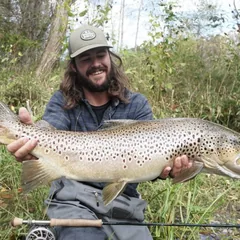
North Georgia Rivers
Delayed Harvest North Georgia: 7 Best Trout Streams
 Daniel Bowman
Updated October 2, 2026
16 min read
Daniel Bowman
Updated October 2, 2026
16 min read

The short version
Delayed harvest is North Georgia's best cold-weather trout fishing. Designated stretches are stocked heavily and managed catch-and-release, single-hook artificial lures only, from November 1 through May 14 — so trout pile up over the winter and get caught and released over and over, keeping trout density on quality DH water far higher than ordinary stocked streams. Georgia designates five DH streams: the Toccoa River (above Lake Blue Ridge), Amicalola Creek (Dawsonville), Smith Creek (Unicoi/Helen), the metro Chattahoochee River (Sope Creek to US 41, near Atlanta), and the remote Chattooga River on the South Carolina line. Just across the state line, the Tuckasegee in North Carolina runs a parallel DH program (October 1 until the Friday night before the first June Saturday) that pulls in plenty of Georgia anglers. Best DH window: December through March, fished on the warmest part of the day with midges, eggs, small nymphs, and slow-stripped streamers. If you want one trip on stocked-loaded water with a guide handling the flows and flies, a guided trip on the Toccoa tailwater or the Tuckasegee DH water is the highest-percentage day on the calendar.
Most anglers who ask about delayed harvest in North Georgia are really asking one of two things: where are the streams, and which one should I fish first. This guide answers both. I've ranked the region's delayed-harvest water by how it actually fishes for a visiting or first-time DH angler — access, trout density, scenery, and how forgiving the day is — not just by reputation. Below the ranking you'll find the regulations, the seasonal calendar, the fly box, and the mistakes that cost people fish on stocked DH water.
What is delayed harvest, and why does it fish so well?
Delayed harvest is a regulatory framework that turns ordinary stocked trout water into the most productive fishing of the cold months. The state stocks designated stretches heavily through fall, winter, and early spring, then manages them as catch-and-release, one-hook artificials only from November 1 through May 14. After the regulated window closes in spring, the same water opens to general harvest regulations for the summer.
Three things make DH water fish far better than standard stocked streams:
- The fish never leave. Because no trout get harvested in the regulated window, the stockings stack on top of each other all winter. A stretch stocked monthly from November through April holds the cumulative total, not just the last load.
- They get educated, not removed. Stocked trout in a harvest stream are caught once and kept. In DH water the same fish gets caught and released repeatedly — which keeps trout density high and, by late season, makes the fishing genuinely technical.
- Density runs high. Because DH stretches are stocked monthly through the season — much of it from the federal hatchery system that supplies the stockings — and nothing is harvested, quality DH water carries far more catchable trout per mile than an ordinary stocked stream, often by a wide margin. That stacked density is the entire reason DH streams are the right call when freestone creeks go dormant in the cold.
The mechanism is the same in Georgia and across the line in North Carolina. The difference is the calendar and the water type, which is exactly what the ranking below sorts out.
The 7 best delayed-harvest streams for North Georgia anglers
These are ranked for an angler driving from metro Atlanta who wants the best combination of catch rate, access, and overall day. Numbers 1, 3, 4 and 5 are Georgia delayed-harvest streams; number 2 is the North Carolina DH water many Georgia anglers fold into their rotation; 6–7 are the high-value tailwater and wild-water alternatives worth knowing when DH water is crowded or you want a different experience.
1. Toccoa River — the all-around best DH day in Georgia
The Toccoa delayed-harvest stretch is the strongest DH option in the state, and the one I'd send a first-time DH angler to. It sits on Forest Service land upstream of Lake Blue Ridge, from 0.4 mile above Shallowford Bridge up to the Sandy Bottom Canoe Access. It is freestone water, so rain sets the level, not a dam. The bonus is what sits 20 minutes away: the Toccoa tailwater below Blue Ridge Dam, whose cold bottom release keeps trout active all winter. One trip covers stocked DH water in the morning and the tailwater in the afternoon.
- Where: Upstream of Lake Blue Ridge, Fannin County, about 90 minutes north of Atlanta.
- Why it ranks first: DH stocking density on public water, with the year-round-cold tailwater a short drive away. Wade the DH water, then wade or float the tailwater.
- The catch: on the DH water, rain; a heavy storm runs it high and stained. On the tailwater, TVA's generation schedule. The dam's single generating unit swings flows from about 150 cfs to about 1,650 cfs, and you cannot wade safely during generation. A guided float on the tailwater sidesteps this, because you fish through generation from the boat.
- Go deeper: the full Toccoa River guide covers access, generation logistics, and the Toccoa delayed-harvest stretch boundaries.
2. Tuckasegee River (NC) — the highest catch numbers on a float
If pure numbers are the goal, the Tuckasegee across the North Carolina line beats anything in Georgia. North Carolina's DH program runs October 1 to the eve of June's first Saturday, a longer window than Georgia's, on water wide enough for full-day drift-boat floats. The DH stretches are stocked so heavily that 15–40 trout on a strong day is a realistic expectation, with the occasional 18-inch-plus holdover.
- Where: the delayed-harvest water is in Jackson County, NC, running down from the NC 107 bridge to a falls, marked by signs, about 275 yards above the US 23-441 bridge; about 90 minutes from Blue Ridge, GA.
- Why it ranks this high: highest DH trout density of any water in the region, drift-boat-friendly, longer DH season than Georgia.
- The catch: a separate North Carolina license is required (trout water is included) — a Georgia license does not cover it. Duke Energy's generation drives the flows the way TVA's does on the Toccoa.
- Go deeper: the Tuckasegee delayed-harvest water breakdown and the full Tuckasegee River guide.
3. Amicalola Creek — the best wadeable DH water near North Atlanta
Amicalola Creek in Dawson County is the delayed-harvest stream most North Atlanta anglers can reach fastest, and it wades better than most. The DH stretch runs through a scenic, rocky freestone corridor — pocket water, runs, and pools rather than big-river current — which makes it ideal for a wade angler who wants to fish on foot rather than from a boat.
- Where: Dawson County, near Dawsonville/Amicalola Falls, roughly an hour to 75 minutes from north metro Atlanta.
- Why it ranks here: short drive for North Atlanta, genuine wade access, classic freestone DH character with heavy stocking.
- The catch: it's a freestone creek, not a tailwater — so it fishes coldest and slowest in a deep freeze, and it can blow out and run high for a day or two after heavy rain. Watch the weather and fish the warmest hours.
- Note: verify the exact DH boundary signs on the water — the regulated stretch is marked, and the surrounding water is general-regulation.
4. Smith Creek — the most beginner-friendly DH stretch
Smith Creek below Unicoi Lake near Helen is the easiest delayed-harvest water in Georgia to fish, which makes it the right pick for a first DH outing or a trip with kids. It's a small, gentle, accessible creek tucked into the Unicoi State Park area — short casts, easy footing, and stocked-loaded DH water that produces willing fish without demanding much technique.
- Where: Below Unicoi Lake near Helen, White County, about 90 minutes from Atlanta.
- Why it ranks here: the most forgiving DH water in the state — small, easy to wade, family-friendly, close to Helen's lodging and amenities.
- The catch: it's small and well-known, so it draws pressure on warm winter weekends. Go on a weekday or early in the morning, and you'll often have stretches to yourself.
- Pair it with: Helen makes a natural base — the trout fishing in Helen, GA rundown covers the wider area.
5. Chattahoochee River (metro DH section) — DH trout inside the metro
The metro Chattahoochee is the delayed-harvest stretch you can fish without leaving Atlanta. The cold bottom-release water below Buford and Morgan Falls dams runs cold enough to hold trout, and the DH section is signed from Sope Creek downstream to US Highway 41 (Cobb Parkway), managed catch-and-release through May 14. For a city angler who wants DH trout on a weeknight, nothing else in the region is this close.
- Where: The metro Atlanta Chattahoochee, from Sope Creek to US 41, within the city's reach.
- Why it ranks here: unbeatable for access — DH trout fishing inside the metro, no long drive required.
- The catch: it's an urban tailwater with crowds, foot traffic, and its own flow schedule below the dam. The fishing quality is real but the experience is city-river, not mountain-stream.
- Go deeper: the North Georgia rivers ultimate guide maps how the Chattahoochee fits the wider regional picture.
6. Soque River (private) — when you want trophies
The Soque isn't delayed-harvest water — it's a private freestone managed catch-and-release, fished from late September to early June, but it earns a spot here because it's the answer to the question DH anglers eventually ask: where do I go for size instead of numbers? The Soque grows and re-grows genuine 20-to-28-inch brown trout on limited-pressure private water, and it fishes through the winter when freestone creeks are slow.
- Where: Habersham County, near Clarkesville, about 90 minutes from Atlanta.
- Why it's here: the trophy alternative to DH numbers — much bigger fish, from September 20 to June 10 on clear private water.
- The trade-off: a long drive and private-water rates, for much bigger fish; Bowman says first-timers catch plenty of them too.
- Go deeper: the Soque River guide.
7. Toccoa & Chattahoochee tailwaters (year-round) — the non-DH winter backup
Worth knowing as a group: the Toccoa tailwater, and the Chattahoochee tailwater outside its DH section, fish well all winter, because the steady cold-water dam releases keep trout active when air temperature drops. When the DH water is crowded on a bluebird Saturday, the broader tailwater is your pressure-relief valve.
- Why it's here: a reliable cold-month fallback when DH stretches are packed.
- The mechanism: dam-controlled water temperature, not air temperature — the same reason tailwaters out-fish freestone in the dead of winter.
- Best paired with: a DH morning and a tailwater afternoon on the same Toccoa trip.
Delayed-harvest stream comparison
A side-by-side of the region's DH-relevant water for a metro-Atlanta angler. Drive times are approximate from north metro.
| Stream | State | Type | DH season | Drive | Best for | Wade or float |
|---|---|---|---|---|---|---|
| Toccoa River | GA | Freestone, above the lake | Nov 1 – May 14 | ~90 min | All-around best DH day | Both |
| Tuckasegee River | NC | Tailwater | Oct 1 – early Jun | ~3 hr | Highest catch numbers | Float |
| Amicalola Creek | GA | Freestone | Nov 1 – May 14 | ~60–75 min | Wadeable, close to N. Atlanta | Wade |
| Smith Creek | GA | Small creek | Nov 1 – May 14 | ~90 min | Beginners & families | Wade |
| Chattahoochee (Sope Ck–US 41) | GA | Tailwater | Nov 1 – May 14 | In metro | DH trout inside Atlanta | Wade |
| Soque River (private) | GA | Private freestone | C&R, fished September to early June | ~90 min | Trophies | Wade |
Confirm current dates and boundaries at the Georgia Wildlife Resources Division trout regulations page before you fish — DH boundaries are signed per stream and the season window can shift year to year.
Delayed-harvest regulations in North Georgia
Georgia's delayed-harvest regulations are simple, and breaking them in the regulated window is a citable offense — so know them before you go. On every Georgia DH stretch during the regulated season:
- Catch-and-release only. No harvest of trout in the regulated window. You may not keep a fish, even one you intend to release later.
- Artificial lures only. Single-hook artificial flies or lures. No bait — no live bait, no scented bait, no corn. Treble hooks are not permitted on DH water.
- Season runs November 1 through May 14. All of Georgia's DH stretches share the same window; on May 15 the water reverts to general harvest regulations for the summer.
- Boundaries are signed. The upper and lower limits of each DH stretch are marked on the water. Outside the signs, general trout regulations apply.
North Carolina's program on the Tuckasegee follows the same catch-and-release, single-hook-artificial logic but on a different calendar, from October 1 through the night before the first Saturday of June, and requires a separate NC license. Regulations evolve, so verify current rules and boundaries at the Georgia Wildlife Resources Division trout regulations page before you go, and check NC rules separately if you cross the line.
When does delayed-harvest fishing peak?
Delayed harvest fishes from the November 1 opener through the May 14 close, but the season breaks into distinct phases that change how you fish it:
- November (opener): The first heavy stockings hit the water and the fish are fresh, naive, and aggressive. Easy fishing — eggs, squirmy worms, and small streamers clean up. The most forgiving DH fishing of the year.
- December–February (peak density): Stockings have stacked up and the water holds its highest trout numbers. This is the heart of DH season. The fish have seen some pressure, so the fishing tightens up, but density carries the day. Fish the warmest part of the day — midday to early afternoon — when water temps tick up and trout feed.
- March–April (technical): Months of catch-and-release pressure have educated the fish. Density is still high but presentations need to be cleaner — smaller flies, finer tippet, drag-free drifts. Spring hatches start, and dry-fly chances open on warmer afternoons.
- May (close): The final stockings flush the water before the May 14 transition to general regulations. Numbers are strong but the fish are the most-pressured of the season.
For the best combination of high numbers and manageable difficulty, target December through early March. For the easiest fishing, go right at the November opener. The winter fly fishing North Georgia playbook covers the cold-weather tactics in detail.
Flies and gear for North Georgia delayed harvest
DH water rewards a focused cold-water fly box and a willingness to fish slow and deep. The trout are stocked-and-holdover fish in cold water, so subsurface presentations carry most days, with dries earning chances on warm afternoons.
The DH fly box — must-haves:
- Egg patterns and squirmy worms (sizes 10–14) — the opener and post-stocking standby. Stocked trout key on eggs hard.
- Zebra midges (sizes 18–22, black and red) — the winter workhorse on every DH stream.
- Pheasant Tail and Hare's Ear nymphs (sizes 14–18) — the dependable searching nymphs.
- Sowbugs and scuds (sizes 16–18) — especially on the tailwater DH stretches.
- Pat's Rubber Legs (sizes 8–12) — a big attractor nymph for stained, higher water.
- Blue-winged Olive emergers and parachutes (sizes 18–22) — for the BWO hatches that pop on warmer winter and early-spring afternoons.
- Woolly Buggers and small articulated streamers (sizes 4–8, olive/black/white) — slow-stripped, they move the bigger holdover browns when the cold has the fish sluggish.
Gear: a 9-foot 5-weight handles the bigger DH water (Toccoa, Chattahoochee, Tuckasegee) and streamer days. On the smaller DH creeks — Amicalola and Smith — drop to a shorter 7'6"–8'6" rod in 3–4 weight for the tighter water and shorter casts. Run a 9-foot leader to 5X for general nymphing, 6X for technical late-season dry-fly work, and 4X for streamers. Studded or felt soles are essential — DH stream rocks are slick, and they're slicker still in winter. Layer for cold; the productive DH window is the coldest part of the year.
On a guided trip, all of this is supplied — the guide reads the day's flow and stocking and rigs you accordingly, which is most of the value of fishing DH water with a guide.
How to fish a North Georgia DH stream — a worked example
Say it's mid-January and you're fishing the Toccoa DH stretch on a cold, bright morning after a dry week. Here's how the day actually plays:
- Check the flow first. The DH stretch sits above the lake, so a dry week means low, clear, wadeable water, and a hard rain the night before means high, stained water. If you're heading to the tailwater after lunch, confirm the TVA schedule too, because a generation pulse is the one thing that ends a wade trip badly.
- Sleep in, fish the warm window. In January, the bite turns on as water temps creep up. There's little point being on the water at first light. Plan to fish roughly 10 a.m. to 3 p.m. when the water is warmest.
- Start with a nymph rig under an indicator. A zebra midge dropped off a sowbug or Pheasant Tail, weighted to tick the bottom of the deeper runs. DH trout in cold water hold low and slow — get the flies down.
- Read the seams and the heads of pools. Stocked DH trout stack in the deeper runs and the soft water at the heads and tails of pools. Pick those apart with drag-free drifts before moving.
- Switch to a streamer if the nymph goes quiet. A slow-stripped Woolly Bugger swung through a deep run moves the bigger holdover browns that won't chase fast.
- Watch for an afternoon BWO pop. On a mild, overcast January afternoon, Blue-winged Olives can come off. If you see noses, switch to a size 20 BWO emerger and fish to the risers — the most exciting fishing of a winter DH day.
That sequence — get down deep, fish the warm window, work the seams, keep a streamer in reserve — is the template for any North Georgia DH stream. The flies and rod weight change between the big tailwaters and the small creeks, but the logic holds.
Common delayed-harvest mistakes
The patterns that cost anglers fish on DH water:
- Fishing too early in the day. In winter, the bite follows the warmest hours. Anglers who arrive at dawn often fish through the dead window and leave before the afternoon turn-on.
- Fishing too shallow. Cold-water DH trout hold low. Indicator set too short, flies riding above the fish — the single most common DH miss. Get the nymphs to the bottom.
- Bringing bait or treble hooks. Single-hook artificial-only is non-negotiable in the regulated window. A scented soft-plastic or a treble-hooked lure is a violation even if you release every fish.
- Ignoring the boundary signs. DH regulations apply only between the marked limits. Anglers who drift outside the signs are fishing general-regulation water under different rules.
- Expecting opener-easy fishing in March. Late-season DH fish have been caught and released for months and are genuinely selective. If late-season fishing feels slow, downsize flies and tippet before you blame the water.
- Skipping the tailwater backup. When the DH stretch is shoulder-to-shoulder on a warm Saturday, the tailwater water outside the DH boundaries, including the Toccoa below Blue Ridge Dam, is the pressure valve most anglers forget.
- Not checking generation on the tailwaters. On the Chattahoochee DH water and the Toccoa tailwater, the dam schedule governs the day. Wading a tailwater without checking the release schedule is the one mistake that's actually dangerous, not just unproductive.
Frequently Asked Questions
What delayed-harvest streams are in North Georgia?
Georgia designates five official delayed-harvest trout streams: the Toccoa River above Lake Blue Ridge, Amicalola Creek near Dawsonville, Smith Creek below Unicoi Lake near Helen, the metro Chattahoochee River (Sope Creek to US 41), and the remote Chattooga River on the South Carolina line. Just across the state line, the Tuckasegee in western North Carolina runs a parallel DH program that many Georgia anglers fold into their rotation. The private Soque isn't DH water but is the go-to catch-and-release alternative for trophy-size fish from fall through spring.
When is delayed-harvest season in Georgia?
Georgia's delayed-harvest season runs November 1 through May 14 on every DH stretch. During that window the water is catch-and-release, single-hook artificial-only. On May 15 the stretches revert to general harvest regulations for the summer. North Carolina's Tuckasegee DH program runs October 1 to the Friday evening before June's first Saturday.
What are the delayed-harvest regulations?
Catch-and-release only, single-hook artificial flies or lures only, no bait, no treble hooks, from November 1 through May 14 on Georgia DH water. You may not keep any trout in the regulated window. Boundaries are marked with signs on each stretch; outside the signs, general trout regulations apply. Verify current rules at the Georgia Wildlife Resources Division trout regulations page before fishing.
What is the best delayed-harvest stream in North Georgia?
For an all-around best day, the Toccoa: stocked DH water above the lake in the morning, then the cold tailwater below Blue Ridge Dam in the afternoon, waded or floated. For the highest catch numbers, the Tuckasegee across the NC line, where 15–40 trout on a strong day is realistic from a drift boat. For the fastest drive from North Atlanta, wadeable Amicalola Creek. For beginners and families, gentle Smith Creek near Helen.
When does delayed-harvest fishing peak?
December through early March is the peak window — months of stocking have stacked up the highest trout density of the year, and the fish are still catchable before late-season pressure makes them selective. The November opener is the easiest fishing as fresh stocked fish are aggressive. Fish the warmest part of the day in winter, roughly midday to early afternoon, when water temperatures rise and trout feed.
What flies work best on delayed-harvest water?
Egg patterns and squirmy worms at the opener and after each stocking; zebra midges (18–22) as the winter workhorse; Pheasant Tail and Hare's Ear nymphs (14–18) as searching patterns; sowbugs and scuds on the tailwaters; Blue-winged Olive emergers (18–22) for warm-afternoon hatches; and Woolly Buggers or small streamers slow-stripped for the bigger holdover browns. Fish nymphs deep — cold-water DH trout hold low in the runs and pools.
Do I need a license to fish North Georgia delayed-harvest streams?
Yes. Anyone 16 or older needs a valid Georgia fishing license plus a trout license for any trout water, including DH streams. Licenses are available online or at outdoor retailers. The Tuckasegee in North Carolina requires a separate North Carolina inland license, which includes trout water; a Georgia license does not cover NC waters. Buy it online before a guided trip, too.
Can beginners fish delayed-harvest streams?
Yes — DH water is one of the best places to learn, because the high trout density means more chances to hook fish than almost any other water. Smith Creek near Helen is the most beginner-friendly Georgia DH stretch: small, gentle, easy wading. The Toccoa tailwater and the Tuckasegee suit beginners too when fished as a guided drift-boat float, where the guide rows while you fish and the catch numbers keep a new angler engaged. Book a guided delayed-harvest trip for a first DH outing and skip the logistics learning curve.
Want to fish the DH season right?
Book a guided North Georgia delayed-harvest trip — gear, flies, and the day's best water handled.
Toccoa River float trip, from $425 per boat · 4.9 stars on Google
See the trip or Toccoa River →