North Georgia Rivers
Etowah River Fly Fishing: A Beginner Starter Guide
 Daniel Bowman
Updated October 1, 2026
12 min read
Daniel Bowman
Updated October 1, 2026
12 min read

The Etowah River is the best place in North Georgia to learn fly fishing, and it earns that title for plain, practical reasons. It is the closest trout water to Atlanta — roughly 75 minutes from Buckhead. It is small enough that you do not need a long cast to catch fish. And it holds a mix of stocked and wild trout that are forgiving of a beginner's drift. If you have never held a fly rod and you want a river that rewards effort instead of punishing mistakes, the Etowah is where you start.
The short version
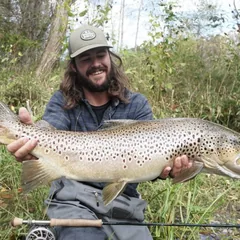
Beginners should start on the middle Etowah near Dahlonega, where the river runs 30–50 feet wide, mostly thigh-deep, and easy to wade. You need a short rod (7'6"–8'6", 3 or 4 weight), felt or studded wading shoes, and a basic fly box — or a guide who supplies all of it. The two best learning seasons are April through early June (active hatches, willing fish) and the first weeks after spring stocking, when trout eat almost anything drifted well. Anyone 16 or older needs a Georgia fishing license plus a trout license. On Bowman's private vineyard water, Bowman says even first-timers have great success catching both quantity and big fish, which is how the cast, the drift and the hookset stick.
Why is the Etowah good for beginners?
The Etowah suits beginners because it removes the three things that frustrate new fly anglers most: long casting, dangerous wading, and empty water. On bigger rivers you need 40-foot casts to reach fish; on the Etowah a 15–25-foot cast covers most of the water you will fish all day. The wading is mostly thigh-deep through the holding runs, so you spend your attention on the drift instead of on staying upright. And the middle section near Dahlonega is stocked through the spring trout season, which means fish are present and feeding while you are still learning to read where they hold.
There is also a confidence factor that matters more than people admit. A first day with a few fish in hand builds the habit; a first day getting shut out usually kills it. The Etowah is forgiving enough to give a beginner that first-day success — especially in the weeks right after a stocking, when the fish have not yet learned to be selective. That, plus the short drive, is a big reason the Etowah is such a common first trip. The reason that mix of stocked and wild trout holds up year after year comes down to cool, clean flow — the same water quality that conservation groups tracking the health of rivers like the Etowah spend their effort protecting, and the reason the upper feeders stay fishable when the main stem warms.
Where on the Etowah should a beginner fish?
Beginners should fish the middle Etowah between Dahlonega and Dawsonville — not the tiny headwaters and not the warmwater lower river. The Etowah's trout water breaks into three zones, and only the middle one is built for learning:
- Upper Etowah (headwaters above Dahlonega): wild rainbow and brook trout in water that often runs 10–20 feet wide. Beautiful, but the tight cover and spooky wild fish make it a poor first classroom.
- Middle Etowah (Dahlonega to Dawsonville): the beginner zone. Stocked and holdover trout, 30–50 feet of fishable width, wadeable runs, and the private vineyard water Bowman fishes.
- Lower Etowah (below Dawsonville toward Cumming): warmwater bass and panfish — no longer a trout option.
Within the middle zone, your two real choices are public access and private guided water. Public stretches like the Dawson Forest WMA shoals and the bridge crossings get stocked and let you scout on your own, but they take weekend pressure and the best runs are knowledge-driven. For a complete breakdown of every public option, see our guide to Etowah access points. The private alternative is Bowman's two-mile vineyard lease north of Dahlonega — limited pressure, bigger holdover fish, and a guide who already knows which run is producing that week.
What gear does a beginner need for the Etowah?
A beginner needs a short rod, a simple line-and-leader setup, slick-bottom wading shoes, and about a dozen flies — and on a guided trip, none of it has to be your own. Here is the honest starter list, sized specifically for the Etowah's small water.
| Item | Beginner spec for the Etowah | Why it matters here |
|---|---|---|
| Rod | 7'6"–8'6", 3 or 4 weight | The river is tight; a 9-foot 5-weight feels overpowered and tangles in cover |
| Line | Weight-forward or double-taper floating, matched to rod | Short, accurate casts beat long ones on small water |
| Leader | 7.5–9 ft, tapered to 5X | Long leaders create wind knots in tight casting lanes |
| Tippet | 5X general, 6X for fussy dry-fly fish | Light enough to fool stocked trout that have seen pressure |
| Wading shoes | Felt or studded soles | Etowah rocks are genuinely slick — this is a safety item, not a luxury |
| Flies | ~12 patterns (see below) | Covers nymph, dry, and post-stocking situations |
If you are buying your first box, these patterns cover nearly every Etowah day:
- Parachute Adams (size 12–18) — the all-purpose dry fly
- Elk Hair Caddis (size 14–16, tan and olive)
- Pheasant Tail nymph (size 14–18)
- Hare's Ear nymph (size 14–18)
- Squirmy worm and egg patterns — deadly the first weeks after stocking
- Foam beetle and ant (size 14–16) — summer terrestrials
- Woolly Bugger (size 8–10, black and olive) — your streamer
The simplest path for a first trip is to bring nothing. On a guided Bowman trip the rod, reel, line, flies, and waders are all supplied — you show up with a license, polarized sunglasses, and a willingness to learn. That removes the single most expensive barrier to trying the sport: buying a kit before you know whether you like it.
When is the best time for a beginner to fly fish the Etowah?
The best beginner windows are April through early June and the two to three weeks following each spring stocking. Both put willing, feeding fish in front of you while you are still learning the mechanics. A beginner-focused calendar looks like this:
- February–March: Cold and slow. Nymphing on the bottom with small midges and stoneflies. Doable, but a tougher first day — skip it unless you want a challenge.
- April: The richest dry-fly month — Quill Gordons, Hendricksons, Blue Quills, and Grannom caddis. Fish look up. Best month of the year for a beginner.
- May: Sulphurs and March Browns, plus evening spinner falls. Still excellent, with longer fishable days.
- June: Light Cahills and Yellow Sallies early, terrestrials arriving. Fish early morning and evening as the days warm.
- July–August: Terrestrial season — beetles, ants, hoppers. Productive at dawn and dusk only; mid-day in the middle Etowah runs too warm. Fish the cooler upper feeders instead.
- September: Cooling water, returning caddis, and morning Tricos. A quietly excellent and underrated beginner month.
- October–November: Streamer season as brown trout get aggressive before the spawn. Fewer dry-fly bites but bigger fish on the bank.
- December–January: Technical midge fishing for fewer bites. For patient learners only.
If you want one sentence to plan around: book an April or May morning, or go within three weeks of a stocking, and you will have fish to practice on.
What license does a beginner need on the Etowah?
Two licenses, bought online before you go: a Georgia fishing license and the trout license that goes with it. Every angler 16 or older needs both on Etowah trout water, guided or not. Anglers under 16 need neither. Here is what they cost:
- Georgia residents: $15 for the annual fishing license and $10 for the annual trout license, so $25 for the year.
- Visitors from out of state: $10 for a one-day fishing license and $10 for a one-day trout license, so $20 for a single day.
- Where to buy: the Go Outdoors Georgia portal. The license can live on your phone.
- Guided trips: the license is yours to buy. Everything else, from special rules to size and catch limits, is the guide's job.
Carry proof of your license whenever you fish public water on your own. The same license rules apply on Bowman's private vineyard beat, so buy it online before the trip.
What is a beginner's first day actually like?
A beginner's first guided day on the Etowah follows a predictable, low-pressure arc — and knowing it in advance takes most of the first-timer nerves away. Here is how a typical Bowman vineyard trip unfolds:
- Meet at the gate (8:00–8:30 AM). The guide rigs your rod, hands you waders, and walks you through the plan and the day's water report.
- A casting primer streamside. Before you fish, the guide gives you the short version of the cast — enough to fish, not a full lesson. Ten minutes, not an hour.
- First run, first fish. On stocked or holdover water, the first fish often comes inside the first 30 minutes. Early success is the whole point.
- Rotating the runs. Through the morning the guide moves you through four to six named pools and runs, coaching your drift and your hookset between fish.
- Lunch midday. Bowman provides lunch on full-day trips — a real break to reset before the afternoon.
- Afternoon and take-out. Deeper runs and pocket water in the afternoon; as the sun drops, dry-fly chances open up in spring and fall. Walk back, break down gear, and tip the guide (15–20% is standard).
For a fuller, non-Etowah-specific walkthrough of the experience, read what to expect on a first guided trip. A beginner learns far more from a day of hookups than from a day of perfect but fishless casting, which is the case for starting on private water.
What mistakes do Etowah beginners make most?
The most common beginner mistakes on the Etowah are bringing too much rod, wading too aggressively, and drifting too long. None of them are about talent — they are habits, and they are easy to fix once you know to watch for them.
- Too much rod. A 9-foot 5-weight overpowers small water and snags the tight cover. Go shorter and lighter.
- Wading like you are in a hurry. Etowah trout in low water spook from heavy footsteps and pushed water. Approach slowly, fish from below, and stop moving before you start casting.
- Drifting too far. Etowah pocket water rewards short, controlled drifts of 3–6 feet. A long mended drift just drags.
- Wrong indicator depth. A lot of holding water is only 18–24 inches deep. Beginners who set their indicator 4–5 feet down fish right past the trout.
- Ignoring the tributary mouths. The seams where cool feeder creeks enter the main stem hold fish reliably. Give them a careful cast every time.
- Setting the hook too hard. On 5X tippet a violent strike snaps off fish. A smooth lift, not a yank, lands more trout.
If you want to read more broadly about the river's character — the vineyard water, hatches, and water levels — the complete guide to fly fishing the Etowah goes deeper than any starter article can. And if you are weighing the Etowah against other entry-level options, our roundup of beginner-friendly North Georgia rivers lays out the alternatives side by side.
Should a beginner book a guide or go it alone?
A beginner should book a guide for the first one or two Etowah trips, then go solo once the fundamentals stick. The math is simple: the cost of a guided day buys you a compressed season's worth of learning, plus gear you do not have to purchase before you know you will use it. Here is the honest comparison.
| Factor | DIY first trip | Guided first trip |
|---|---|---|
| Gear cost up front | $400–800+ for a starter kit | $0 — all supplied |
| Finding fish | Hours of trial and error | Guide knows the producing runs |
| Casting + drift coaching | None | Real-time correction all day |
| Typical fish caught | Often 0–3 | 8–15 (half-day) |
| Wading safety | On your own | Guided through the safe lines |
| Best for | Patient self-teachers | Anyone who wants to actually catch fish day one |
There is nothing wrong with the DIY path — many anglers learn that way and love it. But if your goal is to catch trout on your first day and decide whether the sport is for you, a guide is the highest-leverage way to start. Bowman's beginner Etowah trips are built for exactly this: short water, willing fish, and a guide whose whole job is getting a first-timer into trout. You can find a beginner-friendly trip through the trip finder or by calling the shop.
Beyond the river: making a weekend of it
Many beginners pair an Etowah trip with a weekend in the North Georgia mountains, and Dahlonega makes that easy — it is a walkable historic gold-rush town with wineries, restaurants, and lodging fifteen minutes from the water. If you are traveling to fish, the region around the Etowah is worth planning a full trip around: book your guided morning first, then build the rest of the weekend around it with dinner reservations and a room in town. A morning on the water and an afternoon in town is a popular first-timer itinerary, and it takes the pressure off the fishing — if the trout are slow, the weekend still wins.
Frequently Asked Questions
Is the Etowah River good for beginner fly fishing?
Yes — the Etowah is widely considered the best beginner trout river in North Georgia. It is the closest trout water to Atlanta (about 75 minutes), small enough that long casts are not required, and stocked through the spring season so fish are present while you learn. The middle section near Dahlonega offers easy, mostly thigh-deep wading and a mix of forgiving stocked and holdover trout.
What rod should a beginner use on the Etowah?
A 7'6" to 8'6" rod in 3 or 4 weight is the right beginner choice for the Etowah's small water. A 9-foot 5-weight will technically work but feels overpowered and tangles in the tight cover. Pair it with a weight-forward floating line and a 7.5–9 foot leader to 5X tippet. On a guided trip the rod and full setup are supplied, so you do not need to buy anything to start.
Do I need a license to fish the Etowah as a beginner?
If you are 16 or older, yes: a Georgia fishing license plus the trout license. A Georgia resident pays $25 for both for the year; a visitor can buy both for a single day for $20. Under 16, no license is needed. Buy them at Go Outdoors Georgia before the trip, since the guide can't sell them at the river.
When should a beginner fish the Etowah for the first time?
April through early June is the best beginner window — active hatches and willing fish. The two to three weeks following each spring stocking are also ideal, when trout eat almost anything drifted well. Avoid mid-summer mid-day, when the middle Etowah warms and fish slow down, and skip the deep-winter midge fishing until you have more experience.
How many fish will a beginner catch on the Etowah?
On Bowman's private vineyard water, Bowman says even first-timers have great success catching both quantity and big fish. DIY first trips on public water vary widely until you learn where trout hold. The point of a guided first day is the volume of hookups — that is how the cast, drift, and hookset actually stick.
Is wading the Etowah safe for beginners?
Yes, in normal flows the middle Etowah is mostly thigh-deep and safe to wade with proper footwear. Felt or studded sole wading shoes are essential because the rocks are slick. Avoid wading when the river runs high: above 400 cfs on the GA 9 gauge near Dawsonville, which Bowman calls high, some sections become unsafe. A guide keeps beginners on the safe wading lines and reads the water level before you step in.
Do I need my own gear for a guided Etowah trip?
No. On a guided Bowman Etowah trip the rod, reel, line, flies, and waders are all supplied. You bring a Georgia fishing license, polarized sunglasses, a hat, and layered clothing. Bowman fishes the vineyard water from September 20 to June 15. Removing the up-front gear cost is one reason a guided trip is the cheapest way to find out whether fly fishing is for you before buying a kit.
How far is the Etowah from Atlanta for a first trip?
The Etowah vineyard water is about 75 minutes from Buckhead and 90 minutes from downtown Atlanta — GA-400 north to Dahlonega, then a short county-road drive to the gate. For anglers leaving from Cumming, Alpharetta, Roswell, or Dawsonville, the drive drops to 30–60 minutes, making the Etowah the closest guided trout fishery for most of the north Atlanta suburbs.
New to fly fishing? Start on the Etowah.
Bowman runs beginner-friendly guided Etowah trips with all gear supplied. Use the trip finder or call (706) 963-0435.
Etowah River private water trip, from $400 · 4.9 stars on Google
See the trip or Find Your Trip →