Trip Planning
Is Private Water Fly Fishing Worth the Cost?
 Daniel Bowman
Updated October 2, 2026
12 min read
Daniel Bowman
Updated October 2, 2026
12 min read

The short version
Private water fly fishing is worth the cost when your goal is a trophy trout, low pressure, or a high-confidence first guided trip — and it's not worth it when you mostly want a high number of fish or a budget day on the water. The premium pays for three things public water can't give you: bigger, less-pressured fish (wild and holdover browns to 22–28 inches on Georgia's Soque), guaranteed elbow room, and a bundled day rate where the lease, the guide, and every piece of gear come in one number — from $400 for a half-day (one angler) to $900 for a full day (three anglers). If you only care about catch count, the Toccoa tailwater float at $425 half / $575 full lands far more fish per day for less money. The honest test: are you buying a fish or buying fish-per-hour?
Is private water fly fishing worth the cost?
Private water fly fishing is worth the cost for anglers chasing a trophy fish, a low-pressure day, or a near-guaranteed first guided trip — and it isn't worth it for anglers who measure a good day purely in catch count. That's the whole decision in one sentence, and everything below is the math behind it.
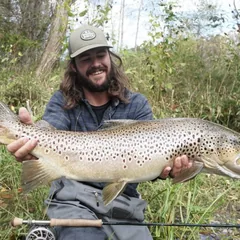
Here's the thing most pricing pages won't tell you straight: you are not paying a premium for water. Water is free. You're paying for what the water doesn't have on it — other anglers — and for the fish that grow large precisely because almost nobody fishes them. On a leased trophy beat of the Soque River, the browns don't see hundreds of drifts a week. They see a handful of guided clients. That's why they live long enough to reach 24 inches, and that's the single biggest thing your money buys.
After more than 10 years guiding North Georgia water, the question I get most from researchers comparing options isn't "how much" — it's "is it actually worth it for me." The answer is genuinely yes for some people and genuinely no for others. This article is the framework I'd give a friend.
What does private water fly fishing actually cost?
A guided private water day in North Georgia runs $400 to $900 on standard water for the trip itself, depending on three variables: half-day or full-day, number of anglers, and which beat you fish. Here's the full 2026 breakdown:
| Trip type | 1 angler | 2 anglers | 3 anglers |
|---|---|---|---|
| Half-day wade (private water) | $400 | $550 | $675 |
| Full-day wade (private water) | $550 | $725 | $900 |
| Dragonfly half-day (premium Soque beat) | $520 | $720 | $920 |
| Half-day float (Toccoa) | $425 | $425 | n/a (max 2) |
| Full-day float | $575 | $575 | n/a (max 2) |
| Corporate (per person) | $190 half / $260 full | — | — |
That number is all-in for the guide and the water together. There's no separate stream fee or lease pass — the access cost is baked into the rate. Not included: your Georgia fishing license and trout license (residents $15 + $10 a year; nonresidents $10 + $10 for a day), lunch on a half day (full days include a riverside lunch), and the standard 15–20% tip. For one angler on a $400 half day, that adds roughly $80 to $105 in licenses and tip, more for a group. For the complete pricing logic across every trip type, the guided fly fishing trip cost breakdown is the parent guide.
The most important cost lever most people miss: splitting a beat. A solo half-day is $400. Add a second angler and it's $550, only $275 per head. Add a third and it's $675, or $225 each. The water and guide cost roughly the same whether one rod or three is on the beat, so the per-person price drops fast. A trophy day that feels expensive solo pencils out cleanly for a pair or a trio.
What are you actually paying for?
You're paying for four things, and only one of them is the guide's time. Understanding the stack is how you decide whether it's worth it:
- The lease. Landowners along the trophy stretch of the Soque lease their fishing rights to outfitters rather than open the bank to the public. That lease is real money the outfitter pays whether you book or not, and it's the reason the water exists as a product at all.
- The fish. Low pressure is the entire game. A trout that sees five drifts a week behaves nothing like one that sees five hundred. Private fish are bigger, less educated relative to their size, and far more willing to eat than a hammered public-water trout of the same length.
- The guide. An expert who reads the water, rigs for conditions, positions you in the right seam, and teaches you to mend in real time. On the Soque, the guide is the difference between a good day and a personal best.
- All the gear. Rod, reel, line, leader, tippet, flies, waders, and boots — provided and dialed in for the exact water you're on. Buying that kit yourself runs $500–$1,500, and you'd buy the wrong thing your first time.
When people say private water is "too expensive," they're usually pricing only line 3 — the guide's day — and forgetting that lines 1, 2, and 4 are bundled in. The all-inclusive rate is part of the value, not a markup.
Private water vs public water: a straight comparison
Here's the honest side-by-side. Neither is "better" — they're built for different goals.
| Factor | Private water | Public water |
|---|---|---|
| Typical day rate | $400–$900 (guide + water) | License fees only (from $20 a day for nonresidents) |
| Pressure | A handful of anglers/week | Heavy, especially weekends |
| Biggest fish | Trout to 28" | Mostly stockers 8–14" |
| Average fish | 17"+ (Etowah) and 18"+ (Soque) on Bowman's water | Smaller |
| Crowding | Guaranteed elbow room | Can be combat fishing |
| Skill required | Guide handles it; beginner friendly | All on you |
| Best for | Trophy hunt, first trip, milestone | Volume days, repeat reps, budget |
Public water in North Georgia is genuinely good — the Toccoa tailwater, the upper Chattooga, the delayed-harvest stretches all fish well. But they fish hard from May through September, and on a spring weekend you're often casting behind anglers who hit the same runs an hour before you. The full breakdown of the trade-off lives in the private water vs public water comparison.
A useful gut-check: if you'd happily catch ten 10-inch stockers, public water is the smart, cheap call. If you'd rather catch two 20-inch wild browns and remember the day for a decade, that's what private water sells. The relationship between cold, low-pressure water and trophy fish is well-documented in the angling literature — Fly Rod & Reel, the long-running fly fishing journal, devoted years of coverage to why that exact combination grows the largest wild trout. Private leases happen to preserve it.
Who is private water worth it for?
Private water is worth the premium for five specific buyers. If you see yourself here, book it:
- The trophy hunter. You want a realistic shot at a 20-inch-plus fish. Private water like the Soque and Bowman's Etowah vineyard water is the consistent place for it, and how that private water access actually works is worth reading before you book. There is no public substitute — full stop.
- The first-time guided angler. Counterintuitive, but true: a beginner's odds of landing a good fish are highest on private water with a guide. The fish are willing, the guide rigs everything, and you learn to cast and read water in a single day instead of a season.
- The milestone trip. Anniversary, retirement, 50th birthday, a buddy's last trip before a move. The Dragonfly, Bowman's premium property at the Soque headwaters, suits exactly this: even more exclusive access, larger fish and a limited calendar. See how Georgia grows these fish in trophy trout fly fishing Georgia.
- The gift buyer. A private water day is a clean, premium, all-inclusive gift — the recipient just shows up. No gear to buy, no access to figure out.
- The group that wants quality, not chaos. A bachelor party or family weekend split across a beat gets a private, uncrowded experience at a per-head price that rivals a round of golf.
Who should skip it?
Private water is genuinely not worth it for three buyers, and I'll tell a client this directly rather than upsell them:
- The volume angler. If a "great day" means a high fish count, the Toccoa tailwater float lands far more fish per day at $425 half / $575 full, and with two anglers it works out to $212.50 each for a half day. You'll catch stockers, not giants, but you'll catch a lot.
- **The budget first-timer who just wants to try it.** If you're not sure you'll like fly fishing at all, a half-day float or a public delayed-harvest stretch is a cheaper way to find out before committing to trophy money.
- The angler with their own access. If you're a member of a club, have a family lease, or fish a productive public stretch you already know cold, you're paying for something you have.
The mistake I see researchers make is assuming "more expensive" means "better for me." It means bigger fish, fewer of them, less company — and whether that's worth it depends entirely on what makes you happy on the water. Be honest about which angler you are.
A worked example: $400 vs $425, side by side
Numbers in the abstract don't help, so picture two anglers with the same budget.
Angler A books a half-day Soque private water wade, $400. On water where Bowman's average fish is 18 inches or better, a few fish can make the day, and one of them could be the biggest trout he has ever seen, sight-fished in clear water with the guide coaching the drift. If size is the goal, that is the trip.
Angler B books a half-day Toccoa float, $425. She and a friend split the boat ($212.50 each) and cover miles of river from a stable drift boat, where browns of 12 to 15 inches are common. Bowman calls its floats a good option for chasing quantity of fish in a day. If a relaxed afternoon with steady action is the goal, that is the trip.
Same money, different days, and both are right. Angler A is buying a shot at a trophy. Angler B is buying a busy day on the water. The price was nearly identical; the product was completely different. That's the entire private-vs-public decision in one paragraph: you're not comparing better and worse, you're comparing size and volume. The Soque sits in the hills north of Gainesville, Georgia, a useful starting point if you want to line up lodging and logistics around the river.
Why private water grows bigger fish — the part that justifies the cost
The premium only makes sense if the fish are genuinely different, so here's why they are. Three factors stack on Georgia's best private water:
- Low pressure. Covered above, and it's the biggest one. Few drifts per week means fish survive to grow large and stay willing to eat.
- Fished only in cool months. Bowman fishes the Soque from September 20 to June 10 and rests it while the water is warm, so the fish are never stressed by summer angling.
- Catch and release. Every fish on Bowman's leased water goes back, so trout live long enough to grow large.
That combination is why Bowman's Soque fish average 18 inches or better, with trout up to 28 inches. No Georgia public water does this. When you pay for private access, you're paying for water that has all three factors at once — and that's genuinely scarce. The October trophy brown season is when the very largest of these fish come out to play.
How to get the most value from a private water day
If you've decided it's worth it, here's how to make sure you get every dollar back:
- Bring a second angler. It's the single biggest value move — it can cut your per-head cost by a third or more without changing the experience.
- Book the right window. May for hatches and sight fishing, late October through mid-November for the biggest pre-spawn browns. Reserve early; the prime dates sell out first.
- Pick the property for your budget. Bowman calls the Soque great for all skill levels, so the choice between standard water and the Dragonfly is mostly about price and occasion.
- Listen to the guide. The fastest way to waste a trophy day is to fish your own way. The guide reads water you can't yet — execute what they say.
- Sort your license ahead of time. Buy your Georgia license and trout stamp online before the morning of, so you're not eating into water time at the put-in.
- Tip for the day, not the catch count. 15–20% is standard. A guide who put you on a giant on a tough day earned the high end even if the number was low.
- Match the river to your goal. Trophy hunt → Soque. Numbers → Toccoa float. Don't book one expecting the other.
Bottom line: private water is worth it when you book it for what it actually delivers. Buy it for a trophy and a quiet river, and you'll feel like you underpaid. Buy it expecting a fish-a-cast bonanza, and you'll feel like you overpaid. Same exact day — your expectation decides the verdict.
Frequently Asked Questions
Is private water fly fishing worth the cost?
Yes, if your goal is a trophy fish, a low-pressure day, or a high-confidence first guided trip — private water is the only consistent path to wild and holdover browns of 22–28 inches in Georgia, and the rate bundles the lease, guide, and all gear in one number. No, if your goal is a high catch count or a budget day; a Toccoa tailwater float lands far more fish per day for less money. The honest test is whether you're buying a fish or buying fish-per-hour.
How much more does private water cost than public water?
A guided private water half-day runs $400 (one angler) to $675 (three), versus a Georgia public-water day that costs only your license fees, $20 for a nonresident day with trout. But the comparison isn't apples to apples: public water is unguided and crowded with mostly stocked 8–14 inch fish, while the private rate includes an expert guide, all gear, and access to lightly pressured wild browns. You're paying for a fundamentally different fishery, not the same one with a surcharge.
Why is private water more expensive?
Because the price covers four things, not one: the lease the outfitter pays the landowner, the low-pressure fish that grow large precisely because few anglers fish them, the expert guide, and all the gear — rod through waders. People who call it overpriced are usually counting only the guide's day and forgetting the other three are bundled in. The all-inclusive rate is the value, not a markup.
Can a beginner justify private water, or should they start on public water?
A beginner's odds of landing a good fish are actually highest on private water with a guide — the fish are willing, the guide rigs everything, and you learn in a day what takes a season alone. That said, if you're not sure you'll even enjoy fly fishing, a cheaper half-day float or a public delayed-harvest stretch is a lower-risk way to test the waters before committing to trophy money. Both are defensible first moves.
Is private water worth it if I just want to catch a lot of fish?
No. If catch count is what makes a day great for you, book the Toccoa tailwater float at $425 half / $575 full, $212.50 each for two anglers on a half day, which Bowman calls a good option for chasing quantity of fish in a day. On private water, Bowman says first-timers catch both quantity and big fish, so the choice is less about count than about the setting and the size of fish you're after.
How can I lower the cost of a private water trip?
Split the beat. A solo half-day is $400, but two anglers is $550 ($275 each) and three is $675 ($225 each) — the water and guide cost roughly the same regardless of how many rods are on it, so the per-head price drops fast. Booking a half-day over a full-day also trims the number. Bringing a second angler is by far the biggest lever.
What's the difference between standard private water and the Dragonfly beat?
Standard Soque private water, where fish average 18 inches or better, is the usual call for first-timers, gifts and most return visitors: $400 (one) to $675 (three) for a half-day, for groups up to 12. The Dragonfly is the premium tier on the upper Soque, which Bowman describes as even more exclusive access with larger fish and more wild, naturally reproducing trout. It takes groups up to 10, costs $520 (one) to $920 (three) for a half-day, and its calendar is limited, so ask early.
Does the private water price include gear and a fishing license?
The price includes all gear — rod, reel, line, leader, tippet, flies, waders, and boots — plus instruction and fly selection for the conditions. It does not include your Georgia fishing license or trout license (residents $15 + $10 a year; nonresidents $10 + $10 for a day), which you buy yourself online before the trip, nor the standard 15–20% tip. Lunch is included on full days but not half days. For one angler on a $400 half day, plan roughly $80 to $105 more for the license and tip.
Spend your trophy day on water worth it
Private access, an expert guide, and every piece of gear — bundled in one day rate. Reserve the prime spring and fall dates early.
Private water trophy trout trip, from $400 · 4.9 stars on Google
See the trip or See Trophy Water Trips →