Seasons & Conditions
October Trophy Brown Trout: Pre-Spawn Streamer Window
 Daniel Bowman
Updated October 2, 2026
12 min read
Daniel Bowman
Updated October 2, 2026
12 min read

The short version
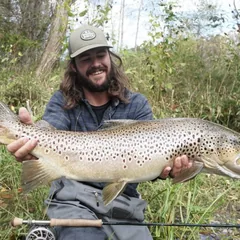
October is the single best month to catch a trophy brown trout in North Georgia. As water temperatures drop into the low-to-mid 50s, brown trout move out of their summer holding lies and turn aggressive ahead of their fall spawn — they hold in shallower water, attack baitfish, and chase streamers they'd ignore in August. The biggest fish of the year get caught in the late-October to mid-November pre-spawn window, with the Soque River and the Toccoa tailwater producing the most consistent shots at a 20-inch-plus brown. The game is streamers — articulated patterns 3 to 6 inches in olive, brown, and black, fished on sink-tips in low light — with nymphs and egg patterns as the backup. The hard rule of the season: fish for browns aggressively before they spawn, then leave the redds alone once they're on them. A guided trip during this window is the highest-percentage way to land a personal-best fish. Book a fall streamer trip on trophy water.
Why is October the best month for trophy brown trout in North Georgia?
October concentrates every variable that produces a big brown into the same four weeks. Brown trout are fall spawners, and in the weeks before they spawn they feed harder and more recklessly than at any other point in the year. Three things line up at once.
First, water temperature drops into the sweet spot. Through August, North Georgia browns sit in deep, oxygenated runs and feed in narrow low-light windows — the metabolic cost of moving in warm water isn't worth it. As October air cools the freestone rivers, the Soque included, those same fish become active feeders across the whole day. On the Toccoa tailwater, the cold dam release means temperature is rarely the limiter, but even there the fall cooldown shifts the surface and shallows back into play.
Second, the spawn turns on aggression. A pre-spawn brown is territorial and calorie-hungry. It will move several feet to crush a streamer that imitates a smaller trout, sculpin, or baitfish — partly to feed, partly to drive a competitor out of its lane. This is why streamer anglers live for October: the eats are violent and the fish that commit are the dominant, oldest, largest browns in the system.
Third, the fish reposition where you can reach them. In summer a 24-inch brown lives in the deepest slot in the river. In October that same fish stages near spawning gravel — the tail-outs of pools, the heads of riffles, shallow shelves it would never sit on in July. They become catchable, sometimes even visible. For the full seasonal context on how fall conditions reshape the fishing across every river, see our guide to fall fly fishing in North Georgia.
When exactly does the trophy window open and close?
The peak runs from roughly the third week of October through mid-November, but the exact timing shifts year to year with water temperature, not the calendar. Browns key on the cooling trend, so a warm, dry early fall pushes the window later and a cold snap pulls it forward. Use this as a working timeline rather than fixed dates:
| Period | Water temp trend | What the browns are doing | Best tactic |
|---|---|---|---|
| Late September | Cooling, mid-to-high 50s | Starting to move, feeding more by day | Streamers in low light, nymphs |
| Early-to-mid October | Low-to-mid 50s | Pre-spawn staging, aggressive | Streamers all day on overcast days |
| Late October–mid November | High 40s to low 50s | Peak pre-spawn, most aggressive | Streamers, egg patterns, sight-fishing |
| Mid-to-late November | Low 40s | On the redds, spawning | Stop targeting spawners — fish other water |
| December | Low 40s | Post-spawn, recovering | Slow nymphing, midges, opportunistic streamers |
The takeaway: the most violent streamer eats of the year happen in the staging period — before the fish actually pair up on gravel. Once browns are visibly spawning, the ethical and productive move is to leave them and fish for the rainbows and non-spawning browns holding below the redds. The Theodore Roosevelt Conservation Partnership has long argued that protecting the cold, healthy habitat where fish spawn is what keeps wild populations producing trophies in the first place — and on a freestone like the Soque, a meaningful share of those big browns are wild or stream-bred holdovers, not stockers.
Where do you find a trophy brown in North Georgia in October?
The two highest-percentage waters are the Soque River and the Toccoa tailwater, for different reasons. Match the river to what you want out of the day.
- Soque River (Habersham County) — Georgia's premier trophy brown fishery, full stop. On Bowman's private water the fish average 18 inches or better, with trout up to 28 inches. October is its marquee streamer month. The catch is access: the productive Soque is almost entirely private water, fished through outfitters with leased beats. If you want the single best shot at a 24-inch-plus brown in the state, this is the water. We cover it in depth in the Soque trophy brown trout breakdown and the full Soque River guide.
- Toccoa tailwater (below Blue Ridge Dam) — cold year-round from the bottom-release dam, with wild and holdover browns that get aggressive on the same pre-spawn schedule. The advantage here is the drift boat: a fall float covers far more streamer-able bank than you could wade, and you can fish safely through a generation pulse. The trophy density is lower than the Soque, but the river is bigger and there's more of it.
- Smaller freestones and wild-trout creeks — the Etowah's wild stretches and the headwater creeks hold smaller wild browns that spawn on the same timeline. These produce fewer giants but offer a genuine wild-trout experience and far less pressure. Average size is the trade-off.
The pattern across all of them: in October, focus on the transition zones — where a deep pool dumps into a shallow tail-out, where a riffle drops into a run, where a feeder creek brings clean gravel into the main stem. Those are the staging lanes.
What flies and setup land October browns?
Streamers are the headline pattern, and the fall brown game rewards size and movement over subtlety. The fish are looking for a meal worth chasing, not a size-20 midge. Build your box around these:
- Articulated streamers, 3 to 6 inches — olive, brown, and black are the core colors. Dark patterns on overcast or stained water; lighter natural tones on clear, bright days. Two-hook articulated bodies give the side-to-side movement that triggers reaction strikes.
- Sculpin and baitfish imitations — sculpins are a brown trout's primary forage in North Georgia freestones. A weighted sculpin pattern dredged along the bottom of a deep run pulls fish that won't move up in the column.
- Woolly buggers, size 4 to 8 — the never-wrong fallback. Olive and black, weighted, fished on a swing or stripped. A great choice when the big articulated patterns are spooking pressured fish.
- Egg patterns and small nymphs — once browns are actively spawning, rainbows and smaller trout stack below the redds to eat dislodged eggs. A drifted egg or a Pat's rubber-legs becomes deadly for those fish (the ones you should be targeting).
For the rig, run a 6 or 7-weight rod for throwing the bigger articulated flies all day — a 5-weight will do it but your arm will quit by lunch. A sink-tip line or a fast-sinking polyleader gets the fly into the strike zone fast, which matters in colder, deeper fall water. Use a short, stout leader — fluorocarbon in the 0X to 2X range, 4 to 6 feet — because turning over a heavy fly and absorbing a violent eat both demand backbone, not finesse. Fly Fisherman's deep-dive on streamer tactics for big browns is a solid read on retrieves and presentation if you want to refine the mechanics before a trip.
How do you actually fish the streamer to a fall brown?
The retrieve matters as much as the fly. A pre-spawn brown is reacting to movement, distress, and a baitfish that looks like it's fleeing — so make your streamer behave like prey that's about to get eaten by something else.
- Cast toward structure, not open water. Target the undercut bank, the downstream side of a midstream boulder, the seam where fast water meets slow. Big browns hold tight to cover and ambush from it.
- Get the fly down before you strip. Let the sink-tip and weighted fly drop for a two-count after the cast lands. The strike zone in fall is low and deep.
- Vary the retrieve until something works. Start with a fast, erratic strip-strip-pause. If that doesn't move fish, slow it to a steady swing through the seam. Some days they want the streamer ripped; some days they want it limping.
- Fish the pause. A huge percentage of fall eats come the instant the fly stops and starts to sink — the "wounded baitfish" moment. Stay tight to the fly through the pause so you feel the grab.
- Set with a strip, not a trout-set. When a brown crushes a streamer, set by continuing the strip and driving the rod low to the side. Lifting the rod tip pulls the fly out of the fish's mouth on a missed eat.
- Cover water, then rest it. Make your presentations, and if a likely run goes quiet, move on and come back. A dominant fish that just refused will sometimes commit on a second pass twenty minutes later.
Low light is your friend the entire month — the biggest browns feed hardest in the first and last hour of daylight and stay active all day under heavy cloud cover. A bluebird-sky October afternoon is the toughest condition; an overcast, drizzly day is when the giants come out to play.
Should you ever fish to a brown that's on a redd?
No — and this is the one non-negotiable rule of the season. Once brown trout pair up and are actively building or defending a redd (a clean, oval depression of bright gravel in shallow water, usually at a pool tail-out), leave them alone. There are two reasons, and both matter:
- Conservation. Spawning fish are the engine of next year's class. On wild and stream-bred fisheries like the Soque, dragging a spawning hen off her redd or trampling the gravel destroys eggs that took the whole year to produce. The trophy you want to catch in three years is being made on those redds right now.
- Ethics and reputation. Targeting visibly spawning fish is widely considered poor form among serious anglers, and guides will steer you off it. It's also just lower-percentage fishing — spawning fish are focused on reproduction, not feeding.
The productive and ethical move once the spawn is on: fish below the redds for the rainbows and the staging browns that haven't committed yet. Watch where you wade — clean gravel in shallow tail-outs is often a redd, and walking through it crushes eggs. If you're not sure whether a fish is staging or spawning, default to leaving it. This is exactly the judgment a guide handles for you, putting you on aggressive pre-spawn fish and keeping you off the gravel.
Wade or float — which is better for October browns?
It depends on the river. On the Soque, you're wade-fishing private beats, working upstream through runs and sight-casting or swinging streamers through the staging water — intimate, clear water, and a real chance at a giant. On the Toccoa, the drift boat is the better fall tool: you cover miles of streamer-able bank, hit far more structure than a wading angler can reach, and fish safely through dam generation. Here's the quick decision:
| Factor | Wade (Soque-style) | Float (Toccoa-style) |
|---|---|---|
| Best for | Largest single fish, technical water | Covering water, more shots per day |
| Trophy odds | Highest per-fish on the Soque | Good, more numbers |
| Generation safety | N/A (no dam) | Float fishes safely through releases |
| Skill demand | Higher — sight-fishing, careful approach | Casting from a moving boat |
| First-timer friendly | Manageable with a guide | Very — guide rows, you fish |
For a self-guided angler weighing the two: if a personal-best brown is the goal and you only get one fall trip, the Soque's private water gives the best odds, and going guided is effectively the only access route. If you want a full day of casting at structure and more eats overall, the Toccoa float is the move.
A worked October scenario: planning one trophy day
Say you've got one Saturday in late October and you want your best realistic shot at a 20-inch-plus brown. Here's how a smart self-serve angler plans it:
- Watch the forecast for clouds, not sun. Book or shift toward the most overcast day in the window. If you have flexibility, a gray, 50-degree drizzle beats a bluebird 65.
- Start at first light. Be in the water before sunrise. The first 90 minutes are prime, and pressured trophy water gets tougher as the day brightens.
- Lead with a big articulated streamer in olive or black on a sink-tip. Work the deep tail-outs and undercut banks first — the staging lanes.
- Downshift if they won't commit. If the big fly only draws follows and refusals, drop to a smaller woolly bugger or swing a sculpin slower and deeper.
- Watch your wading. Avoid clean gravel in shallow tail-outs. Once you spot paired fish, move below them and fish to the rainbows eating eggs.
- Save the back half for a second pass through the best run you fished at dawn, ideally as evening light returns.
Even executed perfectly, a trophy brown is never a guarantee — that's what makes one worth chasing. What you can control is fishing the right window, the right water, and the right presentation. The fastest way to compress the learning curve is a guide who already knows which beat is staging fish that week. Book an October trophy trip on private water and you're fishing the staging lanes from cast one.
Frequently Asked Questions
What is the best month to catch a big brown trout in Georgia?
October, with the peak running from roughly the third week of October through mid-November. As water temperatures drop into the low-to-mid 50s, brown trout turn aggressive ahead of their fall spawn and feed harder than at any other time of year — making the biggest fish of the season catchable on streamers. The Soque River and the Toccoa tailwater are the most consistent waters for a trophy-class brown during this window.
When do brown trout spawn in North Georgia?
Brown trout in North Georgia typically spawn from mid-November into December, with the exact timing driven by water temperature rather than the calendar. The weeks before the spawn — the pre-spawn staging period in late October and early November — are when the fish are most aggressive and the streamer fishing is at its best. Once fish are actively on the redds, they should be left alone.
What flies should I use for October brown trout?
Streamers lead the season: articulated patterns 3 to 6 inches in olive, brown, and black, plus weighted sculpin imitations and woolly buggers in sizes 4 to 8. Dark colors on overcast or stained water, lighter naturals on clear bright days. Once browns are spawning, egg patterns and small nymphs drifted below the redds catch the rainbows and staging fish you should be targeting instead.
Should I fish to brown trout on their redds?
No. Once brown trout are paired up and actively spawning on a redd — a clean oval of bright gravel in shallow water — leave them alone. Targeting spawning fish damages next year's class and is considered poor form. Fish below the redds for rainbows and non-spawning browns instead, and avoid wading through clean gravel in shallow tail-outs, which can crush eggs.
Where is the best place to catch a trophy brown in North Georgia?
The Soque River in Habersham County is Georgia's premier trophy brown fishery, where Bowman's private water averages 18-inch-plus fish with trout up to 28 inches — and October is its marquee streamer month. The productive Soque is almost entirely private water fished through outfitters. The Toccoa tailwater is the strong second choice, especially for a drift-boat streamer float.
What rod and line do I need for fall streamer fishing?
A 6 or 7-weight rod handles the bigger articulated streamers all day without wearing out your casting arm. Pair it with a sink-tip line or a fast-sinking polyleader to get the fly into the deeper fall strike zone, and a short, stout fluorocarbon leader in the 0X to 2X range, 4 to 6 feet, to turn over heavy flies and absorb violent eats. Confirm exact gear with your guide at booking if you're going guided.
What time of day is best for October browns?
The first and last hour of daylight are prime, and big browns feed hardest in low light. On heavily overcast or drizzly days they stay active across the whole day, which makes a gray October day far better than a bright bluebird one. If you can pick your day in the window, choose clouds over sun.
Do I need a guide to catch a fall trophy brown?
Not strictly, but a guide dramatically raises your odds during this window — and on the Soque's private water, going guided is effectively the only access route. A guide knows which beat is staging fish that week, keeps you on aggressive pre-spawn browns and off the redds, and handles the streamer setup and reads. For a one-trip-a-year angler chasing a personal best, a guided October trip is the highest-percentage play.
Want your shot at a fall trophy?
Book a guided October streamer trip on North Georgia trophy water — private access, big-brown tactics, the year's best window.
Private water trophy trout trip, from $400 · 4.9 stars on Google
See the trip or See Trophy Water Trips →