Seasons & Conditions
November Fly Fishing in North Georgia: The Best Month
 Daniel Bowman
Updated October 1, 2026
13 min read
Daniel Bowman
Updated October 1, 2026
13 min read

The short version
November is North Georgia's peak big-brown-trout month. The water has cooled into the 40s, so trout feed through the middle of the day instead of just dawn and dusk, and brown trout are on the spawn — staging, paired up, and aggressively territorial. The bug menu narrows to midges (size 20–24), blue-winged olives (size 18–22), and the occasional October caddis, so the real game is streamers and nymphs for reaction strikes. Fish the cold-stable Toccoa tailwater for spawn-run browns, the private Soque for trophies, and wild creeks like Noontootla for territorial pre-spawn fish. The non-negotiable rule: learn to spot a redd and never wade through or fish to spawning fish. A guided November day puts you on the productive water and keeps you off the gravel. Best windows are the warmest part of cold, overcast days and the day or two after a rain.
November is the month most North Georgia guides quietly circle on the calendar. The crowds that stacked up through October are gone, the water is cold enough that trout feed hard in the middle of the day again, and the brown trout — the biggest fish in these rivers — are on the spawn and behaving in ways they don't the other eleven months of the year. It is also the month that punishes anglers who fish it like October. By the first week of November the bug life has thinned to midges and a few stubborn blue-winged olives, the freestones have dropped into the 40s, and the game shifts from dry-fly opportunism to a deliberate streamer-and-nymph hunt for fewer, larger fish. If you read the water right, it's the best big-fish month of the year.
Why is November the best month to fly fish in North Georgia?
November is the best month because two things peak at once: brown trout are on the spawn, and cold water has trout feeding all day instead of in narrow windows. Through summer and early fall, North Georgia's freestone rivers force you into a dawn-and-dusk rhythm — the middle of the day is too warm and bright for consistent feeding. By November the water has shed all its summer heat. Freestones like the Etowah settle into the mid-40s to low 50s, and the Toccoa tailwater, fed by cold bottom-release water from Blue Ridge Dam, holds steady in the high 40s and low 50s regardless of air temperature.
That cold water does three things that make November special:
- It reopens the whole day. Cold-water trout are most active when the water is in the high 40s to mid-50s. In November that band lands in the warmest part of the afternoon, so the best fishing is often 11 a.m. to 4 p.m. — the opposite of the summer dawn patrol.
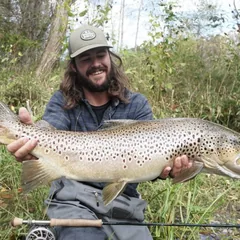
- It puts the biggest fish in reach. Brown trout spawn from late October into December. To do it, they move out of the deep, hard-to-reach runs they hide in all summer and push up into shallower gravel. Fish that were ghosts in August are suddenly visible and catchable in November.
- It empties the rivers. Deer season, football, and cold mornings thin the crowds dramatically. On a Tuesday in mid-November you can have a stretch of the Toccoa or a beat of the Soque almost to yourself.
The trade-off is volume. You will catch fewer fish in November than in a May caddis hatch. But the average size goes up, and your odds of a genuine trophy — a 20-inch-plus wild brown — are the best they'll be all year. That's the November bargain: fewer fish, bigger fish.
What changes between late October and November?
Late October still has hatches and active surface fish; November is colder, sparser on bugs, and fully committed to the spawn. October is the front half of streamer season — browns are staging and aggressive, but you still get olive and caddis activity, and the freestones haven't fully cooled. November is the back half: water in the 40s, midges and a few BWOs as the only reliable hatches, and the spawn at or past its peak on most rivers. The table below shows the split.
| Factor | Late October | November |
|---|---|---|
| Freestone water temp | Low-to-mid 50s | Mid-40s to low 50s |
| Toccoa tailwater temp | High 40s–low 50s | High 40s–low 50s (stable) |
| Best hours | Late morning + afternoon | Warmest midday window (11–4) |
| Top hatches | BWOs, October caddis, midges | Midges, sparse BWOs, fading caddis |
| Primary tactic | Streamers + dry-dropper | Streamers, nymphs, midge rigs |
| Brown trout stage | Staging, early spawn | Peak spawn into post-spawn |
| Crowds | Moderate (leaf season) | Light to empty |
The practical takeaway: if late October is a hatch-and-streamer month, November is a streamer-and-nymph month with a midge rig in your pocket for the slow afternoons. The fish are there, but you have to go get them — they won't come up and find you the way they do in spring.
What is happening with the brown trout spawn in November?
Brown trout spawn in November across most of North Georgia's trout water, which is exactly what makes the month so productive — and so easy to get wrong. As water temperatures drop into the upper 40s and low 50s, female browns move onto clean gravel in the tailouts of pools and the heads of riffles, fan out depressions called redds, and deposit eggs while males fight for position. The fish stage in the days before, get territorial during, and feed hard again afterward. That whole arc — pre-spawn, spawn, post-spawn — runs through November on a schedule set by water temperature and flow, not the calendar.
Here is how it shapes the fishing:
- Pre-spawn browns are the target. The aggressive, eat-anything fish are the ones staging below and around the spawning gravel — not the paired-up fish on the redds themselves. Fish the deeper runs and the seams just upstream and downstream of gravel.
- The Toccoa is the headline run. As covered in the fall fly fishing guide, browns make spawn runs up the Toccoa starting in mid-September and peaking through fall. November is when the biggest of those fish are in the system.
- Wild creeks turn territorial. On Noontootla and other wild streams, the naturally reproducing browns become aggressively territorial in their pre-spawn window — a well-stripped streamer through a deep run draws reaction strikes from fish that ignore everything else.
- Rain resets the run. A good rain bumps the flow and pushes a fresh wave of fish upstream. Fishing a day or two after a November rain often puts you on the biggest, freshest fish of the season.
This is the month to chase a personal best. For the specific streamer game on the river that produces the most consistent trophies, the trophy brown trout on the Toccoa guide goes deep on patterns, sink-tips, and the low-light windows that matter.
How do you fish redds ethically in November?
You fish around spawning trout, never to them — and the first skill of November fly fishing is learning to recognize a redd and leave it alone. A redd is a clean, light-colored oval of gravel where a female has fanned away the silt and algae to deposit eggs; it stands out as a brighter patch against the darker streambed, usually in the tailout of a pool or the head of a riffle where the current is moderate. You'll often see a pair of fish holding directly over it. Those fish are the future of the fishery. Hooking them, or wading through the gravel and crushing the eggs, does real damage — and clean spawning gravel is exactly the kind of habitat that river-conservation groups like American Rivers work to protect. Treating a redd as off-limits is the standard worth internalizing before you fish this season.
The ethics are simple in practice:
- Learn the look of a redd. Bright, clean, oval gravel — often with a darker pit at the upstream end and a paler mound below. Once you've seen one, you can't unsee them.
- Never wade across gravel. Walk the banks or the deeper channels. Every footstep through a redd destroys eggs you can't see.
- Don't fish to paired fish on a redd. A big male guarding a redd will sometimes eat — that doesn't make it right. Leave spawning fish to spawn.
- Target the fish below the redd. Trout and other fish stack in the runs below spawning gravel to eat dislodged eggs. Those staging and feeding fish — not the spawners — are the ethical, legal, and most aggressive target.
- Keep them wet and fast. Cold November water actually helps fish recover, but a long fight and air exposure still hurt. Land them quickly, keep them in the net in the water, and release without a long photo session.
A guide earns their fee here as much as anywhere. Knowing which fish are spawners and which are feeders — and steering you to the right water — protects both your day and next year's fish.
What flies and tactics work in November?
November fishing is a streamer, nymph, and midge game — the dry-fly windows are short and the subsurface fish are the consistent ones. With the bug life narrowed down, you're either provoking reaction strikes with streamers or drifting small, accurate nymph and midge rigs through the deeper holding water. Match your tactic to the hour and the conditions rather than forcing one approach all day.
Streamers — the big-fish play. Pre-spawn browns are territorial and will chase. Throw articulated streamers and sculpin patterns in olive, brown, black, and white, size 4–8 on the freestones and larger on the tailwater. Fish a sink-tip to get down fast, and work a slow, methodical strip-pause-strip through the deep runs and undercut banks — the cold-water streamer tactics covered by technique resources like Gink & Gasoline reward patience over speed this time of year. The how to strip a streamer guide covers the retrieve cadence that triggers cold-water browns. Low light — first light, last light, and overcast afternoons — is prime.
Nymphs — the all-day producer. When the streamer bite is off, a tight-line or indicator nymph rig keeps you catching. Productive November nymphs:
- Zebra midges and small midge larvae, size 18–22, the year-round tailwater staple
- Pheasant tails and frenchies, size 16–18, for the BWO nymph imitation
- Sowbugs and scuds, size 14–18, especially on the Soque and tailwaters
- Egg patterns, fished below spawning gravel where fish key on loose eggs
- Small stonefly nymphs, size 12–16, as a heavy anchor in faster water
Midges and BWOs — the surface window. On warmer, overcast November afternoons you'll see midges and blue-winged olives come off, and trout sip them in the slow tailouts. A size 20–24 midge or 18–22 BWO dry on a long, light leader catches the heads-up fish. The window is short — often an hour or two midday — but it's some of the most rewarding fishing of the month.
Where should you fish in November in North Georgia?
The best November water is anything that stays cold and stable and holds spawning browns — which points you at the tailwaters, the private trophy water, and the wild freestone creeks. Each fishes a little differently in late fall, so pick based on what kind of day you want.
- Toccoa tailwater — the headline November fishery. Cold bottom-release water from Blue Ridge Dam keeps trout active all day, and it gets the biggest brown-trout spawn run in the region. Check the Blue Ridge Dam generation schedule and current streamflow before you go — you can't wade safely during generation, and a drift-boat float fishes through it. This is the most reliable November big-fish water.
- Soque River (private) — Georgia's trophy water and the single best place to land a personal-best brown in November. Fall is one of Bowman's two peak seasons there, and the big browns turn aggressive before they spawn. Detailed in the Soque fall streamer fishing guide; access is through a guided trip.
- Noontootla Creek — wild, naturally reproducing browns that turn aggressively territorial pre-spawn. Bigger streamers worked slowly through the deep runs draw reaction strikes. This is also the water where redd awareness matters most — the gravel is full of next year's fish.
- Etowah and headwater freestones — coldest and clearest of the year. Streamers in the deep runs, nymphs through the riffles, and a midge rig for the slow afternoons. Lower, clearer water means a careful, low-profile approach.
- Chattahoochee tailwater — the cold release below Buford Dam fishes through the cold months and holds trout when the freestones get tough. A good option closer to Atlanta.
What about the weather and water conditions in November?
November weather in North Georgia is cold, variable, and the single biggest factor in how the fishing goes day to day. Daytime highs swing from the 60s early in the month to the 40s by month's end, with overnight lows regularly dipping below freezing in the mountains. Two patterns matter most:
- Warm, overcast days fish best. Cloud cover keeps the water from chilling overnight and brings the midge and BWO hatches up. A 55-degree gray afternoon will out-fish a bluebird 40-degree morning almost every time. Fish the warmest part of the day.
- Rain drives the spawn run. A November rain bumps flows and pulls fresh browns upstream. Watch the forecast and the gauges, and fish the day or two after a good rain when fresh fish are in the system.
Cold mornings also mean ice in the guides and stiff fingers — start later, layer heavily, and don't rush onto the water at first light the way you would in summer. The fish won't be moving much until the water warms a few degrees anyway. For a sense of where the season is heading after Thanksgiving, the winter fly fishing the Toccoa guide picks up where November leaves off, when the midge game becomes the whole game.
Is November a good month to book a guided trip?
November is one of the best months to book a guide, precisely because it's the hardest month to fish well on your own. The spawn changes where the fish hold week to week, the bug life is thin enough that fly choice matters more, and the ethical line around redds is easy to cross without knowing it. A guide solves all of that — they know which runs are holding staged pre-spawn browns, which water to avoid because fish are on gravel, and exactly what to throw on a given cold afternoon. They also handle the cold-weather logistics: the right layers, the heated truck between runs, and the generation schedule on the Toccoa.
A few reasons November is a smart booking month:
- Trophy odds peak. Your best shot at a 20-inch-plus wild brown is November, and a guide puts you on the water that produces them.
- Empty rivers. You'll share the water with almost no one, which means more shots at undisturbed fish.
- Gear is handled. Cold-weather fly fishing has a longer gear list — waders, layers, the right line, streamer boxes. On a guided trip it's all included.
- You'll fish ethically without guessing. The guide keeps you off the redds and on the feeders, protecting the fishery and your conscience.
Whether you're chasing a personal best or want to learn the late-fall game from someone who fishes it every week, a November day on North Georgia trout water is hard to beat. Use the trip finder to match the water to your goals, or call to book a guided November day.
Frequently Asked Questions
Is November a good time to fly fish in North Georgia?
Yes — for big fish, it may be the best month of the year. The water has cooled enough that trout feed through the middle of the day, and brown trout are on the spawn, which puts the biggest fish in reachable water. You'll catch fewer fish than during a spring hatch, but your odds of a genuine trophy brown are the highest they get. The rivers are also nearly empty.
When do brown trout spawn in North Georgia?
Brown trout spawn from late October into December, with the peak in most North Georgia rivers falling in November. The timing follows water temperature and flow rather than the calendar — fish move onto gravel as the water drops into the upper 40s and low 50s. The Toccoa's spawn run starts as early as mid-September and builds through fall, with the biggest fish in the system in November.
What flies should I use for November fly fishing in North Georgia?
Lead with streamers — articulated and sculpin patterns in olive, brown, black, and white, size 4–8 — for territorial pre-spawn browns. When the streamer bite is off, drift small nymphs: zebra midges (18–22), pheasant tails (16–18), sowbugs (14–18), and egg patterns below spawning gravel. On warmer overcast afternoons, a size 20–24 midge or 18–22 blue-winged olive dry catches surface-feeding fish.
What time of day is best for fly fishing in November?
The warmest part of the day, roughly 11 a.m. to 4 p.m. This is the opposite of summer, when you fish dawn and dusk. Cold November water means trout are most active once the day warms a few degrees, and the midge and BWO hatches come off midday. Don't rush onto the water at first light — start later and fish the warm window.
How do I avoid fishing to spawning trout?
Learn to recognize a redd — a clean, bright oval of gravel, usually in a pool tailout or riffle head, often with a pair of fish holding over it. Never wade through that gravel, and never fish to paired fish on a redd. Instead, target the staging and feeding fish in the runs just below and above the spawning gravel. Land any fish quickly and release it without long air exposure.
What's the best river to fly fish in November in North Georgia?
The Toccoa tailwater for the biggest spawn run and cold, day-long activity; the private Soque for the best trophy odds; and wild Noontootla Creek for aggressive, naturally reproducing browns. The Chattahoochee tailwater near Atlanta also fishes well through the cold months. Tailwaters stay the most stable once the freestones get cold.
Do I need a license to fly fish in North Georgia in November?
Yes. Anyone 16 or older needs a Georgia fishing license plus a trout stamp year-round, available at gooutdoorsgeorgia.com or most outdoor retailers. Confirm any river-specific regulations — some stretches are catch-and-release or single-hook artificial only — before you fish, and confirm details at booking.
Is November fishing cold and miserable?
It's cold, but not miserable if you dress for it. Highs run from the 60s early in the month to the 40s by month's end, with freezing mornings in the mountains. Layer heavily, start later in the morning when the water warms, and you'll fish comfortably through the productive midday window. On a guided trip the cold-weather gear and logistics are handled, including warm transport between runs.
Fish the November peak with a guide
Aggressive spawn-run browns, empty rivers, and fall color. Use the trip finder or call (706) 963-0435 to book a November day.
Etowah River private water trip, from $400 · 4.9 stars on Google
See the trip or See Fall Private Water Trips →