North Georgia Rivers
Soque vs Etowah: Which North Georgia River Should You Fish?
 Daniel Bowman
Updated October 2, 2026
10 min read
Daniel Bowman
Updated October 2, 2026
10 min read

The short version
On Bowman Fly Fishing's private water, the Soque and the Etowah are closer than most people expect. Both cost the same ($400 for a half day for one angler, $550 for a full day), both are wade trips with all gear provided, both take groups of up to 12, and Bowman calls both beginner friendly. The Soque's fish average 18 inches or better across 4+ miles on 7 properties near Clarkesville, with a premium Dragonfly option. The Etowah's average is often 17 inches or more on 2+ miles at a working winery near Dahlonega. Choose the Soque for its famous name, extra water and the Dragonfly. Choose the Etowah for the vineyard setting, the shorter drive from north Atlanta and a winery tasting afterward.
What's the real difference between the Soque and the Etowah?
Most comparisons of these two rivers describe the public Etowah, a stocked stream with small wild fish, against the private Soque, a trophy river. That isn't the choice you face when you book with Bowman. Bowman fishes both on private, leased water, and says the fishing on the Soque "is similar to the fishing on the Etowah River."
So the useful question is narrower: on Bowman's private water, how do the two trips differ? The answer comes down to setting, size of the water, the drive, and one premium option.
How do the two trips compare side by side?
| Soque private water | Etowah private water | |
|---|---|---|
| Where | Near Clarkesville, Habersham County | A working winery near Dahlonega |
| How much water | 4+ miles across 7 properties | 2+ miles on one property |
| Average fish | 18 inches or better | Often 17 inches or more |
| Biggest listed | Trout up to 28 inches | Rainbows and browns up to 28 inches |
| Half day, 1 / 2 / 3 anglers | $400 / $550 / $675 | $400 / $550 / $675 |
| Full day, 1 / 2 / 3 anglers | $550 / $725 / $900 | $550 / $725 / $900 |
| Group size | Up to 12 | Up to 12 |
| Skill level | Beginner friendly, all skill levels | Beginner friendly, all skill levels |
| Season | September 20 to June 10 | September 20 to June 15 |
| Premium option | The Dragonfly, from $520 | None |
| Nearest town | Clarkesville | Dahlonega |
Full details are on the Soque and Etowah trip pages and the rates page.
How do they fish?
Both trips are a day of wading with a guide. You walk the bank or short trails between spots, stand in the shallows, and fish one run at a time. Neither river is floated; there's no boat fishing on Bowman's Etowah section at all.
Both waters are catch and release, and both are lightly fished, because Bowman leases the access and limits how many anglers use it. Georgia treats the riverbed of a non-navigable stream as the landowner's property, so fishing it takes the owner's permission. That combination is why the fish on both properties grow so large.
Where they feel different is the setting:
- The Soque is a famous name. As Bowman puts it, most Southeastern fishermen have heard of the Soque and the monster trout it holds. Seven properties give it more water to choose from.
- The Etowah runs through what Bowman calls one of North Georgia's best and most beautiful wineries, with deep pools and swift runs of cold mountain water.
Which river has bigger trout?
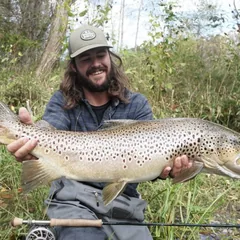
They're close. Bowman's Soque fish average 18 inches or better. On the Etowah, Bowman's figure is an average that often tops 17 inches, and it reports fish of two feet or more coming to the net. Both pages list trout up to 28 inches, and both say rainbows average around 17 to 18 inches with browns about the same, and browns of 27 inches or more possible.
The Soque keeps a slight edge on paper, and it has one thing the Etowah doesn't: the Dragonfly, its premium property near the Soque headwaters. Its selling points, in Bowman's telling: tighter access than anywhere else it fishes, larger fish, and a bigger share of wild, river-born trout. If the biggest possible fish is the whole point of the trip, the Dragonfly is where Bowman points you.
Which river is better for beginners?
Neither has the edge. Bowman calls both beginner friendly and great for all skill levels, and it guides complete beginners on both. Bowman's verdict on both rivers is the same: beginner friendly, with first-timers catching plenty of fish and big ones.
All gear is provided on both, including waders and boots. The guide starts a beginner with a short lesson, and Bowman's promise to a complete novice is a working cast in about 20 minutes.
The one water Bowman flags as harder is a third river, Noontootla Creek, which it calls technical and not for beginners.
What does each cost?
Exactly the same. Bowman prices the Etowah and the Soque identically:
- Half day (4 hours): $400 for one angler, $550 for two, $675 for three.
- Full day (8 hours, riverside lunch): $550 for one, $725 for two, $900 for three.
The only price difference is the Dragonfly on the Soque, which runs $520 to $920 for a half day and $645 to $1,150 for a full day. Bowman's gift certificates work on both rivers but not on the Dragonfly.
On top of the trip price, budget for the Georgia fishing license and trout license (a resident pays $25 for both for the year, a visitor $20 for one day) and the guide's tip.
How long is the drive?
Bowman lists both as about 90 minutes from Atlanta. In practice the answer depends on which side of the city you start from. The Etowah water is near Dahlonega, up GA-400, which makes it a natural pick for anglers in Alpharetta, Cumming and the north suburbs. The Soque is near Clarkesville, north of Gainesville, which suits anglers coming from that direction.
For either river, the meeting spot and start time arrive from your guide the evening before.
When is each river at its best?
The two run on the same calendar, with one small difference:
- Peak seasons on both: March through May, then October and November. Flows and water temperature in those months put the trout at their most active.
- The cold months: slower fishing from December into February, yet Bowman names that stretch as a time for some of its biggest fish on both rivers.
- Summer: Bowman rests the Soque from June 10 and the Etowah from June 15, both until September 20, because the water gets too warm for the trout.
If you're planning a trip in the first half of June, the Etowah stays open five days longer. For summer trout fishing, Bowman's option is the Toccoa float, where cold water from the dam keeps trout feeding through July and August.
How do you check conditions before you go?
Both rivers have a USGS stream gauge you can watch in the days before a trip, and Bowman's river conditions page reads them for you.
- The Soque: the gauge is the Soque River at GA 197 near Clarkesville (station 023312495). Bowman treats flows from about 150 cubic feet per second as good, 200 to 300 as prime, 400 as high and 550 as blown out.
- The Etowah: the gauge is the Etowah River at GA 9 near Dawsonville (station 02389150), downstream of the private water. Bowman's bands there run from about 140 as good, 200 to 340 as prime, 400 as high and 550 as blown out.
You don't need to read either one. Your guide watches the water and will call if conditions make the day unsafe, since Bowman cancels or reschedules only for lightning, flooding or extreme cold. Light rain, Bowman notes, often makes the fishing better.
What should you bring for either trip?
The list is the same for both rivers:
- Eyewear with polarized lenses, which matter more on these clear rivers than almost anywhere, because spotting a fish is half the game.
- Sun protection for a day spent in open water, cloudy or not.
- A warm layer or two, since a spring, fall or winter morning in the hills starts colder than Atlanta.
- Both Georgia licenses, the basic fishing license plus the trout license, from Go Outdoors Georgia.
- Any gear you already own, which Bowman is happy to see, though it supplies rods, reels, waders and boots to anyone without them.
Flies and terminal tackle come from the guide. Full days add a lunch by the river.
Who looks after these rivers?
Both waters depend on clean, cold water from the hills above them. The Soque River Watershed Association is the local group keeping watch over the Soque's water quality. On private water, anglers do their part by handling fish gently, keeping them wet, and staying off spawning gravel in fall and winter, which keeps the fish growing for the next visit.
When should you pick the Soque?
- You want the famous river. The Soque's reputation for big trout is the draw for many anglers, and it's worth fishing at least once.
- You want the Dragonfly. If you're marking a milestone or chasing a personal best, the premium headwater property is only on the Soque.
- You're coming from the northeast side of Atlanta, where Clarkesville is the easier drive.
- You're bringing a group of up to 12 and like the idea of seven properties to choose from.
When should you pick the Etowah?
- You want the vineyard. Fishing a trout river that runs through a working winery is a different kind of day, and the setting suits a couple, a client outing or a celebration.
- You want a tasting afterward. For groups, Bowman can arrange wine tastings at the winery after the fishing.
- You're coming from the north suburbs, where the drive to Dahlonega is shorter.
- Your date is in early June, between June 10 and June 15, when the Soque has already closed for the summer.
What's a typical day like on each?
The shape of the day is the same on both rivers. You meet your guide at the water in the morning, get fitted with waders and boots if you need them, and start with a short casting lesson if anyone is new. Then the guide walks you from run to run, picks the flies, and coaches each drift. Every fish is photographed and released.
The differences are in the surroundings. On the Etowah, you fish one property from end to end, with the winery around you and trails along the river between spots. On the Soque, your guide chooses among several properties, so two trips there can feel quite different. A full day on either includes a riverside lunch, and a half day leaves the afternoon free for a winery visit near Dahlonega or the small towns around Clarkesville.
Groups work the same way on both. Bowman pairs one to three anglers with each guide, ideally two, and takes up to 12 anglers on either river, so a family or a team can split across a few guides on the same water.
Can you fish both?
Yes, on separate days. The two rivers are in different directions from Atlanta, so a single day on both isn't practical, but a weekend split between them works: one day on the Soque, one at the winery on the Etowah. Since the prices are the same, the second day costs no more than repeating the first.
How do you decide?
Ask yourself one question: is the setting or the river the draw?
If you want the vineyard, a tasting and a slightly shorter drive from the north side, book the Etowah. If you want the Soque's name, more water, or the Dragonfly, book the Soque. Either way you'll be on private, catch-and-release water with big fish, a guide and all the gear, at the same price.
If you're still unsure, the trip finder asks a few questions and suggests a trip, or call Bowman at (706) 963-0435.
Frequently Asked Questions
Should I fish the Soque or the Etowah?
Both are private, catch-and-release wade trips at the same price, and Bowman calls both beginner friendly. Pick the Etowah for the winery setting and shorter drive from north Atlanta. Pick the Soque for its reputation, more water, or the premium Dragonfly property.
Which is closer to Atlanta?
Bowman lists both at about 90 minutes from Atlanta. The Etowah, near Dahlonega, is usually the shorter drive from the north suburbs; the Soque, near Clarkesville, can be easier from the northeast.
Which river has bigger trout?
They're close. Bowman's Soque fish average 18 inches or better, and its Etowah fish often average 17 inches or more. Both list trout up to 28 inches. The Soque's Dragonfly property has larger fish still.
Is the Soque or the Etowah better for beginners?
Neither. Bowman calls both beginner friendly and great for all skill levels, and it guides complete beginners on both.
Which river is cheaper to fish?
Neither. Bowman charges the same for both: $400 to $675 for a half day and $550 to $900 for a full day, for one to three anglers. Only the Soque's Dragonfly costs more.
Do you need a guide to fish these waters?
On Bowman's private water, yes. Both are private, leased sections that the public can't fish, and a guided trip includes the access.
What kind of fish are in each river?
Rainbow and brown trout on both. Rainbows average around 17 to 18 inches and browns about the same, with browns of 27 inches or more possible.
Can I use a gift certificate on either river?
Yes, on both, with one exception. Bowman's gift certificates are valid on any trip except the Dragonfly on the upper Soque. A certificate covers a standard Soque trip or an Etowah trip in full or in part, and the recipient pays any difference when booking.
Which river is better for a group?
Either. Both take groups of up to 12, with one to three anglers per guide. The Etowah suits a group that wants a tasting at the winery afterward; the Soque suits one that wants to spread across several properties. For four or more anglers, ask about Bowman's group pricing, which starts at $190 per person for a half day.
When is each river closed?
Bowman rests the Soque from June 10 and the Etowah from June 15, both until September 20, because of warm water.
Not sure which river?
Tell us your experience and goals — we'll match you to the right water. All gear included.
Soque River private water trip, from $400 · 4.9 stars on Google
See the trip or Reserve Your Trip →