North Georgia Rivers
The Soque Dragonfly Trophy Beat, Explained
 Daniel Bowman
Updated October 2, 2026
10 min read
Daniel Bowman
Updated October 2, 2026
10 min read

The short version
The Dragonfly is Bowman Fly Fishing's premium property on the upper Soque River, at the headwaters near Batesville. Bowman describes it as "even more exclusive access" with larger fish and more wild, naturally reproducing trout than its other Soque water. It is a wade trip, all gear provided, for groups of up to 10, and Bowman calls the Soque "great for all skill levels." A half day costs $520 / $720 / $920 for one, two or three anglers; a full day, with lunch, costs $645 / $900 / $1,150. The calendar on the property is limited, so ask early. Gift certificates can't be used on the Dragonfly.
What is the Dragonfly?
The Soque River starts near Batesville, in Habersham County, and runs south to meet the Chattahoochee at Clarkesville. Almost all of it is private. Bowman has spent a decade securing permission to fish 7 different properties along it, which add up to more than 4 miles of river.
Most of those properties make up Bowman's standard Soque River trips. The Dragonfly is the exception. It sits on the upper Soque, at the headwaters, and Bowman sells it as a separate, premium trip.
In Bowman's own words, the Dragonfly offers "even more exclusive access on the headwaters of the Soque," and "more big wild trout in a pristine setting." Bowman also puts it more briefly: "even more exclusive access and larger fish."
How is it different from Bowman's other Soque water?
Bowman says the fishing on its Soque properties is similar to the fishing on its Etowah water, "with the only difference being the upper Soque Dragonfly property having more wild, natural reproducing fish than other locations."
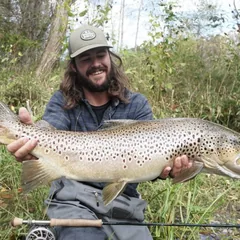
That one line explains most of what makes the Dragonfly special. A wild trout was born in the river. It has lived its whole life there, it knows the water, and it looks and behaves differently from a fish that arrived from a hatchery. For many anglers, a big wild trout is the fish that means the most, because no hatchery had a hand in it.
Here is how the two trips compare, using Bowman's published details:
| Standard Soque water | Dragonfly | |
|---|---|---|
| Where | Several properties along the Soque | The upper Soque, at the headwaters |
| What Bowman says | Trophy rainbows and browns, average 18 inches or better | Even more exclusive access, larger fish, more big wild trout |
| Group size | Up to 12 anglers | Up to 10 anglers |
| Half day, 1 / 2 / 3 anglers | $400 / $550 / $675 | $520 / $720 / $920 |
| Full day, 1 / 2 / 3 anglers | $550 / $725 / $900 | $645 / $900 / $1,150 |
| Gift certificates | Accepted | Not accepted |
| Gear | All provided | All provided |
Everything else is the same: a wade trip with a guide, catch and release on every fish, and the same season.
Why do the fish get so big?
Bowman's answer for the whole Soque applies to the Dragonfly too. Under Georgia law, whoever owns the land along a non-navigable stream owns the bed beneath it too, so nobody can legally fish there without the owner saying yes. Bowman leases the access, releases every fish, and limits how many people fish each property. As Bowman puts it, that "allows the fish to grow much larger than you would typically find on public streams."
The Dragonfly adds two things on top of that. Access there is even more exclusive, and a larger share of the trout are wild fish. Put together, you get a stretch of river where big trout have had years to grow without being kept or bothered often.
How big are the fish?
Bowman doesn't publish a separate size chart for the Dragonfly. What it does publish is the baseline for its Soque water and the promise that the Dragonfly's fish run larger:
- Average across Bowman's Soque water: 18 inches or better.
- Rainbows: around 17 to 18 inches on average, with some much larger.
- Browns: about the same on average, with fish of 27 inches or more possible.
- Largest Bowman lists for the Soque: trout up to 28 inches.
- On the Dragonfly: larger fish, and more of them wild.
Who is the Dragonfly for?
Bowman calls its Soque fishing "great for all skill levels," and takes first-timers and lifelong anglers alike. In Bowman's words: "If you've never held a fly rod, we'll teach you. If you've been fishing for decades, we'll put you on water that challenges you."
So there is no skill test for the Dragonfly. The better question is what you want out of the day. The Dragonfly tends to suit:
- Anglers who want a wild trophy. If a big, wild, river-born trout is the fish you're after, this is where Bowman points you.
- People marking an occasion. A milestone birthday, a retirement or an anniversary, where the setting and the fish matter as much as the price.
- Hosts. Bowman lists entertaining guests among the things its Soque trips suit, and the most exclusive water makes the strongest impression.
- Return clients. Someone who has fished Bowman's standard Soque water and wants to see the headwaters.
- Small groups. Up to 10 anglers, split so each guide has one to three people, two being the sweet spot.
The standard Soque water is the better fit if the price difference matters to you, if you're using a gift certificate, or if your group is 11 or 12 people.
What does a day on the Dragonfly look like?
The guide sends directions and a meeting time the day before. Most Bowman trips meet at the river around 8 a.m. You arrive with sunglasses, sunscreen, layers and your license. The guide brings the rest: rods, reels, waders, boots, flies, leaders and tippet.
If anyone in the group is new, the day starts with a casting lesson. Bowman says it can teach someone who has never held a fly rod to cast in about 20 minutes.
Then the fishing starts. It is a wade trip, which Bowman describes as "a day spent wading the river, not floating in a boat." You walk the bank with the guide, stand in the shallows and fish one stretch at a time. On clear water, the guide will often spot a fish before anyone casts, then set you up to drift a fly to it. That's sight fishing, and the Soque is known for it; sight fishing the Soque walks through how it's done.
A half day is 4 hours on the water. A full day is 8, with a riverside lunch. The guide takes photos, and every fish goes back into the river.
What tackle and flies work there?
On a guided trip you don't need to bring any of this; the guide rigs everything for the day. If you want to understand the setup or bring your own rod, here is the usual approach on the Soque:
- Rod. A 9-foot 5-weight handles most of the year. A 6-weight helps with heavier flies in fall.
- Leader. Long and fine for clear water, so the line lands well away from the fish.
- Nymphs. Small sowbugs, scuds, midges and Pheasant Tails, drifted near the bottom. Small flies take big fish on this river.
- Dry flies. In the spring hatches, caddis and mayfly patterns when fish are feeding at the surface.
- Streamers. In fall, larger flies that imitate small fish, for browns that turn aggressive before they spawn.
The skill that matters most is the drift. A fly that moves naturally with the current gets eaten; one that drags gets ignored. The guide will coach that on every cast. For a full fly list, see the best flies for the Soque.
When should you book it?
The Dragonfly follows the Soque's season. Bowman fishes the river from September 20 to June 10 and rests it through the warm summer months. Within that window:
- Spring, March to May, is a peak season, with hatches and clear water.
- Fall, October and November, is the other peak season, when pre-spawn browns chase streamers.
- Winter, December to February, is quieter, but Bowman says it "can often bring some of the largest fish we see all year."
Because the Dragonfly's calendar is limited, the peak weeks go first. If you have a specific date in mind, such as a birthday, ask as early as you can.
Weather rarely stops a Bowman trip. It fishes rain or shine, and calls a day off only for lightning, flooding or extreme cold. Bowman adds that light rain often makes for better fishing.
What does it cost, and how does the price compare?
From Bowman's rates page:
| Anglers | Dragonfly half day | Dragonfly full day | Standard Soque half day | Standard Soque full day |
|---|---|---|---|---|
| 1 angler | $520 | $645 | $400 | $550 |
| 2 anglers | $720 | $900 | $550 | $725 |
| 3 anglers | $920 | $1,150 | $675 | $900 |
The premium is $120 to $245 on a half day and $95 to $250 on a full day, depending on group size. For two anglers on a full day, the Dragonfly works out to $450 each against $362.50 each on standard water.
Not included: your Georgia fishing license and trout license, bought online from Go Outdoors Georgia before the trip, and the guide's tip. Anglers under 16 don't need a license.
How do you book it?
Booking the Dragonfly works the same way as any Bowman day trip. Ask for the Dragonfly by name, either on the trip finder form or by phone at (706) 963-0435, with your dates and head count. Within 24 hours Bowman gets back to you by text or call to settle the date and time, and the trip is locked in once payment is collected.
A few things make the call go faster:
- Have two or three dates ready. The Dragonfly's calendar is limited, so a backup date helps.
- Know your group size. Up to 10 anglers fit on the Dragonfly. Each guide takes one to three people, so the head count decides how many guides come.
- Say whether anyone is new. Beginners are welcome; the guide just plans the first part of the day around a lesson.
- Pick half day or full day. A full day gives you twice the time on the water and lunch by the river.
- Mention any occasion. A birthday or a retirement is worth mentioning when you call.
What should you bring?
Bowman keeps the list short:
- Polarized sunglasses. They cut the glare so you can see fish under the surface, which matters on a sight-fishing river.
- Sunscreen.
- Layers for the weather. Mornings on the upper Soque can be cold in spring, fall and winter.
- Your Georgia fishing license and trout license, bought online before the trip.
- Your own rod, reel or waders, if you have them. Bowman encourages it, but provides all of it for anyone who needs it.
The guide brings all flies, leaders and tippet. On a full day, lunch is provided.
Getting there
The Soque is about 90 minutes north of Atlanta, in Habersham County. The Dragonfly sits on the upper river near Batesville. Your guide sends the exact meeting point and time the day before the trip, so there's nothing to look up in advance. If you're coming from farther away, Clarkesville is the nearest town at the lower end of the river.
How does it compare to the rest of Bowman's water?
- Versus standard Soque water: the same river, the same kind of day and the same season, at a lower price and with room for up to 12 people. The Dragonfly adds more exclusive access, larger fish and more wild trout.
- Versus the Etowah: Bowman says its Soque fishing is similar to its Etowah fishing. The Etowah's private water is a vineyard near Dahlonega and the closest of the two to Atlanta.
- Versus the Toccoa: a tailwater below Blue Ridge Dam, fished by drift boat or on foot, and fished through the summer when the Soque is resting. The Toccoa vs Soque comparison lays out the differences.
- Versus Noontootla Creek: wild trout in small, technical water, which Bowman says is not for beginners.
For the bigger picture of why the Soque grows such large trout, see why the Soque grows such big brown trout. For the river as a whole, see Bowman's Soque River page.
Looking after the headwaters
Water this good depends on a healthy river. The Soque River Watershed Association works to protect the Soque's water quality. On the Dragonfly, you help by handling fish gently and keeping them wet, stepping around spawning gravel when browns are on it, and taking out anything you brought in. Wild fish that are released carefully are the fish the next angler gets to see, and the ones that will spawn the next generation of wild trout in the headwaters.
Frequently Asked Questions
What is the Dragonfly on the Soque River?
It's Bowman Fly Fishing's premium property on the upper Soque, at the headwaters. Bowman describes it as even more exclusive access with larger fish and more wild, naturally reproducing trout than its other Soque water.
How much does a Dragonfly trip cost?
A half day is $520 for one angler, $720 for two and $920 for three. A full day, with a riverside lunch, is $645, $900 and $1,150.
Is the Dragonfly good for beginners?
Yes. Bowman calls its Soque fishing great for all skill levels and guides complete beginners, with a casting lesson at the start of the day. All gear is provided.
How many people can fish the Dragonfly?
Groups of up to 10 anglers. Each guide takes one to three anglers, ideally two.
Can I use a gift certificate on the Dragonfly?
No. Bowman's gift certificates are valid on any trip except the Dragonfly. They can be used on Bowman's standard Soque water.
When is the Dragonfly open?
It follows the Soque's season, September 20 to June 10. Spring and fall are the peak seasons, and winter can bring some of the largest fish of the year.
How big are the fish?
Bowman's Soque water averages 18 inches or better, with browns of 27 inches or more possible and trout listed up to 28 inches. Bowman says the Dragonfly's fish are larger.
Is it a float trip?
No. Like all of Bowman's Soque trips, it's a wade trip: you fish on foot with the guide, in waders and boots Bowman provides.
Is the Dragonfly worth the extra cost?
It depends on the occasion. For a milestone, a gift to yourself or a client you want to impress, the more exclusive access and larger fish are the point. For a first look at the Soque, the standard water costs less and is the same kind of day.
Fish the Soque headwaters
The Dragonfly is Bowman's most exclusive Soque water, with larger fish and a limited calendar. Ask early and we handle the rest.
Soque River private water trip, from $400 · 4.9 stars on Google
See the trip or See Trophy Water Trips →